Buying Guide
Choosing the best solid wood floating shelves starts with separating the board material from the visual finish. A listing that says walnut, brown, or natural may describe the finish rather than the species. In this comparison, the most useful evidence is the explicit construction language: solid pine, solid elm, solid oak, or solid paulownia. That distinction matters because a printed wood-look surface does not provide the same material information.
Match shelf depth to the objects
Depth affects both utility and visual weight. The RICHFOCUS and Fun Memories shelves are 9.3 inches deep, making them better suited to deeper books, plants, canisters, or larger decorative objects. Acovy documents an 8-inch depth, while Realgulf and BANFFLOW also provide 8 inches. These formats offer more usable front-to-back space, but they can project farther into a walkway or make a narrow room feel crowded.
The Homeforia shelf is 6.5 inches deep, and Marsmiles, ROGMARS, and BGMG are listed at 6.7 inches. These slimmer profiles can work well above desks, consoles, or bathroom fixtures where a deeper shelf may interfere with movement. Gieanoo is specifically a 7-inch corner shelf, so its strength is placement rather than large-item storage. Measure the wall and the objects together instead of choosing by length alone.
Check length against the wall
A 24-inch shelf is easier to fit beside mirrors, doors, and small vanities. Medium formats such as Realgulf at 32 inches can provide a broader display without taking over a wall. The 36-inch options from Homeforia, Fun Memories, Marsmiles, and ROGMARS are more appropriate above a desk, console, or longer counter.
Acovy is useful when the wall plan is uncertain because the listing identifies lengths from 24 to 72 inches. BANFFLOW’s 48-inch shelves and the 36-inch formats can create a strong horizontal line, but long boards should be planned around studs and the stated mounting instructions.
Compare support details carefully
A floating shelf’s bracket is hidden, but it still determines how the load transfers to the wall. Homeforia, RICHFOCUS, Fun Memories, Marsmiles, Realgulf, and ROGMARS document metal or steel hidden brackets. Gieanoo also uses hidden mounting, while BANFFLOW uses a distinctive solid-wood trident bracket. These designs are not interchangeable, so follow the supplied instructions for the chosen product.
Several listings provide load figures, but those figures should not be treated as universal results. RICHFOCUS states up to the current price, Marsmiles states up to the current price, and Homeforia, Fun Memories, Realgulf, and ROGMARS list 50-pound figures under specified installation conditions. BANFFLOW lists the current price, and Gieanoo lists the current price per shelf. A capacity statement may depend on studs, anchors, wall type, and correct hardware placement. Heavy books, ceramics, and dense equipment deserve more conservative planning than lightweight décor.
Plan for wall type and installation
Included hardware varies. Homeforia lists a bracket, screws, anchors, and instructions. Fun Memories includes a magnetic level, while Realgulf documents a drilling template and hardware for drywall and concrete. BGMG lists toggle bolts for drywall and hardware for wood studs. Gieanoo includes installation hardware and describes compatibility with several 90-degree wall surfaces.
These details improve installation readiness, but they do not eliminate the need to identify the wall structure. Locate studs where the product’s support claim depends on them. For drywall-only installation, use the hardware and limits supplied for that surface rather than assuming the stud-mounted capacity applies. Also check the bracket position, shelf thickness, and clearance before drilling.
Choose a wood character
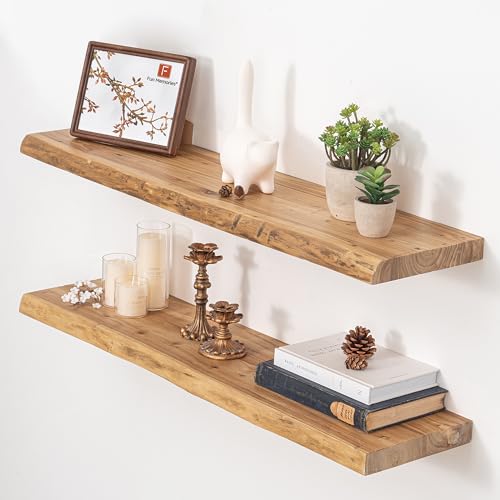
Reclaimed elm appears across several rustic designs. RICHFOCUS, Fun Memories, Marsmiles, Acovy, and Realgulf describe knots, grain variation, or live-edge characteristics. This gives each board a less uniform appearance and can make a shelf the main decorative feature. A live edge is especially suitable for rustic, farmhouse, or organic interiors, but it may provide a less consistent straight line than a flat-edge board.
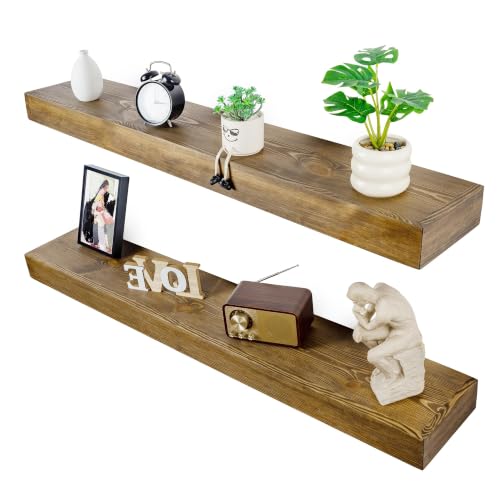
Solid pine offers a different look. Homeforia uses a thick pine board in a walnut tone, while BANFFLOW emphasizes a substantial three-inch profile. BGMG uses solid pine with a dark walnut finish. Solid oak is documented for Gieanoo, whose compact corner format is more functional than rustic. Review the listed finish and species separately, since a walnut finish does not necessarily mean walnut wood.
Consider sets and layout
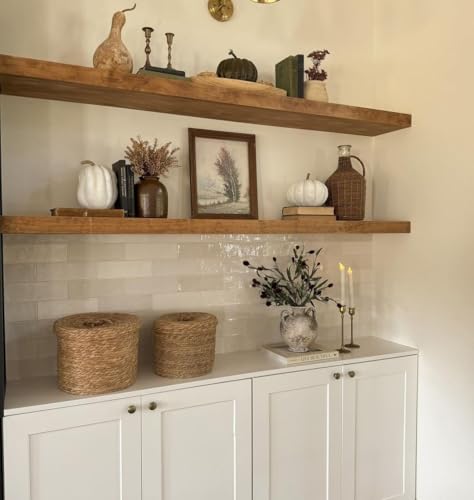
Most selected products provide two shelves, which allows stacked, staggered, or side-by-side arrangements. A two-shelf set is usually easier to distribute around décor, but the board lengths and mounting positions still need to match the wall.
For a coordinated wall, use equal lengths and align the bracket positions where possible. For a more casual display, live-edge products such as Fun Memories or Realgulf can be staggered. Corner shelves such as Gieanoo should be treated as a separate layout solution because they occupy a 90-degree corner rather than a straight wall run.
Final recommendation
RICHFOCUS 30-Inch Reclaimed Elm Shelves ranks first overall in this specification-based comparison under the published weighted criteria.
Homeforia 36-Inch Solid Pine Shelves is the first overall specification-based choice among the best solid wood floating shelves because it combines clearly documented solid pine, a thick 1.75-inch board, hidden hardware, long usable length, and a stated 50-pound-per-shelf support figure when mounted to studs. RICHFOCUS is the better fit for deeper storage and a stronger stated capacity, while Fun Memories is appealing when FSC-certified reclaimed elm and a live-edge look are priorities.
For a slimmer 36-inch profile, consider ROGMARS. For a very thick farmhouse statement, BANFFLOW is distinctive. BGMG is easier to place in a compact room, and Gieanoo is the clearest choice for a 90-degree corner with cable management. Acovy provides the broadest documented range of lengths, while Realgulf balances a medium-long span with live-edge character. These top solid wood floating shelves should still be matched to the wall type, object weight, and installation instructions before purchase.
Frequently Asked Questions
What should I verify before buying the best solid wood floating shelves?
Confirm the actual wood construction, board dimensions, finish, bracket type, stated load limit, and included hardware. Also determine whether the listed support figure assumes installation into wall studs. The product’s depth matters as much as its length because deeper boards may hold larger objects but extend farther into the room.
Are reclaimed elm shelves suitable for a rustic room?
Yes, when the documented grain, knots, and live-edge or irregular-edge details fit the intended style. RICHFOCUS, Fun Memories, Marsmiles, Acovy, and Realgulf all describe reclaimed elm characteristics. Expect natural variation rather than identical boards. If you prefer a straighter visual line, a flat-edge option such as Marsmiles may be more appropriate than a live-edge design.
Which selected shelf works best in a corner?
Gieanoo is the most specialized option because it is designed for 90-degree corners and includes a rear cable-management notch. Its 7-inch shelves are intended for compact displays and small items, not broad book storage. Measure both walls at the corner and confirm that the mounting surface and included hardware suit the installation.
Can a long floating shelf hold heavy items?
Some selected listings state support figures of the current price or more, but those figures are tied to the product’s mounting conditions. RICHFOCUS lists up to the current price, Marsmiles up to the current price, and Homeforia, Fun Memories, Realgulf, and ROGMARS list 50-pound figures. Install into the recommended wall structure, distribute weight across the board, and use the supplied hardware and instructions.
Is a thicker shelf always the better choice?
Not necessarily. BANFFLOW’s three-inch profile creates a bold look, while Homeforia’s 1.75-inch board offers substantial visual weight without the same thickness. Thicker boards may suit farmhouse or rustic interiors, but a slimmer shelf can be less intrusive above a desk, counter, or narrow passage. Choose thickness according to the room, objects, and mounting requirements.