Buying Guide
The best stainless steel garment racks are not all designed for the same job. Some are rolling closet organizers with shelves, some separate clothing across multiple rods, and others are foldable drying racks intended to disappear into storage. Start by identifying whether the rack will hold a wardrobe continuously, support laundry temporarily, or travel with you. The selected products include all three formats, but their dimensions, stated capacities, and stability features differ substantially.
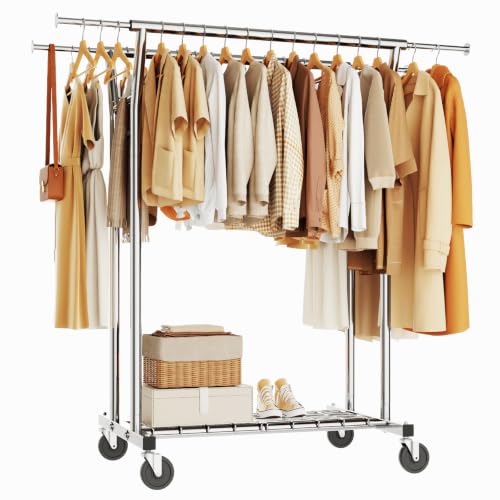
A rolling garment rack is the most versatile format for bedrooms, entryways, laundry rooms, and temporary closet expansion. The FYBEE models and the Sakugi rolling racks use casters so clothing can move between rooms. Look for wheel locks when the rack will remain loaded in one place. Several selected models document two locking wheels, while the FYBEE three-rod rack describes industrial-grade swivel wheels with locking capability.
A multi-rod rack is useful when clothing needs to be divided by person, garment length, or category. The three-rod FYBEE rack offers the most documented hanging organization, while the double-rod models provide a simpler split-level arrangement. Double rods can help separate shirts from longer garments, but check the overall height and width before choosing a tall configuration.
Drying racks serve a different purpose. JAUREE and APEXCHASER emphasize folding structures, multiple rods or wings, airflow spacing, and laundry use. JAUREE reaches a stated 95-inch span and includes windproof hooks, whereas APEXCHASER uses four wings and two levels. These designs are useful for bedding, towels, and air-drying, but their open layouts may not replace a freestanding closet rack.
Compare stainless steel evidence
Listings use stainless steel language in different ways. The FYBEE products explicitly describe 100% stainless steel construction, including stainless fittings or shelf mesh in some listings. Sakugi and Y AKAGI describe stainless steel tubes or frames. The hatleues rack lists both plastic and stainless steel materials, so it should be treated as a mixed-material option rather than directly compared with an all-stainless frame.
Stainless steel can be attractive for humid laundry areas because several listings describe rust resistance or rust-defying construction. Those are listing claims, not independent test results, so shoppers should still consider where the rack will be used and follow any care instructions supplied with the product. Smooth or polished surfaces may also matter when delicate fabrics are hung; Y AKAGI specifically describes mirror-polished edges.
Match capacity to the load
A stated load limit is useful only when interpreted alongside the frame design and the intended load. The largest documented figures in this comparison belong to the FYBEE heavy-duty racks. They are appropriate candidates for substantial clothing inventories, but a high capacity generally comes with a larger structure and more floor space. By contrast, the Lmaray travel rack lists an 8.8-pound maximum and is intended for a few garments, not a full closet.
Do not assume that a rack with a high headline capacity can be loaded unevenly without affecting handling. Clothing should be distributed across rods and shelves, especially on rolling designs. For drying racks, balance matters as well: JAUREE advises balancing weight on both sides for improved stability in windy conditions. A smaller rack may be the better practical choice if it fits the room and the load is modest.
Check dimensions and adjustment ranges
Measure the available floor area, ceiling height, doorway, and storage location. The compact Sakugi model is 42.5 inches wide and 65.9 inches high, while some FYBEE models approach or exceed 72 inches in height. A rack that fits when empty may be difficult to turn once garments are loaded, so include clearance for wheels and side hooks.
Adjustability is particularly useful when a rack will handle both short and long garments. The FYBEE 860-pound model documents adjustable height and multiple hanging zones, and the 760-pound model adjusts both horizontal width and vertical height. The hatleues rack offers a broad metric height range, while the Lmaray model adjusts in both height and length for travel use. Confirm the listed range against your garments rather than relying on the word “adjustable.”
Consider shelves, hooks, and accessory storage
A hanging bar is only part of the storage equation. Bottom shelves can hold shoes, folded clothing, or storage boxes, and side hooks can accommodate bags, hats, or scarves. The FYBEE racks, Sakugi racks, and hatleues model document added shelf or hook features. These elements improve organization but also increase the rack’s footprint and may make it harder to slide into a narrow closet.
For laundry drying, spacing is more important than shelf capacity. APEXCHASER documents 3.9-inch spacing between drying areas, while JAUREE uses retractable rods and windproof hooks. Choose the format that matches the items you dry most often. Bulky bedding may benefit from a wide winged or folding design, while everyday shirts and coats are easier to manage on a conventional hanging bar.
Review assembly and storage needs
Assembly varies from no-installation folding racks to rolling racks that use screws, tools, and instructions. The selected FYBEE listings describe snap-style or reduced-bolt assembly and included tools. Sakugi describes screw connections and included tools, while APEXCHASER and JAUREE emphasize ready-to-use or no-assembly designs. If the rack will be moved often or stored seasonally, folding or tool-free setup may be more important than maximum capacity.
Also consider warranty information where supplied. One FYBEE model lists a two-year manufacturer warranty, and JAUREE, APEXCHASER, and the travel design describe convenience-oriented construction, but warranty coverage is not uniform across the selection. Treat the warranty as a supporting specification, not as proof of long-term performance.
Final recommendation
FYBEE 960-LB Three-Rod Rolling Rack ranks first overall in this specification-based comparison under the published weighted criteria.
The final choice among the best stainless steel garment racks depends on the documented features that match your intended use.
The FYBEE 960-LB Three-Rod Rolling Rack is the highest-scoring returned product and the first overall specification-based choice. Its stated capacity, three hanging rods, shelves, hooks, large wheels, and wheel locks make it the most comprehensive option for substantial clothing storage. Among the top stainless steel garment racks, it is best for buyers who have enough room for a large rolling organizer.
Choose the FYBEE 860-LB Adjustable Double-Rod Rack if height control and separate hanging zones matter more than a third rod. The Sakugi Rolling Rack with Mesh Shelf is a more compact everyday option, while JAUREE and APEXCHASER are better suited to folding laundry duty. Y AKAGI fits visible home storage, hatleues covers lighter utility use, and Lmaray is the specialized travel pick. The remaining FYBEE racks provide heavy-duty alternatives with different rod layouts and storage footprints.
Frequently Asked Questions
Are all of these racks made entirely from stainless steel?
No. The listings describe several products as 100% stainless steel, while others specify stainless steel tubes, frames, or mixed stainless steel and plastic construction. Review the individual material wording if full stainless construction is essential.
Which of the best stainless steel garment racks is better for drying laundry?
JAUREE and APEXCHASER are the most drying-focused selections. JAUREE documents three retractable rods, folding storage, and windproof hooks. APEXCHASER uses four adjustable wings, two levels, and 3.9-inch spacing. Both differ from rolling closet organizers designed primarily for stored clothing.
Do rolling racks need locking wheels?
Locking wheels are useful when a loaded rack should remain in one position. Several selected models document two lockable casters. A rack without documented locks may still move easily, but the supplied evidence does not establish how securely it will stay positioned on every floor.
What should I measure before buying a garment rack?
Measure the available width, depth, height, doorway clearance, and storage area. Also account for side hooks, wheel movement, shelves, and the extra width created when an extendable bar is opened. Compare those measurements with the rack’s listed dimensions and adjustment range.
Can a travel rack replace a full-size clothing rack?
The Lmaray travel rack is designed for portability and lists a much lower stated capacity than the heavy-duty rolling models. It is suitable for temporary hanging or drying of a small number of garments, but its compact dimensions limit its usefulness as a primary wardrobe organizer.