Buying Guide
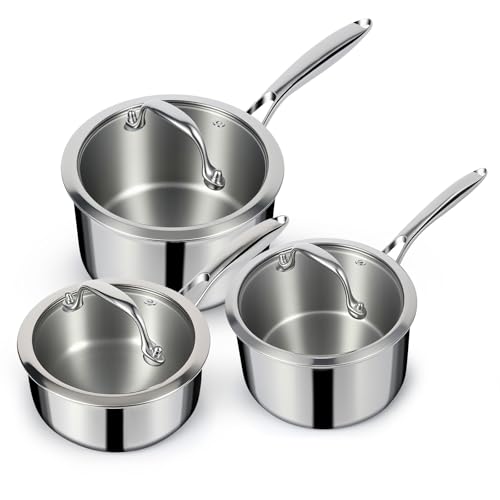
Choosing the best stainless steel saucepans starts with matching construction and capacity to the jobs you actually cook. A compact 1- to 1.5-quart pan is convenient for butter, milk, single portions, and small sauces. A 2-quart pan is a more general-purpose size for soup, gravy, oatmeal, and reheating. Three-quart options provide more room for pasta, rice, vegetables, or family-sized side dishes. Sets such as the EWFEN, MICHELANGELO, and Idymere selections trade storage space for a wider range of tasks.
Compare the heating structure
Stainless steel is a durable, non-reactive cooking-surface material, but the way heat is distributed depends heavily on the base or body construction. Several selected pans document an aluminum core. The Tramontina Signature uses tri-ply construction with an aluminum core, while the Cuisinart MultiClad Pro lists an 18/10 stainless body with a solid aluminum core. The EWFEN set combines a 304 stainless interior, 430 stainless exterior, and aluminum core.
A full-cap or impact-bonded base can also be useful. Farberware describes a full-cap base with stainless steel layered over a thick aluminum core, and Sunhouse specifies an impact-bonded three-layer bottom. These descriptions support a preference for layered construction when even heating is important, but they are listing specifications rather than independent performance test results. Uncoated stainless surfaces can require appropriate heat and cooking technique, especially for foods that tend to stick.
Choose the right capacity
Capacity is one of the clearest differences between these products. The EWFEN and MICHELANGELO sets include 1-, 2-, and 3-quart pans, allowing the cook to select a closer fit for each recipe. Idymere takes a narrower approach with 1.5- and 2.5-quart sizes. These sets may be sensible when multiple saucepan sizes are needed, but they occupy more cabinet and dishwasher space.
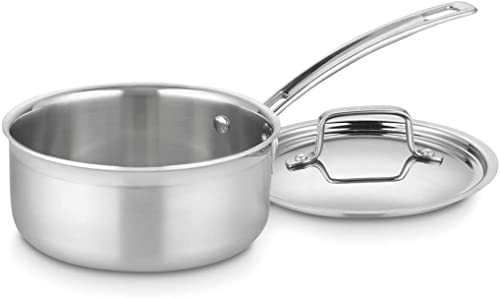
For a single pan, 2 quarts is a flexible middle ground. Tramontina, AuFranc, CAROTE, and Farberware all document a 2-quart-class option. The Sunhouse 3-quart model is better suited to larger portions, while the Cuisinart 719-16 and MultiClad Pro 1.5-quart pans emphasize compact cooking. Capacity labels can vary slightly between a title and a specification field, so compare the listed size and intended tasks rather than assuming every nominal size is identical.
Check cooktop compatibility
Induction compatibility should be confirmed rather than assumed from a stainless finish. The Tramontina Signature, EWFEN, MICHELANGELO, Idymere, AuFranc, Sunhouse, and Farberware listings explicitly cover induction along with other stovetop types. CAROTE lists gas, electric, and induction. The Cuisinart 719-16 listing names electric, gas, and induction, while the MultiClad Pro listing supplied here does not specify cooktop compatibility.
If your kitchen uses ceramic glass, halogen, or a particular electric surface, look for that exact wording. AuFranc names halogen, and the EWFEN and MICHELANGELO listings include ceramic and glass surfaces. Broad compatibility is useful, but the pan still needs to sit flat and fit the burner or induction zone appropriately; those physical-use details are not independently tested in this comparison.
Decide between glass and stainless lids
A transparent lid lets you monitor simmering without lifting it. EWFEN, Idymere, AuFranc, and Sunhouse specify glass lids, while the MICHELANGELO, Tramontina, and MultiClad Pro listings specify stainless lids. Glass offers visibility, but temperature restrictions and handling deserve attention. AuFranc states that its glass lid is safe to 210°F/100°C, and Sunhouse excludes its lid from the 500°F oven rating. EWFEN also includes an installation warning for the glass-lid handle.
Stainless lids are opaque but can be a durable, heat-retaining choice. The MICHELANGELO listing warns that its metal lid knob may become hot, so oven mitts or a kitchen towel may be needed. Handle construction varies as well: riveted stainless handles appear on Tramontina, AuFranc, Cuisinart, and Idymere, while Sunhouse and EWFEN describe stay-cool stainless handles. Those phrases describe the supplied product claims, not a hands-on temperature test.
Review oven and cleanup details
Dishwasher-safe care is listed for every selected product, though stainless steel cookware may still benefit from following the manufacturer’s cleaning guidance. Oven limits are not interchangeable. Tramontina and Sunhouse list 500°F, AuFranc lists 480°F without its glass lid, and the MultiClad Pro lists 550°F plus broiler safety. Farberware lists 350°F. The Cuisinart 719-16 listing says oven safe but does not provide a temperature in the supplied evidence.
Always separate pan and lid ratings when the listing does so. A high pan rating does not automatically apply to a glass lid or a handle component. The CAROTE listing also says oven safe without stating a temperature, so it should not be treated as equivalent to the models with explicit limits.
Look for pouring and measuring features
Small design details can make saucepan work more controlled. CAROTE has a flared pour rim, MICHELANGELO documents a flared rim, and Sunhouse lists rounded closed edges for pouring. The Cuisinart 719-16 includes measurement markings and drip-free pouring in its listing. These features are especially relevant when transferring milk, soup, sauce, or hot water. Most other selected pans do not document interior markings, so they should not be assumed to have them.
Final Recommendation
EWFEN 3-Piece 1-, 2-, and 3-Quart Saucepan Set ranks first overall in this specification-based comparison under the published weighted criteria.
The final choice among the best stainless steel saucepans depends on the documented features that match your intended use.
Tramontina Signature Tri-Ply 2-Quart Sauce Pan is the highest-scoring returned product and the first overall specification-based choice. It combines tri-ply aluminum-core construction, a useful 2-quart capacity, all-cooktop compatibility, dishwasher-safe care, and a 500°F oven rating. It is a strong single-pan choice when a stainless lid is acceptable.
For maximum size flexibility, the EWFEN and MICHELANGELO sets are the better fit because each supplies 1-, 2-, and 3-quart pans. Idymere is a more compact two-size alternative. Choose Sunhouse when interior markings, a glass lid, and a larger 3-quart capacity matter. AuFranc and CAROTE provide focused 2-quart options with visible lids or pouring-focused designs. The MultiClad Pro is notable for its stated 550°F oven and broiler specifications, while Farberware and the Cuisinart 719-16 remain practical compact choices with different feature trade-offs. Together, these are among the top stainless steel saucepans for comparing documented construction rather than relying on volatile marketplace signals.
Frequently Asked Questions
What size saucepan is most versatile?
A 2-quart saucepan is a useful middle size for sauces, reheating soup, oatmeal, and other everyday tasks. Tramontina, AuFranc, CAROTE, and Farberware each document a 2-quart-class option. A 1- to 1.5-quart pan is better for smaller portions, while a 3-quart pan gives more room for pasta, rice, vegetables, or larger side dishes.
Are the best stainless steel saucepans compatible with induction?
Many are, but the listing should say so. Tramontina, EWFEN, MICHELANGELO, Idymere, AuFranc, Sunhouse, and Farberware explicitly list induction compatibility. CAROTE and Cuisinart 719-16 also identify induction use. The supplied MultiClad Pro evidence does not state cooktop compatibility, so it should not be assumed from the stainless construction alone.
Is a glass lid better than a stainless lid?
Neither is universally better. A glass lid provides visibility, as documented for EWFEN, Idymere, AuFranc, and Sunhouse. A stainless lid is opaque but appears on models such as Tramontina, MICHELANGELO, and MultiClad Pro. Check separate lid temperature limits, because AuFranc and Sunhouse specify restrictions for their glass lids.
Do stainless steel saucepans need a nonstick coating?
No coating is required for a stainless steel cooking surface, and the EWFEN, MICHELANGELO, AuFranc, and other listings describe uncoated or no-coating surfaces. Stainless steel can still require suitable heat, liquid, oil, and cleaning technique. This comparison does not make hands-on claims about stick resistance.
What should I check before using a saucepan in the oven?
Check the exact oven limit for the pan, lid, and handle. Tramontina lists 500°F, MultiClad Pro lists 550°F and broiler safety, Farberware lists 350°F, and AuFranc lists 480°F without the glass lid. Sunhouse excludes its lid from its 500°F rating. Follow the product’s supplied care instructions rather than applying the pan’s rating to every component.