Buying Guide
The best stainless steel utensil crocks should match the way your kitchen stores and uses long-handled tools. A plain open cylinder can work well when you want fast access, while a divided or rotating holder can make a crowded collection easier to sort. The listings in this comparison show meaningful differences in footprint, capacity, base design, and cleaning features.
Measure the open area where the crock will sit, including the space needed to pull tools out from the front. Wide fixed designs such as the KSENDALO 7-Inch Wide Stainless Steel Utensil Holder and OKT 7.2-Inch Large Stainless Steel Utensil Crock are aimed at larger collections, but their broad diameters can take up valuable prep space. The Reluen holder is a better documented fit for tighter areas because its listed height is about 5.2 inches and its design is described as a sink insert.
Tall holders can keep long spatulas, ladles, and whisks upright, but height alone does not tell you how much the base will occupy. Standcn lists a 4.7-inch width and 7.5-inch height, giving it a vertical profile. Before buying, compare the listed width or diameter with the distance between your wall, sink, cooktop, and cabinet edges. Also remember that a rotating holder needs room to turn, even if its footprint remains stationary.
Choose open storage or compartments
A fixed, open-top crock is the simplest arrangement. It lets you see and grab tools quickly, but utensils may lean together or become harder to distinguish when the container is full. Wide models are useful when you prefer one central location and do not need separate sections.
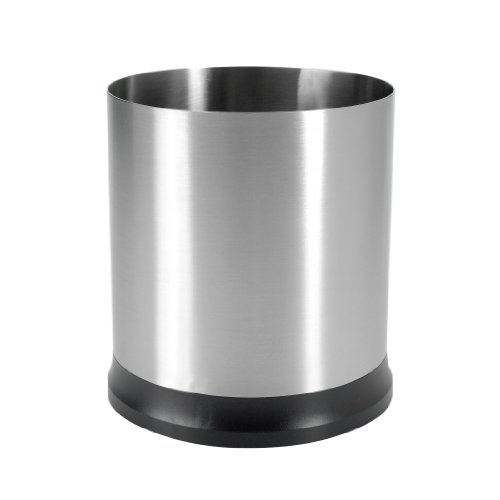
Compartments are more useful when you divide tools by task. TIMENIL documents four compartments, while the OXO Good Grips Stainless Steel Rotating Utensil Holder documents three. The OXO Good Grips Adjustable Stainless Steel Organizer takes a different approach with two removable dividers and a hinged platform for short tools. That adjustability is helpful when a collection includes both long cooking utensils and smaller handled pieces.
A removable divider can also make washing and rearranging easier, but it introduces another component to handle. Nigelia documents a removable three-compartment lid, allowing a more open arrangement for larger cookware. Bartnelli similarly lists a removable divider. These options are worth considering when your tool mix changes between everyday cooking and larger meal preparation.
Consider rotation and reach
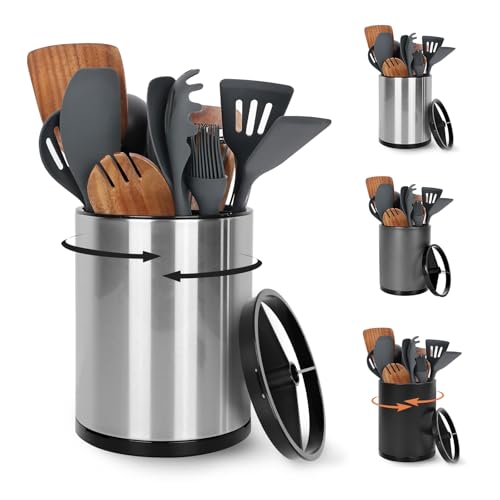
A rotating base can reduce the need to reach across a cluster of handles. OXO, Bartnelli, TIMENIL, Nigelia, and Rcemlip all document rotating designs. Rotation is most useful when the crock is full or when it sits against a wall, because the rear tools can be brought forward. It does not replace a sensible arrangement: very wide handles can still overlap, and a heavily loaded holder may feel different to turn than an empty one.
If you prefer fewer moving parts, a fixed holder may be the better match. KSENDALO, OKT, Standcn, and Reluen emphasize stationary storage. Fixed crocks are straightforward to position and do not require a rotating mechanism, while their access depends more on the width of the opening and how the tools are placed.
Look for a stable base
Stability matters because long tools can shift the center of gravity. Reluen also lists a heavy bottom. OKT specifies a non-slip silicone bottom, while Rcemlip lists four non-slip rubber pads. Nigelia documents four non-slip feet, and TIMENIL specifies a non-slip swivel bottom.
These details are more useful than a vague claim that a crock is sturdy. A weighted or widened base may help with a tall collection, while rubber or silicone contact points may help limit sliding and protect the counter. The supplied listings do not provide standardized tip or load testing, so treat stability descriptions as design information rather than a guarantee for every utensil arrangement.
Plan for water and cleaning
Wet tools need a path for moisture to leave the container. Nigelia documents a porous drainage layer and bottom spout, Rcemlip lists drainage holes, and Reluen describes an open frame intended to support rinsing and drying. These features are particularly relevant if you wash tools shortly before returning them to the crock.
Cleaning instructions vary. OXO’s rotating holder, KSENDALO’s wide holder, OKT, Standcn, and Reluen are listed as dishwasher safe. Bartnelli specifically recommends hand washing, and other products do not provide a dishwasher claim in the supplied evidence. A removable divider or base can improve access to interior surfaces, but it may also mean more pieces to rinse. Check the care guidance before choosing a design based on convenience.
Capacity is not just the largest number in a listing. A tall, narrow crock can suit long utensils but may be less forgiving when filled with broad spatula heads. A wide crock can accept more handles but occupy more workspace. Rcemlip’s set offers a large and small holder, which may be useful when separating everyday tools from overflow. OXO’s adjustable model lists capacity for over 16 large-handled tools, and the rotating OXO lists over 15.
For a small collection, a compact holder can prevent unused counter space. For a large collection, prioritize a wide base, compartments, or two containers rather than simply selecting the tallest option. Keep the opening accessible and avoid packing tools so tightly that handles become difficult to retrieve.
Final Recommendation
Nigelia Extra Large Rotating Utensil Holder ranks first overall in this specification-based comparison under the published weighted criteria.
The OXO Good Grips Adjustable Stainless Steel Organizer is the first overall specification-based choice among these top stainless steel utensil crocks. Its documented fingerprint-proof stainless steel, removable dividers, tall walls, platform configuration, and capacity for over 16 large-handled tools give it the broadest organization flexibility.
Choose the OXO Good Grips Stainless Steel Rotating Utensil Holder if rotation and dishwasher-safe care matter most. Bartnelli is a strong alternative for a weighted, rotating design with a removable divider. TIMENIL is the clearest fit for four-way sorting, while Nigelia is the drainage-focused option. For a fixed holder, KSENDALO offers a wide opening and heavier base, OKT emphasizes large volume, and Standcn provides a tall double-wall 304 stainless steel body. Rcemlip is useful when two container sizes are preferable, and Reluen is the compact choice for a sink-adjacent or smaller counter.
The best stainless steel utensil crocks are therefore not identical substitutes. Select by the space available, the number and shape of your tools, whether you need rotation, and how you prefer to clean the holder.
Frequently Asked Questions
Among the best stainless steel utensil crocks, what size utensil crock should I choose?
Start with the number and shape of tools you use most often, then compare the listed height, width, or diameter with your available counter space. Wide models such as KSENDALO and OKT are suited to larger collections, while Reluen’s shorter, compact profile is more appropriate for a tighter location. A tall holder can support long handles, but a wide base may be more important when spatula heads and ladles crowd the opening.
Are stainless steel utensil crocks dishwasher safe?
Some are, but the listings do not support a universal answer. The OXO rotating holder, KSENDALO wide holder, OKT crock, Standcn holder, and Reluen holder are described as dishwasher safe. Bartnelli recommends hand washing. For the remaining products, follow the care information supplied with the specific model rather than assuming that stainless steel construction alone determines dishwasher compatibility.
Is a rotating utensil holder better than a fixed crock?
Rotation can make rear tools easier to reach, particularly when the holder is full or positioned against a wall. It also adds a base mechanism that a fixed crock does not need. A fixed holder may be preferable when you want a simpler format or have limited turning clearance. Compare the access benefit with your counter layout and the way you arrange tools.
Why do drainage holes matter in a utensil crock?
Drainage features can help water leave after a damp tool is placed inside. Nigelia documents a porous drainage layer and bottom spout, while Rcemlip and Reluen describe drainage-oriented designs. These features may simplify drying, but they do not remove the need for routine cleaning. If you store only dry tools, drainage may be less important than capacity or compartment layout.
What makes a utensil crock stable?
The supplied products document several stability approaches: heavier or weighted bases, non-slip silicone or rubber contact points, widened bottoms, and non-slip feet. These design details may help limit sliding or tipping, but the listings do not provide standardized load testing. For a tall collection, place heavier tools toward the center and avoid overfilling the holder.