Buying Guide
Choosing among the best step-down power converters starts with identifying the source and destination voltage. A converter can reduce AC mains voltage, such as 220V to 110V or 120V, or reduce DC battery voltage, such as 48V to 12V. These are different designs with different installation requirements. Do not treat an AC transformer and a small buck module as interchangeable simply because both reduce voltage.
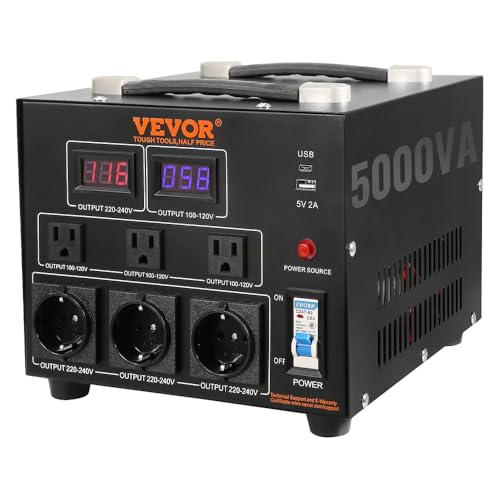
Check the actual input range first. The HYTED AC120V accepts 220V-to-250V input and produces 120V pure sine wave output, while the VEVOR HYDXOG–3000VA is designed for 220V-to-110V conversion. These are intended for appliances connected to AC outlets.
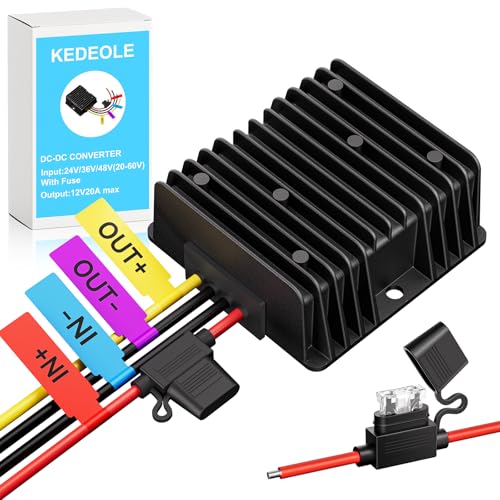
DC models use a different voltage language. The Zhaumim Z72J12V20A accepts 20V-to-72V DC and produces fixed 12V output. The KEDEOLE F60J12V20A covers 20V-to-60V, and the Jreixr listing gives the same broad 20V-to-60V class with a fixed 12V output. A nominal 48V battery system can therefore be compatible, but the stated input range still needs to include the system’s real operating voltage.
Output voltage must match the equipment. A 12V device should not be connected to the 24V output of the YIPIN HEXHA DC3648-2420-480. Likewise, the DROK 90597 is specifically a 6V converter, and the Seloky SY070 is adjustable rather than fixed. For an adjustable module, set and verify the output before connecting the load.
Size capacity with headroom
Current and wattage describe how much power the converter can provide, but a load should not be selected right at the limit without checking the listing guidance. The HYTED is listed for appliances from 0W to 1600W, while the VEVOR is rated to 3000VA and specifies an 80% maximum-load condition. For DC installations, the YIPIN HEXHA provides up to 480W at 20A and 24V, the Jreixr provides 360W at 30A and 12V, and the Zhaumim provides 240W at 20A and 12V.
Lower-power equipment can use smaller converters. Nilight’s 120W and 10A output is aimed at 12V vehicle accessories, while the DROK 90597 reaches 18W at 6V. The Seloky LM2596 module supports adjustable voltage but specifically advises improving heat dissipation above 15W. Capacity is not only about the largest number; it must fit the load, output voltage, cooling arrangement, and installation space.
Review protection features
Protection circuits are especially important in vehicle and battery projects. The Zhaumim lists over-current, overload, over-voltage, under-voltage, over-temperature, and short-circuit protection, plus a built-in input fuse. Nilight lists over/under-voltage, over-current, overload, overheat, over-temperature, and short-circuit protection. These claims describe the listed design features, not a guarantee that every installation will be safe.
The AC products take a different approach. HYTED lists over-temperature, over-current, overload, surge, and short-circuit protection, with automatic power disconnection if an issue is detected. VEVOR lists six protections, including intelligent overload, under/over-voltage, short-circuit, overheating, and damp-proof circuit-board protection. Follow the manufacturer’s load and wiring instructions, and confirm polarity on DC equipment before powering it.
Consider the enclosure and environment
A sealed housing can matter in a golf cart, RV, truck, or outdoor project. Zhaumim, YIPIN HEXHA, Nilight, and DROK describe aluminum cases with silicone sealing or potting; the first three selected DC designs list IP68 protection. The KEDEOLE describes aluminum encasing and thermal pads, but the supplied evidence does not state an IP rating. The Jreixr listing discusses heat dissipation but does not provide a waterproof rating.
Small electronic modules are a separate category. Seloky’s LM2596 is a compact PCB module with terminal blocks and an LED display, not a sealed vehicle enclosure. It can be convenient for a bench or enclosed DIY project, but the listing’s heat-dissipation warning should be considered at higher power. The Azocek AZSDC02 likewise provides a battery adapter and wiring hardware, but its compatibility is tied to specified Milwaukee batteries.
Check connections and extras
AC convenience features include outlet formats and USB charging. For DC projects, look for fuse arrangements, terminal blocks, and wiring instructions. Azocek includes a fuse holder, 30A fuse, and heat-resistant wires, but the battery is not included. Seloky includes terminal blocks and a mini-screwdriver adjustment method. The Jreixr listing recommends soldered connections and wire sized at least for the converter’s requirements. These details can affect installation effort even when the electrical ratings appear similar.
Final Recommendation
VEVOR 3000VA Heavy-Duty Voltage Converter ranks first overall in this specification-based comparison under the published weighted criteria.
HYTED AC120V is the first overall specification-based choice among the best step-down power converters returned here. Its pure sine wave 120V output, 1600W capacity, international adapter set, automatic protection response, and two-year warranty make it a well-supported option for users converting 220V-to-250V AC for American appliances.
Choose VEVOR HYDXOG–3000VA when the priority is substantially higher AC capacity, dual US outlets, and LCD monitoring. For vehicle and off-grid DC work, Zhaumim Z72J12V20A offers the broadest documented input range and IP68 construction, while Jreixr F60J12V20A is the documented 12V choice when 30A output is useful. YIPIN HEXHA DC3648-2420-480 is the specialist pick for a 24V, 480W output.
The top step-down power converters are not all aimed at the same job. Select Nilight for a smaller sealed 24V-to-12V installation, Azocek AZSDC02 for a compatible Milwaukee battery setup, Seloky SY070 for adjustable electronics work, and DROK 90597 for a compact 12V-to-6V load. Confirm voltage, current, polarity, cooling, and enclosure needs before installation.
Frequently Asked Questions
What are the best step-down power converters for 220V appliances?
HYTED AC120V and VEVOR HYDXOG–3000VA are the selected AC transformer options. HYTED documents 120V pure sine wave output and up to 1600W, while VEVOR documents 220V-to-110V conversion up to 3000VA, two US outlets, USB outputs, and dual LCD displays. Choose based on the appliance’s voltage, plug format, and power requirement.
Can a 48V battery use a 12V converter?
It can when the converter’s documented input range includes the battery system’s actual voltage. Zhaumim Z72J12V20A lists 20V-to-72V DC input and fixed 12V output, while KEDEOLE F60J12V20A and Jreixr F60J12V20A list ranges that include common 36V and 48V systems. Verify the load’s current requirement and wiring polarity before use.
Is an IP68 converter necessary for a golf cart?
Not every installation requires IP68, but it can be relevant where the converter may encounter water, dust, moisture, or vibration. Zhaumim Z72J12V20A, YIPIN HEXHA DC3648-2420-480, and Nilight 50149A list IP68 construction. KEDEOLE F60J12V20A describes weather-resistant aluminum construction without supplying an IP rating, so its environmental claim should not be treated as equivalent.
What is the difference between a fixed and adjustable buck converter?
A fixed converter, such as Nilight 50149A or DROK 90597, is designed around one stated output voltage. An adjustable module, such as Seloky SY070, lets the user set the output within a documented range. Adjustable designs add flexibility but require careful setup and voltage verification; Seloky also advises improved heat dissipation above 15W.
How much headroom should a converter have?
Use the manufacturer’s guidance rather than assuming the maximum rating is a continuous target. VEVOR specifies an 80% maximum-load condition, and Jreixr recommends a 30%-to-50% power margin. Check the converter’s output wattage and current against the connected equipment, then allow for cooling and wiring requirements.