Buying Guide
The best power converters are not interchangeable. The right model depends first on the direction of conversion and then on the electrical load. A travel voltage converter changes foreign mains voltage for equipment designed for US voltage. A vehicle inverter changes 12V battery power into household-style AC. An AC-to-DC supply, by contrast, feeds equipment that specifically requires low-voltage DC. These designs have different connections and limits.
Match the conversion direction
For international travel, confirm the voltage available at the destination and the voltage required by the device. HYTED documents conversion from 220–250V to 120V, while Ceptics and GWINLLYYK describe 220V-to-110V travel conversion. BESTEK’s travel model accepts 100–240V input and provides US voltage. These are step-down or universal-input designs; they should not automatically be treated as step-up converters.
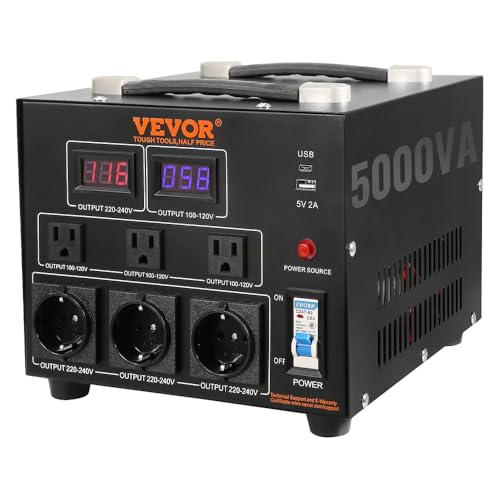
If you need both directions, VEVOR explicitly supports 110V-to-220V and 220V-to-110V conversion. That flexibility is useful for equipment moving between electrical systems, but its larger enclosure and listed weight make it better suited to stationary use than ordinary luggage.
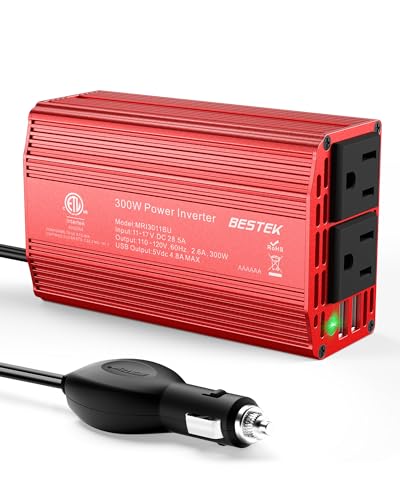
For vehicle use, the source is a 12V system. Cantonape, OLTEANP, EPANEE, Vansoet, and BESTEK convert that DC source to 110V or 120V AC. Check whether the unit plugs into a cigarette-lighter socket or connects directly to the battery. OLTEANP states that its cigarette-lighter connection supports up to 150W, with direct battery connection required for higher specified ranges. Similar source limitations should be checked on any vehicle inverter before installation.
Calculate the required wattage
Read the device label for running watts, then leave headroom for startup or surge demand where applicable. A converter’s headline number is not permission to operate every appliance at that level. Ceptics separates a 2,000W outlet for a non-electronic hair dryer from two 200W outlets for smaller devices. GWINLLYYK lists a 1,000W combined limit for its voltage-converter outlets. BESTEK’s travel model has a 300W maximum and specifically excludes hair dryers.
For vehicle inverters, Cantonape lists 3,000W continuous and 6,000W surge output. OLTEANP lists 1,000W continuous and 2,000W peak output, while EPANEE and Vansoet list 400W models. BESTEK’s car unit lists 300W continuous output. These ranges represent different use cases: high-capacity models are intended for larger battery-connected setups, while compact plug-in models are more suitable for laptops, chargers, small electronics, and other moderate loads.
Do not confuse surge output with continuous output. A short peak figure may help with startup, but the continuous rating is the more useful number for equipment that runs for an extended period. Also verify the vehicle’s wiring, fuse, and socket limits rather than relying only on the inverter label.
Waveform information matters when powering sensitive or motor-driven equipment. HYTED explicitly identifies a pure sine wave output, which is a notable specification for users bringing varied American appliances abroad. Cantonape and OLTEANP identify modified sine wave output. The OLTEANP listing says it is suitable for most small electronics but not every device, so users should check the requirements of medical equipment, motors, compressors, audio equipment, and other sensitive loads.
A listing that does not state the waveform should not be assumed to provide pure sine wave output. EPANEE, Vansoet, and the BESTEK car model do not document a waveform in the supplied evidence. That does not establish incompatibility; it means the specification should be verified before buying for a sensitive device.
Compare outlets and USB charging
Port count can be more important than peak wattage for travel. Ceptics provides multiple AC outlet groups plus three USB-A and one USB-C port. GWINLLYYK combines AC outlets with two USB-A and two USB-C ports and documents 35W total USB output. The BESTEK travel converter has three AC outlets and four USB ports, including USB-C output up to 20W.
Vehicle models vary as well. EPANEE documents a 65W USB-C PD port and an 18W USB-A QC port. Vansoet has a 30W USB-C PD port, another USB-C port, and two USB-A ports. Cantonape supplies four AC outlets and four USB ports, while the compact BESTEK car model has two AC outlets and two USB ports. USB output is separate from the AC wattage rating; using several ports at once may divide available charging output according to the design.
Treat protection features as operating requirements
The selected products commonly document protection against overload, overcurrent, overheating, short circuits, and voltage faults. HYTED adds surge protection and a fuseless automatic disconnect design. VEVOR lists overload, overcurrent, and short-circuit protection and includes CE and FCC certification claims in its listing. Cantonape additionally lists reverse-polarity protection, which is relevant to battery connections.
These features address specified fault conditions, but they do not replace correct setup. Use the correct input voltage, choose the right outlet group, keep ventilation paths clear, and stay below the continuous rating. For battery-connected equipment, follow polarity and cable instructions. A cooling fan or aluminum housing can help manage heat, but the supplied evidence does not establish a specific operating result in every environment.
Decide how portable the converter must be
Compact travel units are generally easier to pack. GWINLLYYK lists dimensions of 3.07 by 3.07 by 1.89 inches, and the BESTEK car model uses an iPhone-sized housing. EPANEE lists a 0.88-pound weight and a compact 6.7-inch body. VEVOR is a different class: its listing gives dimensions around 10.6 by 9.5 by 8.5 inches and a weight near the current price, with a handle for transport.
Portability also includes installation. A cigarette-lighter inverter is convenient, but its socket may limit usable wattage. A direct-battery inverter can support more output but needs appropriate cables, ventilation, and a suitable battery. Choose the simplest connection that safely supports the intended load.
Final recommendation
VEVOR 5000W Step-Up/Step-Down Transformer ranks first overall in this specification-based comparison under the published weighted criteria.
VEVOR 5000W Step-Up/Step-Down Transformer is the first overall specification-based choice in this comparison.
The final choice among the best power converters depends on the documented features that match your intended use.
For bidirectional conversion and stationary high loads, VEVOR is the more suitable design. HYTED is the stronger fit when pure sine wave, step-down conversion, and international adapters are priorities. Travelers focused on charging several devices can consider Ceptics, GWINLLYYK, or BESTEK’s 300W travel model. For vehicles, Cantonape and OLTEANP cover higher-output needs, while EPANEE, Vansoet, and BESTEK provide more compact options. Among these top power converters, the best match still depends on source voltage, continuous wattage, waveform, and connection method.
Frequently Asked Questions
What should I check before choosing the best power converters for international travel?
Confirm the destination voltage, the device’s required voltage, the converter’s direction, and the device’s wattage. Then check whether the included plug adapter fits the destination outlet. A converter with several international plugs may still have separate limits for high-wattage and low-wattage outlets, so read those limits rather than using the largest number on the package.
Can a travel converter power a hair dryer?
Only when the listing explicitly supports that use and the hair dryer remains within the stated outlet limit. HYTED documents a 2,000W outlet for a non-electronic hair dryer, while Ceptics documents a separate high-wattage outlet arrangement. BESTEK’s 300W travel converter specifically says not to use it with hair dryers, regardless of their wattage. Always confirm both the appliance type and wattage.
Are vehicle inverters suitable for any 12V car socket?
No. A vehicle socket has its own wiring and fuse limit. OLTEANP states that its cigarette-lighter connection supports up to 150W and recommends direct battery connection for higher ranges. Do not assume a 1,000W or 3,000W inverter can draw its full output through a socket. Follow the supplied connection instructions and use a suitable battery connection for higher loads.
Is pure sine wave output necessary?
It depends on the device. HYTED documents pure sine wave output, while Cantonape and OLTEANP document modified sine wave output. Some electronics may operate on modified sine wave power, but the supplied evidence does not establish compatibility for every device. If the equipment manufacturer specifies pure sine wave power, select a converter that explicitly provides it or verify compatibility before purchase.
Do more ports mean a converter has more usable power?
Not necessarily. Ports improve connectivity, but the total AC or USB output remains limited by the converter’s specifications. GWINLLYYK documents 35W total USB output, BESTEK documents a 300W overall travel maximum, and EPANEE documents 400W continuous AC output. Add the loads together and stay within the relevant total and per-outlet limits.