Buying Guide
The best ac adapter converters are not interchangeable just because they have a wall plug and a DC cable. The right choice depends on the connected device’s required voltage, current, connector size, polarity, and power type. A converter changes household AC into DC power; it is not automatically a battery charger, and several listings explicitly warn against charging batteries.
Start with voltage
Voltage is the first compatibility check. A fixed 12V adapter should be used with equipment designed for 12V DC, while a fixed 24V model belongs with 24V equipment. The selected 24V choices are SHNITPWR and ALITOVE. A device that requires 5V, 9V, 19V, or another voltage should not be connected to one of those fixed-output products.
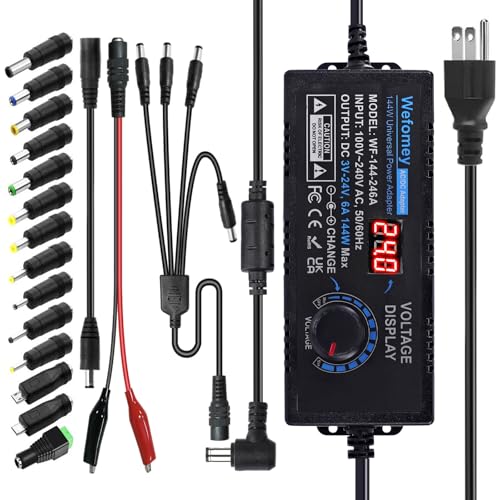
Adjustable models such as minidodoca and Wefomey cover 3V through 24V. That range can be convenient when one supply must serve several small electronics, but flexibility adds a setup responsibility: set the output to the device’s specified voltage before connecting equipment.
Match current and wattage
Current is the next key limit. The adapter’s maximum current should meet or exceed the device’s stated draw. Do not treat a larger number as permission to exceed the device’s voltage or connector specifications.
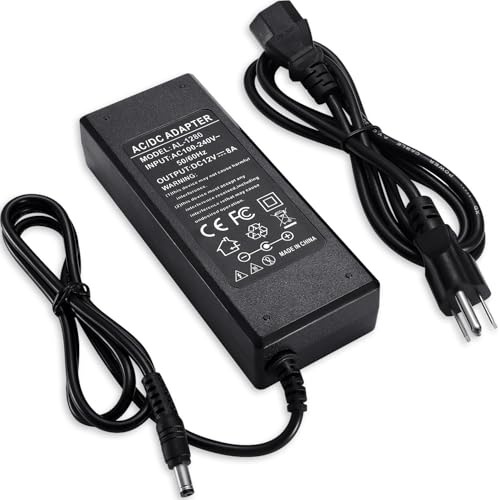
For 12V equipment, LitStar is aimed at lower-power devices with a 2A maximum, ALITOVE reaches 5A and 60W, and TOBWOLF reaches 8A and 96W. AstroAI provides 10A and 120W through a cigarette-lighter socket, while Weishuo raises the documented ceiling to 15A and 180W. The Weishuo listing warns that motorized products such as inflators and vacuum cleaners can have startup current above their rated current.
For 24V equipment, ALITOVE provides 3A and 72W, and SHNITPWR provides 5A and 120W. The adjustable minidodoca and Wefomey supplies reach 3A and 72W across their voltage ranges.
Verify the plug and polarity
Check the barrel connector’s outside and inside diameters, not just the general description. Several fixed-output products use 5.5x2.5mm plugs and describe compatibility with 5.5x2.1mm sockets, but the device should still be checked before purchase.
Wefomey lists multiple tips plus alligator clips, a polarity-reverse cable, and a splitter. Polarity also matters. SHNITPWR, LitStar, and other fixed-output listings identify center-positive arrangements. The device and adapter should agree before power is applied. A connector that physically fits is not proof of electrical compatibility.
Most selected models accept 100-240V AC at 50/60Hz. A broad input range can be useful when the adapter may be used with different household supplies.
Wagan’s EL9903 is different: its specifications list 120V AC, or 110-130V AC, at 60Hz. That makes its documented input range narrower than the universal-input alternatives.
Read protection and certification details
The selected listings variously document overload, overvoltage, overcurrent, thermal, overheating, and short-circuit cutoffs. AstroAI lists a broad protection set and identifies CE, FCC, and RoHS certifications. Wagan lists ETL, TUV, CE, and RCM certifications. SHNITPWR lists FCC, CE, and RoHS.
These features should be considered after the basic electrical requirements have been confirmed. Also note installation limits. ALITOVE’s 12V model, TOBWOLF, and other listings identify indoor use, while the automotive-style products are intended to power car accessories from a household outlet.
Choose fixed or adjustable output
Fixed-output adapters are easier to evaluate for a single known device. Wagan, ALITOVE, SHNITPWR, TOBWOLF, and LitStar each document a specific voltage and current ceiling. This format reduces the number of settings, but it also narrows compatibility.
Adjustable supplies are more appropriate when the user has several devices with different DC requirements. Wefomey adds a splitter and alligator clips; minidodoca lists 16 tips and an LED display. These features improve connection versatility, but careful setup remains essential. Confirm voltage, current, polarity, plug fit, and total load for every connected device.
Final recommendation
Wefomey 3V-24V 3A 72W Adapter ranks first overall in this specification-based comparison under the published weighted criteria.
Wefomey 3V-24V 3A 72W Adapter is the first overall specification-based choice under the published weighted criteria. It combines adjustable output, a voltage display, multiple tips, polarity reversal, alligator clips, and a splitter.
AstroAI AC to DC Converter 10A/120W is a strong general choice for compatible car accessories that use a cigarette-lighter plug. It combines a 12V, 10A, 120W output with a 7.78-foot cord, 100-240V input, automotive compatibility, and documented protections.
The top ac adapter converters serve different use cases rather than one universal specification. Choose Weishuo when the connected 12V automotive device needs a higher documented capacity, Wagan when certification documentation and a defined 60W cooler-oriented use matter, and TOBWOLF when 12V equipment needs up to 8A. For 24V systems, SHNITPWR offers 120W, while ALITOVE provides a 72W alternative with a supplied female connector.
LitStar is a focused lower-power 12V choice with eight tips. Before ordering any of these best ac adapter converters, compare the device label with the adapter’s voltage, maximum current, wattage, connector dimensions, and polarity. If the listing says the product is not a charger, do not use it to charge a battery-powered device.
Frequently Asked Questions
What should I check before buying one of the best ac adapter converters?
Check the device’s DC voltage, current draw, connector dimensions, polarity, and total power requirement. The adapter’s voltage must match the device. Its current and wattage limits should meet the device’s documented demand without exceeding the adapter’s maximum. Also verify whether the product uses a fixed or adjustable output and whether its input range suits the intended outlet.
Can an AC to DC converter charge batteries?
Not automatically. AstroAI states that it is not designed or intended to charge batteries, and SHNITPWR identifies itself as an AC adapter rather than a charger. A battery requires a charging system with the appropriate charging profile and controls. Use a product specifically documented as a charger for that purpose.
Are 5.5x2.5mm and 5.5x2.1mm plugs interchangeable?
Some listings describe a 5.5x2.5mm plug as compatible with a 5.5x2.1mm socket, but users should confirm the device’s actual jack and polarity. Physical fit alone is not sufficient. ALITOVE documents this compatibility on its selected 12V model, while SHNITPWR specifies a 5.5x2.5mm plug. Treat each adapter and device pairing individually.
When is an adjustable adapter better than a fixed-output model?
An adjustable adapter is useful when compatible devices require different voltages. Minidodoca and Wefomey both document 3-24V adjustment, multiple tips, and a 72W maximum. A fixed model is simpler when the required voltage is known, such as a 12V camera or 24V LED system. With an adjustable unit, set the voltage and confirm polarity before connecting the device.
Can a 15A adapter power any 12V device?
No. The device must still be designed for 12V, use a compatible connector and polarity, and stay within the adapter’s documented current and wattage limits. Weishuo’s listing also warns that motorized products may draw more current during startup. Confirm the equipment’s maximum demand instead of relying only on the adapter’s headline rating.
Methodology
This is a specification-based comparison, not a hands-on product test. Editorial scores use a published weighted formula: output voltage and current fit (30.0%), AC input range (15.0%), connector flexibility (20.0%), safety features and certifications (20.0%), and documented application fit (15.0%). A limited non-published marketplace adjustment is applied internally after the editorial formula; its underlying values are not reproduced. The comparison uses the supplied product features and specifications and does not summarize customer sentiment.