Buying Guide
Finding the best stoneware pasta bowls for 2026 starts with understanding how documented specifications translate to real plate-and-fork performance. Because every model in this comparison is stoneware, the meaningful differences appear in capacity, diameter, rim profile, glaze technique, and firing temperature. The picks below were judged against the same evidence-based criteria, so the comparisons remain consistent across the top 10.
Capacity and Portioning
Capacity controls how comfortably a bowl holds pasta, sauce, salads, or soups without overflowing. In this comparison, capacities range from 30 oz to 50 oz per bowl. The Artena embossed bowls and vancasso Bonita set both offer 50 oz, the largest documented volumes, while the JoyJolt Mesa set offers the most compact 30 oz. Mid-range options, such as the AmorArc 36 oz sets and the KooK 40 oz bowls, provide a balanced middle ground for everyday portions. Larger capacity is helpful for layered dishes, while smaller capacity suits plated courses where presentation matters more than volume.
Diameter and Rim Profile
Diameter and rim shape affect how easily you can lift twisted pasta or spoon sauce without spillage. The widest bowls here are the Artena 9.75-inch design and the vancasso Bonita 9.6-inch bowl, which provide generous plating surfaces. The 8.75-inch Pokini, GBhome, and AmorArc handpainted models offer a wide-yet-slightly-more-condensed footprint. Shallow profiles, such as the theterra 1.7-inch depth and the Pokini 1.77-inch depth, keep the rim low for fork access, while deeper 2-inch bowls, like the JoyJolt Mesa, hold more liquid and brothy dishes.
Stoneware Firing and Durability
Firing temperature is one of the most reliable documented indicators of stoneware strength. Pokini lists a 2340°F firing over 13.5 hours, AmorArc models use 2350°F firings for 13 hours, and theterra documents a 2340°F firing for 13 hours. The Artena bowls are oven safe to 450°F. Higher documented firing temperatures generally indicate denser, more chip-resistant stoneware, which matters for daily dishwasher cycles and microwave reheating.
Glaze Quality and Finish
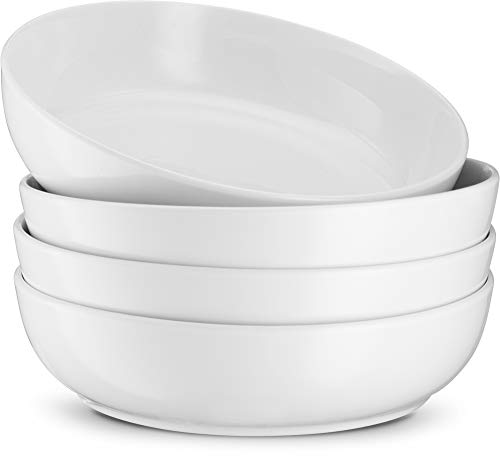
Glaze quality influences both appearance and food safety. These glazes produce natural variations between pieces, which is part of their appeal. Solid finishes like the JoyJolt matte black or the KooK glossy white provide a more uniform look. Several listings, such as GBhome, theterra, and JoyJolt, also document lead-free and cadmium-free glazes.
Care and Safety Compatibility
Most of the bowls in this comparison are documented as microwave, dishwasher, and freezer safe, which simplifies daily use. Buyers who plan to move bowls from freezer to microwave or oven will want to confirm each specification in the product listing.
Stackability and Storage
Stackable design is a recurring feature across the top 10, including Pokini, AmorArc sets, GBhome, theterra, KooK, and JoyJolt. Larger bowls like the 9.75-inch Artena and 9.6-inch vancasso Bonita may require deeper cabinets, so buyers with limited vertical space should measure the documented dimensions before purchasing.
Final recommendation
AmorArc 8.75" Handpainted Stoneware Bowls, Set of 4 (Stone Blue) ranks first overall in this specification-based comparison under the published weighted criteria.
The final choice among the best stoneware pasta bowls depends on the documented features that match your intended use.
For shoppers comparing top stoneware pasta bowls on documented specifications, the Pokini 8.75" Reactive Glaze Stoneware Pasta Bowls, Set of 4 stands out as the first overall specification-based choice, combining a 2340°F firing, a documented scratch-resistant surface, and a stackable 8.75-inch design. Buyers wanting extra capacity should consider the 50 oz options from the Artena embossed set or the vancasso Bonita set, while those preferring a more uniform look may prefer the JoyJolt Mesa matte black or the KooK white bowls. Among the top stoneware pasta bowls reviewed here, the AmorArc family offers the widest range of configurations, theterra delivers the richest double reactive glaze, and GBhome balances size with a 38 oz capacity.
Frequently Asked Questions
What size bowl is considered ideal for pasta?
Pasta bowls in this comparison range from 7.3 inches to 9.75 inches in diameter, with capacities from 30 oz to 50 oz. A wide 8.5 to 9 inch bowl with a depth of 1.5 to 2 inches is a strong match for most pasta servings, as it gives enough surface area to twist noodles while keeping sauce contained.
Are the best stoneware pasta bowls safe for microwave and dishwasher use?
Several, including Artena and vancasso Bonita, are also documented as oven safe, which adds flexibility for warm dishes.
Do reactive glaze finishes vary between bowls in the same set?
Yes. Reactive glaze finishes on the Pokini, AmorArc reactive glaze variants, GBhome, and theterra bowls are documented as producing natural variation between pieces. This is a design feature rather than a defect, and it means each bowl will look slightly different within the set.
Are the best stoneware pasta bowls lead-free?
Several listings explicitly document lead-free and cadmium-free glazes, including GBhome, theterra, and JoyJolt. AmorArc also lists that its bowls are made with degradable clay and fired to remove harmful substances. Buyers who want confirmation should review each product’s specification sheet directly.
Which stoneware pasta bowls are easiest to store?
The compact sets, including JoyJolt Mesa, KooK, Pokini, GBhome, and theterra, are documented as stackable, which helps them fit into tighter cabinet spaces. Larger bowls such as the 9.75-inch Artena and 9.6-inch vancasso Bonita may require deeper cabinets due to their wider profile.