Buying Guide
The best straight-through car exhaust mufflers in this comparison are universal components, not vehicle-specific bolt-in assemblies. That distinction affects nearly every buying decision. A universal muffler normally needs compatible tubing, accurate positioning, and either clamps or welding. Before comparing sound descriptions or body styles, match the muffler’s inlet and outlet dimensions to the existing exhaust system and check the available space beneath the vehicle.
Start with inlet and outlet diameter
Connection size is the first practical filter. The selected products cover 2-inch, 2.25-inch, 2.5-inch, and 3-inch configurations. MagnaFlow 11224 and MagnaFlow 12224 use 2-inch connections, while MagnaFlow 10415 and Floshine use 2.25-inch connections. TOTALFLOW 20416 and ELSHINE use 2.5-inch connections, and TOTALFLOW 20319 and Cabtherlyn use 3-inch connections.
Do not assume that a close measurement is interchangeable. The listings distinguish inner diameter in several products. Measure the tubing and identify whether the muffler connection is specified as an inside or outside dimension. The selected models are generally single-inlet, single-outlet mufflers, but the surrounding exhaust layout still determines whether an adapter, sleeve, clamp, or welded joint is needed.
Compare the straight-through core evidence
A straight-through muffler generally uses a relatively direct internal path, with sound control provided by perforations, mesh, packing, or related internal material. The most specification-aligned documentation in this group comes from the MagnaFlow models. Their listings identify a straight-through perforated core and two-stage acoustic packing. TOTALFLOW documents stainless mesh and internal fill, while EVIL ENERGY specifies fiberglass coverage, an inner mesh, and a double-layer stainless design.
Other selected listings describe a straight-through design but provide less detail about the exact core. That does not make them ineligible, but it does make the evidence narrower. ELSHINE, Cabtherlyn, and Floshine describe straight-through noise reduction and internal reinforcement or partitioning without naming a particular perforated-core material. Compare the level of documentation rather than treating every use of the same label as identical construction.
Check body shape and available clearance
Body dimensions can be as important as pipe diameter. The compact TOTALFLOW 20314 and 20319 each list a 12-inch overall length, with the latter using a 5-inch round body and 3-inch connections. EVIL ENERGY lists a 13.77-inch overall length and a 3.97-inch body diameter. These formats may be easier to place where longitudinal room is restricted, but the surrounding pipes and hangers still need to align correctly.
Longer options include TOTALFLOW 20416, Floshine, ELSHINE, and Cabtherlyn, each with a 20-inch overall length listed. Floshine’s body width is 9 inches, while the larger MagnaFlow 10415 lists a 25.25-inch length. A longer or wider body may not fit the same tunnel, hanger position, or heat-shield arrangement as a compact round muffler. Measure length, diameter, width, inlet offset, outlet offset, and orientation before fabrication.
Evaluate material and joining method
Most selected products specify stainless steel. TOTALFLOW, ELSHINE, and Cabtherlyn identify 409 stainless steel, while EVIL ENERGY lists a 201 stainless housing and 430 stainless inner mesh. Stainless construction is a useful specification to compare, but the supplied evidence does not establish identical alloy thickness, corrosion behavior, or service life across brands.
Welding details also vary. TOTALFLOW documents MIG welding; ELSHINE and Cabtherlyn describe fully welded construction; Floshine identifies a factory-style welded structure; MagnaFlow highlights its construction warranty rather than a particular welding process in the supplied points. EVIL ENERGY is the most flexible on joining method because its listing allows welding or an exhaust clamp. Models that specifically require welding should be treated as fabrication projects rather than simple replacements.
Consider sound-control descriptions carefully
The listings use terms such as deep, smooth, low, throaty, and aggressive. These are product-description language, not independent sound measurements. A muffler’s actual exhaust note will also depend on engine size, pipe diameter, catalytic components, resonators, exhaust exits, and cabin insulation. Use those descriptions to identify the intended design direction, but do not treat them as certain results.
Acoustic packing is explicitly documented on the MagnaFlow models, while TOTALFLOW lists internal fill and EVIL ENERGY lists fiberglass sound absorption. These details indicate that the products include sound-control material alongside the straight-through path. They do not provide a standardized decibel comparison between models.
Plan installation and vehicle matching
Universal fitment means the muffler is intended for adaptation across applications, not that it directly matches every vehicle. MagnaFlow recommends professional installation for its selected models. Floshine, TOTALFLOW, and Cabtherlyn identify clamps or welding as installation requirements, while ELSHINE lists clamp-on or welding options. EVIL ENERGY also lists both methods and recommends professional installation.
Confirm the vehicle’s pipe diameter, muffler location, body clearance, inlet and outlet alignment, hanger position, and local exhaust requirements. A muffler can have the correct diameter but still require changes to pipe routing or support brackets. Also inspect adjacent components before removing the existing unit, particularly heat shields and exhaust hangers.
Final Recommendation
MagnaFlow Performance Exhaust Muffler 11224 ranks first overall in this specification-based comparison under the published weighted criteria.
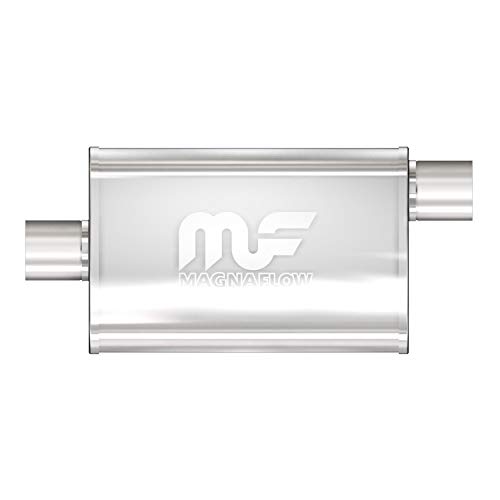
MagnaFlow Performance Exhaust Muffler 11224 is the first overall specification-based choice among the best straight-through car exhaust mufflers reviewed here. Its listing gives the clearest combination of a straight-through perforated core, two-stage acoustic packing, 2-inch connections, oval dimensions, universal placement, and a limited lifetime construction warranty.
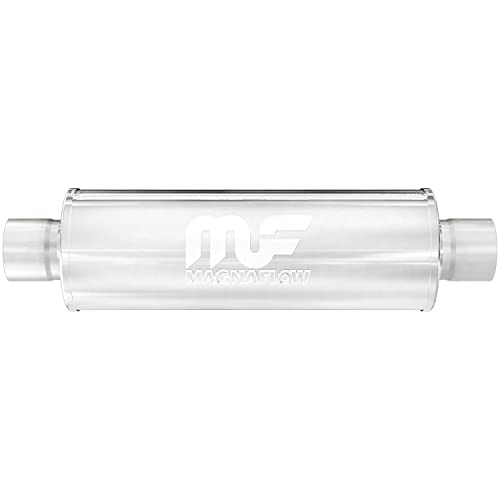
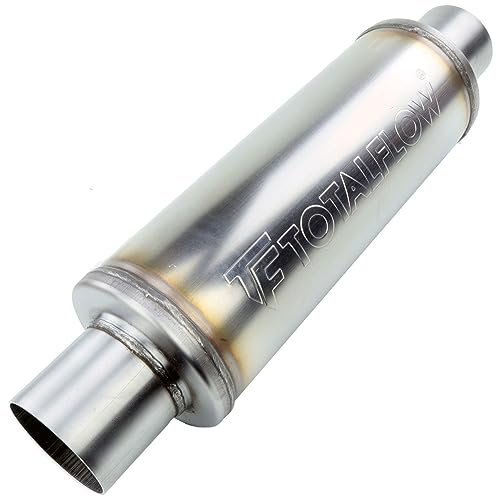
MagnaFlow Performance Exhaust Muffler 10415 is the better fit for a compact round 2.25-inch configuration, while MagnaFlow 12224 offers a 5-by-8-inch oval body with the same documented core-and-packing approach. For 2.5-inch systems, TOTALFLOW 20416 and ELSHINE provide strong dimensional and construction detail. Choose TOTALFLOW 20319 or Cabtherlyn when the exhaust system uses 3-inch tubing, and consider EVIL ENERGY when clamp-or-weld flexibility is especially useful.
The top straight-through car exhaust mufflers are not interchangeable solely because their titles use similar terminology. Connection diameter, body clearance, internal design evidence, material, and fabrication requirements should control the final selection. Verify those specifications against the vehicle before installation.
Frequently Asked Questions
What makes the best straight-through car exhaust mufflers different from chambered designs?
The selected listings describe a direct or straight-through internal arrangement, often paired with a perforated core, mesh, fiberglass, or acoustic packing. MagnaFlow explicitly identifies a straight-through perforated core, while TOTALFLOW identifies stainless mesh and internal fill. Chambered designs use internal chambers and are a different construction type. The supplied evidence does not provide a universal sound or flow measurement for either design.
How do I choose between a 2-inch, 2.25-inch, 2.5-inch, and 3-inch muffler?
Match the muffler’s listed inlet and outlet dimension to the exhaust tubing. MagnaFlow 11224 and 12224 are 2-inch options; MagnaFlow 10415 and Floshine are 2.25-inch options; TOTALFLOW 20416 and ELSHINE are 2.5-inch options; and TOTALFLOW 20319 and Cabtherlyn are 3-inch options. Also confirm whether the listing states an inside or outside diameter, because that affects how the joint is made.
Do these universal mufflers install without welding?
Not all of them. EVIL ENERGY lists welding or exhaust-clamp installation, and ELSHINE lists clamp-on or welding installation. Floshine and Cabtherlyn state that clamps or welding are required. MagnaFlow recommends professional installation, and universal placement may require cutting or fabrication. Inspect the individual listing and plan the joining method before selecting a muffler.
What dimensions should I measure before selecting a muffler?
Measure tubing diameter, available overall length, body diameter or width, inlet and outlet alignment, hanger position, and nearby heat-shield clearance. The selected products range from compact 12-inch overall formats, such as TOTALFLOW 20314 and 20319, to longer bodies measuring 20 inches or more. A correct pipe diameter alone does not ensure that the body will fit the available space.
Can a product description predict a particular exhaust sound?
Not precisely. Descriptions such as deep, smooth, throaty, or aggressive indicate the manufacturer’s intended sound character, but they are not standardized acoustic measurements. Engine configuration, pipe routing, resonators, catalytic components, and exhaust exits also affect the final result. Treat sound language as a general design indication rather than a certain outcome.