Buying Guide
The best street bike powersports pads should be chosen by matching the pad to the motorcycle, caliper position, riding application, and documented friction material. These listings cover several different design types, so a pad that suits a heavy touring motorcycle is not automatically appropriate for a sport bike or a specific Ducati rear caliper.
Start with exact fitment
Fitment is the first filter. Check the motorcycle make, model, year, brake position, and part number against the listing. The JSA 209 HH listing covers motorcycles from BMW, Ducati, Harley-Davidson, KTM, Triumph, Royal Enfield, Yamaha, CFMOTO, and other brands, but broad coverage makes exact verification especially important. The S SYUU and LE LEFOSSI listings likewise cover multiple Harley families and years.
Model-specific entries can reduce ambiguity. The Road Passion rear pad for Ducati Multistrada 1200 identifies both the application and dimensions, while the Hypermotard-focused Road Passion listing supplies a different rear-pad size and compatibility list. Do not assume that two Ducati models use interchangeable pads simply because they share a brand or general motorcycle category.
Compare friction materials
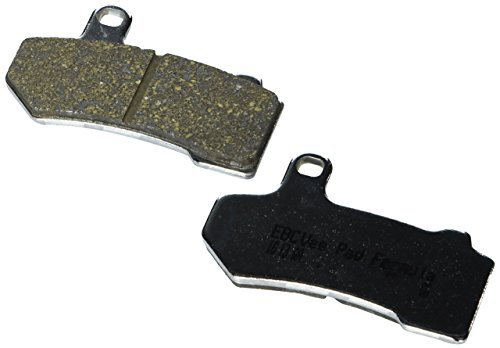
Material affects how much useful information a listing provides about intended use. The EBC EPFA630HH is a sintered street-and-trackday pad with enhanced friction-stabilizing additives. EBC’s VLD and V-Pad entries use a semi-sintered construction containing 30 percent copper, combining an organic molded material with sintered-pad characteristics according to the supplied descriptions.
Other products use resin-based HH, carbon-fiber, semi-metallic, or semi-organic metallic materials. JSA identifies a resin-based friction material with a copper-plated backing. SCITOO and LE LEFOSSI identify carbon-fiber construction. The Harley-focused S SYUU entry specifies semi-metallic material, while both Road Passion Ducati entries specify metallic or semi-metallic materials.
These labels should not be treated as a universal performance ranking. They are useful for comparing the evidence supplied by each listing and for narrowing choices to the type intended for your motorcycle and riding conditions.
Look for heat-management details
Heat evidence is more useful when it explains a design feature rather than simply promising performance. The EBC EPFA630HH documents a double-segment vented design intended to keep the pads cooler and includes stainless steel radiator plates where required. JSA describes copper-plated backing for heat dissipation, while EBC’s touring products describe low heat generation and stable friction across a wide operating-temperature range.
The Ducati-specific Road Passion pads provide stronger application and dimensional evidence than thermal detail. That distinction matters: a model-specific pad with limited heat information may still be the more relevant choice when it is the documented match.
Consider position and package coverage
Confirm whether you need a front pad, rear pad, or both. The JSA product is explicitly a rear pad. Both Road Passion entries are rear-position products. In contrast, LE LEFOSSI and S SYUU describe front-and-rear sets, and SCITOO states a six-pad package for front and rear Suzuki applications.
Package quantity can also affect installation planning. LE LEFOSSI states two pairs and four pieces total. SCITOO lists three pairs and six pads. Other entries list a single unit or pair. Treat package wording carefully and verify how many caliper positions the specific listing covers before ordering.
Weigh wear and rotor considerations
The EBC touring entries are the most detailed on wear-related behavior. They describe long-life heavy-duty material, minimal pad and rotor wear, minimal dusting, and a projected street-mile figure. The EPFA listing also describes long street service and repeated trackday use, but those are listing claims rather than independent test results.
The Road Passion Indian Street rear pad, which was not selected, also documents bio-metallic material and wear claims, but this comparison prioritizes products with stronger combined evidence across the scoring criteria. As with every entry, replace pads according to the motorcycle manufacturer’s service requirements and inspect the rotor and caliper system as part of the job.
Final recommendation
EBC EPFA630HH Sintered Street and Trackday Pad ranks first overall in this specification-based comparison under the published weighted criteria.
EBC EPFA630HH is the highest-scoring returned product and the best street bike powersports pads choice when the documented street-and-occasional-trackday brief, enhanced sintered compound, and vented design match your application. It has the most specification-aligned combination of material, heat, and use-case evidence in this comparison.
The EBC FA400VLD, FA409VLD, and FA631V are better aligned with the supplied heavy-touring descriptions, while JSA 209 HH is the leading fitment-breadth option for compatible multi-brand rear applications. LE LEFOSSI and S SYUU are useful front-and-rear Harley-oriented choices, and SCITOO is the focused six-pad Suzuki option. The Road Passion entries are the most targeted choices for the specified Ducati rear applications.
Among these top street bike powersports pads, fitment remains more important than a general material label. Verify the exact motorcycle, year, position, dimensions, and part number before installation.
Frequently Asked Questions
What should I verify before buying the best street bike powersports pads?
Verify the motorcycle make, model, year, brake position, caliper or pad shape, and part number. Also check whether the listing supplies one pad, one pair, or enough pieces for front and rear service. The Road Passion Ducati entries show why dimensions and position should be checked rather than inferred from a model family.
Are sintered pads suitable for every street motorcycle?
The supplied evidence does not establish universal suitability. EBC documents the EPFA630HH for street and occasional trackday use, but compatibility still depends on the specific motorcycle and caliper. A sintered, semi-sintered, resin-based, carbon-fiber, or semi-metallic label should be considered alongside the manufacturer’s fitment information.
Which selected pads cover both front and rear positions?
LE LEFOSSI states front-and-rear coverage with four pieces, S SYUU describes a front-and-rear set, and SCITOO lists three pairs for front and rear Suzuki applications. Confirm the exact allocation and package contents for your model before beginning the installation.
Why do some products have extensive model lists?
Some replacement pads share a shape across many motorcycles. JSA lists numerous BMW, Ducati, Harley-Davidson, KTM, Triumph, Royal Enfield, Yamaha, and CFMOTO applications. A long compatibility list is helpful for research but does not remove the need to verify the exact model year and rear or front position.
No. This is a specification-based comparison using public listing data, not a hands-on test. Claims about heat resistance, wear, noise, dust, or braking behavior are included only when supplied in the product evidence and should not be read as independent test results.