Buying Guide
Choosing the best surround sound speaker mounts requires more than checking whether a bracket is described as universal. The speaker’s actual width, depth, weight, and rear connection determine whether the mount can hold it securely. Installation surface and the desired listening direction matter just as much. The models in this comparison include clamp shelves, threaded ball-joint brackets, and wall-and-ceiling mounts, so the right choice depends on the speaker and room rather than a single universal design.
Match the mount to the speaker
Start with the speaker’s mounting method. The Borenbuir Universal Rear Speaker Wall Mounts support keyhole, 1/4-inch-20, 5mm, and 6mm connections, making them suitable when the rear interface is uncertain or varies across a system. The Borenbuir BL-SM-003 instead documents 1/4-inch-20, 4mm, and 5mm compatibility and names several Samsung rear-speaker families and Roku models.
Clamp-style mounts are different. The Perlegear PGSM06B, TNP Products SPK_MOT_VM, Yibracki BSB-LSSM, WALI SWM201, and VideoSecu MS56B grip the speaker cabinet rather than relying on a threaded insert. Measure the cabinet before selecting one. Perlegear accepts widths from 5.12 to 11.81 inches and depths up to 13.78 inches. TNP Products and WALI cover widths from 5.5 to 11 inches, while Yibracki covers 5 to 11 inches. VideoSecu MS56B also documents support for cabinets up to 13 inches deep.
Consider weight and cabinet size
Capacity should be compared with the complete speaker weight, not just a nominal category. Perlegear, TNP Products, Yibracki, and WALI each document support up to 55 pounds, although the wall and installation method still need to be suitable. VideoSecu MS56B supports up to 33 pounds, and the Howonder BS-218pro supports up to 30 pounds.
For compact rear speakers, the Borenbuir BL-SM-003 and ECHOGEAR EGAV-SWMSP are more focused choices. Their listed limits are 11 and 8 pounds respectively. The ECHOGEAR model is especially specific about satellite speakers and uses weather-resistant nylon, while the Borenbuir bracket uses aluminum and a ball-joint structure. Do not use a lightweight satellite bracket for a deep bookshelf speaker simply because the connection appears to fit.
Compare adjustment ranges
Angle adjustment helps direct surround channels toward the listening area, but the useful range depends on where the bracket is installed. Perlegear offers ±15-degree tilt and ±90-degree swivel. Yibracki provides ±10-degree tilt and ±90-degree swivel, while TNP Products and WALI list 7.5-degree tilt with 45-degree swivel. These ranges are suitable when the wall position is already close to the intended aim.
The broadest movement comes from the Howonder BS-218pro and the Borenbuir rear-speaker models. Howonder lists up to 120 degrees of tilt and 180 degrees of swivel. Both Borenbuir rear designs list ±30-degree tilt and 180-degree horizontal movement, with the BL-SM-003 also specifying full 360-degree swivel. Mount-It! MI-SB292 provides 20-degree tilt and 90-degree swivel, with a tool-free adjustment knob.
Check the wall and ceiling requirements
The mounting surface is part of the specification. Perlegear, TNP Products, Yibracki, and WALI identify studs, concrete, brick, or stone as compatible surfaces. The Borenbuir rear models include drywall and concrete anchors, while the ECHOGEAR mount supports wall or ceiling placement. The Mount-It! model uses a slide-in wall plate, and ECHOGEAR includes screws for its satellite-speaker design. Always verify the speaker dimensions and the wall construction before drilling.
Decide between clamps, plates, and shelves
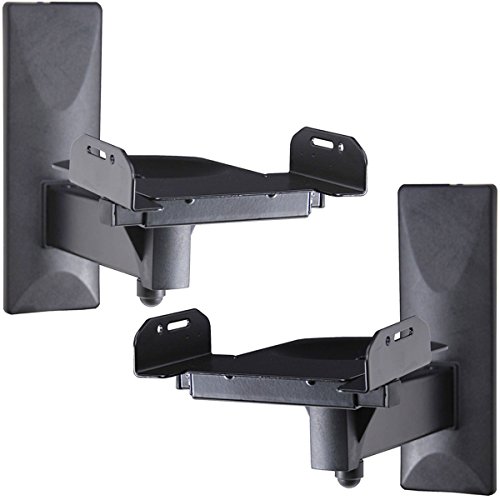
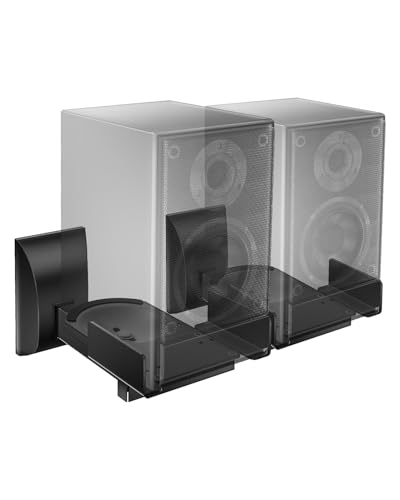
Side clamps are useful for bookshelf speakers without pre-drilled mounting holes. VideoSecu MS56B explicitly supports that type of cabinet, and the Perlegear, TNP Products, and Yibracki designs also use clamp-based support. Foam or rubber contact surfaces can help protect the cabinet; Yibracki specifies foam padding, while Perlegear specifies grippy rubber padding.
Threaded ball-joint mounts are better suited to compact speakers with a documented rear connection. They offer broad aiming movement and can remain visually compact. Shelf-style products provide a flat platform, but they need a suitable speaker footprint.
Plan the cable route and installation
Cable management keeps wall-mounted wiring controlled. Perlegear, TNP Products, WALI, VideoSecu MS56B, and the Borenbuir models document cable routing or cable ties. Yibracki also includes reusable cable ties. These details do not replace careful wall anchoring, but they can make the finished installation neater.
Look for supplied anchors, adapters, and clear instructions when the bracket uses several connection types. The Borenbuir models include adapters and installation hardware, while Perlegear documents labeled hardware and a four-step installation process. Mount-It! uses a slide-in wall plate, and ECHOGEAR includes screws for its satellite-speaker design. Always verify the speaker dimensions and the wall construction before drilling.
Final Recommendation
Perlegear PGSM06B Speaker Wall Mounts ranks first overall in this specification-based comparison under the published weighted criteria.
The final choice among the best surround sound speaker mounts depends on the documented features that match your intended use.
Perlegear PGSM06B Speaker Wall Mounts is the highest-scoring returned product and the first overall specification-based choice for larger bookshelf and surround speakers. Its 55-pound support, broad width and depth range, dual-side clamps, padding, and wide adjustment range give it the most complete documented fit among these selections.
The top surround sound speaker mounts are not interchangeable. Choose TNP Products or Yibracki when a heavy bookshelf or studio speaker needs a clamp, with Yibracki adding documented foam protection and studio-monitor compatibility. VideoSecu MS56B is the more specific choice for deep cabinets. For compact threaded rear speakers, Borenbuir BL-SM-003 offers strong interface coverage and extensive movement, while the universal Borenbuir bracket covers keyhole and several threaded formats.
Howonder BS-218pro and ECHOGEAR EGAV-SWMSP address different placement needs. Howonder offers broad movement and indoor-or-outdoor use for speakers within its capacity; ECHOGEAR focuses on lightweight satellite speakers and weather-resistant construction. Mount-It! MI-SB292 is a compact alternative when the speaker’s M5 pattern and weight fit its documented limits.
Frequently Asked Questions
What should I measure before choosing the best surround sound speaker mounts?
Measure the speaker’s width, depth, weight, and rear mounting interface. Clamp models need cabinet dimensions and enough side clearance. Threaded models need the correct hole size or adapter. Also confirm that the wall or ceiling surface matches the supplied hardware.
Are clamp mounts suitable for large bookshelf speakers?
They can be, when the cabinet falls within the documented width and depth range and the weight is below the stated capacity. Perlegear, TNP Products, Yibracki, WALI, and VideoSecu MS56B all document clamp-style support for bookshelf speakers, but their ranges are not identical.
Can surround speaker mounts be installed on a ceiling?
Some selected models document ceiling use. ECHOGEAR supports wall or ceiling placement, and the Borenbuir rear-speaker designs use ball-joint adjustment suitable for flexible positioning. Confirm the speaker connection, weight, ceiling material, and included hardware before installation.
Do all speaker mounts fit speakers without mounting holes?
No. Side-clamp models such as VideoSecu MS56B are designed to hold compatible cabinet sides and are specifically described for speakers without pre-drilled mounting holes. Threaded or keyhole brackets require the corresponding connection on the speaker.
How much angle adjustment is useful for surround placement?
The needed range depends on the wall position and listening area. Moderate adjustment may be enough for a nearby side wall, while broad tilt and swivel are more useful when the bracket is offset or mounted high. Compare the stated ranges rather than assuming that every universal bracket moves identically.