Buying Guide
The best bookshelf speaker mounts are selected by matching the hardware to the speaker cabinet and the wall, not simply by choosing the bracket with the largest advertised capacity. Start with the speaker’s width, depth, weight, and rear connection pattern. Then consider how much aiming control you need and whether the mount protects the enclosure or organizes the cable.
Match the mount to speaker dimensions
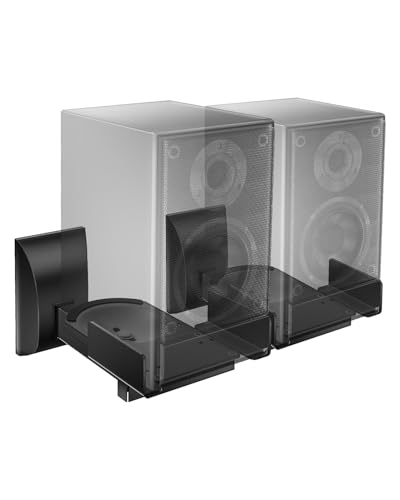
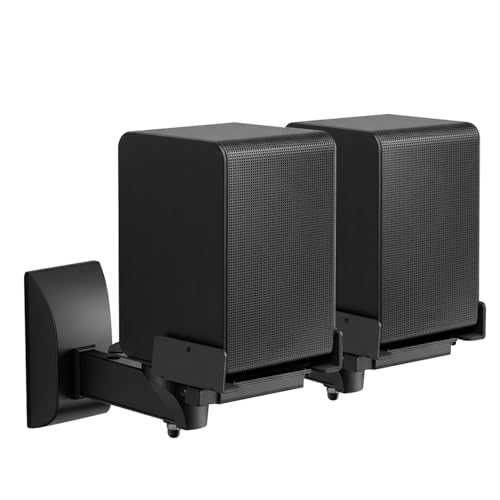
Measure the speaker cabinet at the points that will sit inside the bracket. Clamp-style products in this comparison commonly cover widths from about 5 to 11 inches, but the limits differ. Perlegear covers 5.12 to 11.81 inches and lists a maximum depth of 13.78 inches. FDM lists 5.5 to 11.1 inches and up to 13 inches deep. VideoSecu also documents support for speakers up to 13 inches deep, making it a useful fit-oriented option for larger cabinets.
Do not assume that a broad width range automatically fits every bookshelf speaker. Check whether the speaker’s side panels are parallel enough for a clamp and whether the cabinet depth leaves room for the wall plate. If the speaker has a compatible threaded mounting pattern, Mount-It! MI-SB130 uses a different approach and requires four threaded inserts in a rectangular pattern. Borenbuir offers another connection-focused design with keyhole, 1/4-20, and 5mm/6mm threaded-hole support.
Compare capacity with the complete installation
A mount’s stated capacity is only one part of the installation decision. The selected listings range from 22 pounds for Mount-It! MI-SB130 to 66 pounds for FDM. Several options, including Perlegear, Monoprice, WALI SWM201, Yibracki, TNP Products, and PEGZONE, state capacities of up to 55 pounds. Borenbuir and VideoSecu list 32 and 33 pounds respectively.
Use the speaker’s actual weight as the first check, then consider the wall surface and the supplied hardware. WALI SWM201, TNP Products, and FDM document installation on studs, concrete, or brick and stone walls. Perlegear identifies a steel structure and expandable clamps, while VideoSecu lists heavy-duty steel construction. These details help distinguish a mount intended for a substantial bookshelf cabinet from one aimed at smaller surround speakers.
Choose the right adjustment range
Tilt and swivel determine how precisely the speaker can face the listening area. Monoprice lists 30 degrees of tilt and 180 degrees of swivel. Perlegear lists ±15-degree tilt and ±90-degree swivel. Borenbuir documents up to 120 degrees of tilt and 180 degrees of swivel, while PEGZONE lists ±10-degree tilt and 360-degree rotation.
A wide range is most useful when speakers sit beside a television, in a room corner, or behind the listening position. For a conventional left-and-right stereo arrangement, the more moderate adjustment of WALI SWM201 or TNP Products may be sufficient. Mount-It! MI-SB130 offers 20-degree tilt and 60-degree swivel, which may work well when its four-insert mounting requirement is already satisfied.
Decide between clamps and threaded attachments
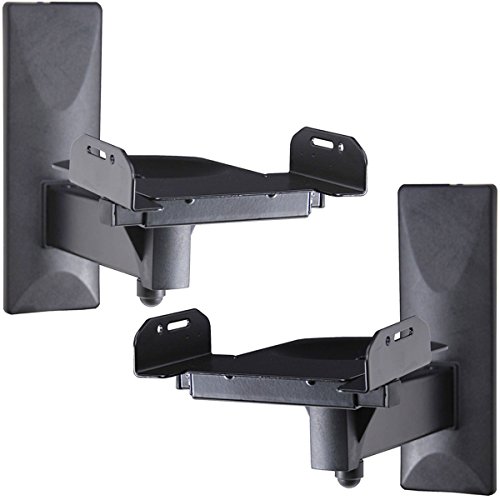
Side clamps hold the speaker from its sides and can work with cabinets that lack pre-drilled mounting holes. The VideoSecu listing specifically says its design works with wood or plastic speakers without pre-drilled mounting holes. Yibracki adds foam padding, and Monoprice lists soft anti-skid pads. These features may help reduce direct contact between the bracket and the enclosure.
Threaded or keyhole attachments depend on the speaker having the matching connection points. Borenbuir gives the widest documented choice of connection formats in this selection. Mount-It! MI-SB130 is more specific and requires four threaded inserts. Review the speaker manufacturer’s rear-panel layout before selecting either style.
Account for wall type and installation hardware
The wall surface should guide the installation plan. WALI SWM201, TNP Products, and VideoSecu list several compatible surfaces, while Borenbuir identifies drywall, wood studs, concrete, and brick or stone. Link the bracket’s anchors and screws to the actual wall construction rather than relying on a general-purpose fastener.
Some products provide additional setup guidance. Perlegear lists a four-step installation process, and PEGZONE includes a manual and installation video. Mount-It! MI-SB130 uses a slide-in wall plate, while the WALI listing includes a mounting hardware kit and user manual. These supplied details can make the installation requirements easier to assess before drilling.
Look for cable routing and finish protection
Cable management matters when the mount is placed above a desk, beside a television, or on a visible wall. WALI SWM201, Perlegear, VideoSecu, and TNP Products document cable organization or integrated routing. Yibracki includes reusable cable ties, while other selected models provide fewer cable-specific details.
Protection at the speaker contact points is another useful distinction. Perlegear lists grippy rubber padding, Yibracki includes anti-vibration foam, and Monoprice lists soft anti-skid pads. Padding may help avoid scuffs, but it does not remove the need to check clamp pressure and cabinet dimensions.
Final recommendation
Perlegear PGSM06B Speaker Wall Mounts ranks first overall in this specification-based comparison under the published weighted criteria.
The final choice among the best bookshelf speaker mounts depends on the documented features that match your intended use.
Perlegear PGSM06B Speaker Wall Mounts are the highest-scoring returned product and the first overall specification-based choice. They combine a 55-pound stated capacity, a broad 5.12-to-11.81-inch width range, support for deeper speakers, ±15-degree tilt, ±90-degree swivel, rubber padding, and cable management. Monoprice is a strong alternative when 30-degree tilt is the priority, while FDM is suited to buyers who need the highest stated capacity in this selection.
For studio-monitor compatibility, Yibracki provides named model examples and foam protection. VideoSecu is useful for deeper cabinets, and Borenbuir addresses varied connection patterns. WALI SWM201 and TNP Products offer balanced clamp-style specifications for standard home theater layouts. PEGZONE emphasizes rotation flexibility, while Mount-It! MI-SB130 is the specialist option for speakers with four threaded inserts. These are the top bookshelf speaker mounts to compare when fit, support, and adjustment matter more than a one-size-fits-all design.
Frequently Asked Questions
What should I measure before choosing bookshelf speaker mounts?
Measure the speaker’s width, depth, and weight, then inspect the rear panel for keyhole slots or threaded inserts. For side-clamp products, compare the cabinet width with the bracket’s stated range. Perlegear, for example, lists both width and maximum depth, while VideoSecu documents support for cabinets up to 13 inches deep.
Are side-clamping mounts suitable for speakers without mounting holes?
They may be. VideoSecu specifically states that its side-clamping design works with wood or plastic speakers without pre-drilled mounting holes. Clamp models such as WALI SWM201 and TNP Products are also described for bookshelf speakers, but the cabinet dimensions and side shape still need to match the listed fit range.
How much adjustment do I need?
Choose adjustment based on speaker placement. A moderate tilt and swivel range may be enough for a front stereo pair, while corner or rear-surround placement can benefit from broader movement. Borenbuir lists up to 120 degrees of tilt, Perlegear lists ±15-degree tilt and ±90-degree swivel, and PEGZONE lists 360-degree rotation.
Can these mounts go on drywall?
That depends on the product and the installation hardware. Borenbuir, WALI SWM201, TNP Products, and VideoSecu list multiple wall surfaces, including drywall or studs in their supplied descriptions. Mount-It! MI-SB130 requires a secure wall plate and is intended for compatible speaker inserts. Always match the anchor type to the actual wall construction.
Which best bookshelf speaker mounts include cable organization?
Perlegear, WALI SWM201, and VideoSecu document integrated cable management. TNP Products also describes cable organization, while Yibracki includes reusable cable ties. If visible wiring is a concern, prioritize a listing that specifically identifies routing features rather than assuming every wall bracket includes them.