Buying Guide
Temperature alarm clocks differ mainly in how they present climate information and how much alarm or bedside functionality they add. The best temperature alarm clocks for a simple nightstand may only need an indoor reading, a readable display, and a dependable alarm. Other shoppers may prefer projection, humidity data, outdoor sensing, or a weather-station layout.
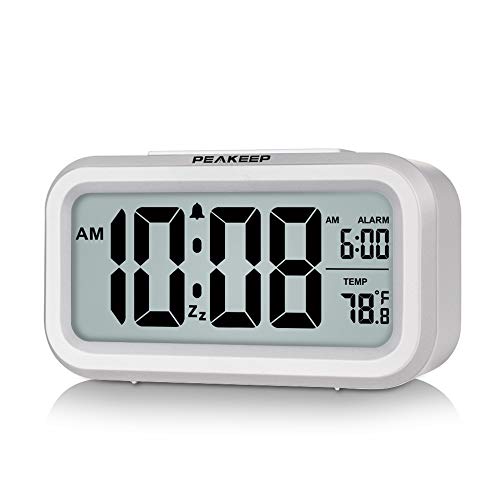
Most selected models show indoor temperature. That is enough for checking the room before bed or after waking. The Peakeep MH-9060 gives a defined indoor range of 15.8 to 122 degrees Fahrenheit and lists a tolerance of plus or minus 1.8 degrees Fahrenheit. The CHEREEKI 2119-1, Netzu 6210TB, and the DreamSky wooden clocks also present indoor temperature alongside date or weekday information.
If you want more than a room reading, look at the SMARTRO SC91. Its listing documents indoor and outdoor temperature, humidity, weather patterns, mold alerts, and temperature trends. It supports up to three wireless sensor channels, although one sensor is supplied. This is closer to a compact weather station than a basic alarm clock. The Netzu P338PB provides another specialized approach: it projects indoor temperature as well as time, so the reading can be viewed from bed.
Temperature displays are not the same as thermostats or climate-control systems. None of the supplied evidence indicates that these clocks adjust heating, cooling, or humidity. Treat the readings as information for room awareness, not as a control function.
Match the alarm to your routine
Alarm flexibility matters if more than one person uses the clock or if weekday and weekend schedules differ. The JALL V18039 offers three separate alarms and weekday mode. The Netzu 6210TB provides two alarms with daily, weekday, and weekend modes. The SMARTRO SC91, 45MinST clock, and DreamSky DS318 also document dual alarms.
For a more basic routine, a gradual alarm and snooze may matter more than multiple schedules. The CHEREEKI 2119-1 describes an alarm that increases from slow to urgent and includes a prominent five-minute snooze. The Peakeep MH-9060 uses a progressively faster beep and an eight-minute snooze. The DreamSky DS318 describes an ascending beep lasting two minutes, while the Netzu P338PB has three volume levels and a nine-minute snooze.
Be careful with claims about loudness. The listings document adjustable volume or loud-alarm descriptions, but they do not establish how every person will experience the sound in a particular room. Choose adjustable volume when you want more control rather than assuming a fixed alarm will suit everyone.
Prioritize display visibility at night
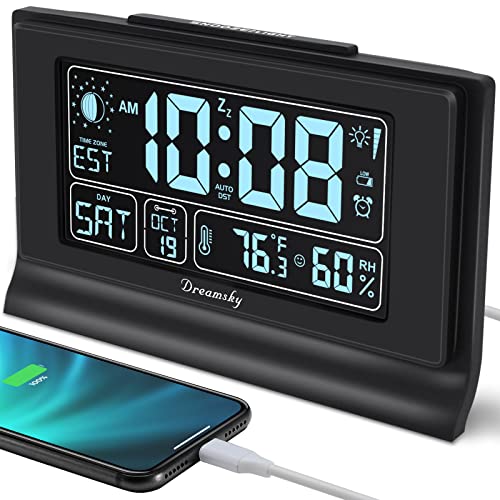
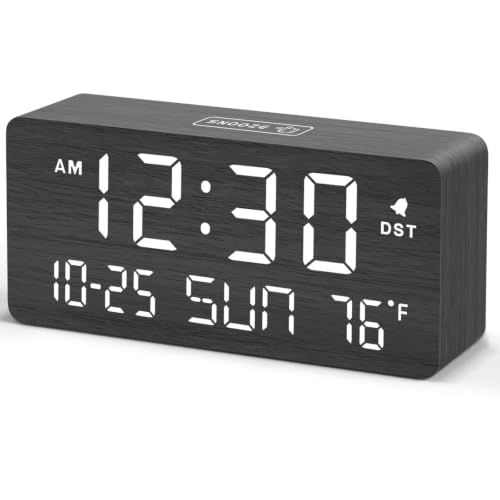
Brightness control is especially important for bedside use. The DreamSky DS318, DreamSky DS2201, and DreamSky DS2209 document six levels or full-range adjustment, with the wooden models offering 0-to-100 percent dimming. The JALL V18039 provides six-level dimming, and the Netzu 6210TB offers five brightness levels. These options allow more adjustment than a display with one fixed brightness.
The 45MinST clock offers three brightness levels with automatic or manual control. Its bottom glow is a separate ambient feature. The Peakeep MH-9060 and CHEREEKI 2119-1 take a sensor-based approach, automatically changing or triggering low illumination in darkness. A light sensor can reduce the need to find a control at night, while manual adjustment gives more direct control over the exact brightness.
Projection clocks need a separate check. The SMARTRO SC91 projects in soft red and has adjustable projection angles. The Netzu P338PB uses a 180-degree rotatable projector and documents projection from 1.6 to 11.4 feet. Projection depends on having a suitable wall or ceiling surface and may not suit every bedroom layout.
Understand power and backup behavior
Power design affects where a clock can be placed. The CHEREEKI 2119-1 is battery operated and lists three included AAA batteries, making it the most straightforward cordless choice among these selections. The Peakeep MH-9060 is also battery operated, but its three AAA batteries are not provided. The 45MinST model supports either three AAA batteries or USB power.
Most of the larger displays are plug-in clocks. The JALL V18039, Netzu 6210TB, Netzu P338PB, SMARTRO SC91, DreamSky DS318, DreamSky DS2201, and DreamSky DS2209 use an adapter or mains power for normal operation. Several add batteries for memory or outage support. Read those descriptions carefully: a backup battery may preserve settings or operate an alarm without keeping the display lit. For example, the JALL V18039 states that its display will not light on battery power alone, and the DreamSky wooden clocks state that batteries cannot power normal clock operation.
Extra functions are worthwhile when they match your routine. The DreamSky DS318 includes a USB charging port, moon phases, time-zone selection, auto DST, and humidity. The DreamSky wooden models also include USB charging and auto DST. The JALL V18039 adds three alarms, weekday mode, humidity, and a wood-grain design. The SMARTRO SC91 is the most expansive option for climate information, while the Netzu P338PB focuses its extra feature set on projection.
A compact design may be preferable when the clock shares a crowded nightstand. The Peakeep MH-9060 and CHEREEKI 2119-1 are small battery-operated formats. Conversely, the 45MinST model has a seven-inch display, and the selected DreamSky wooden models are intended for larger, easy-to-read presentation. Check the listed dimensions and available surface before choosing a large display.
Final recommendation
DreamSky Alarm Clocks for Bedrooms with Battery Backup, Auto Set ranks first overall in this specification-based comparison under the published weighted criteria.
The SMARTRO SC91 is the highest-scoring returned product and the first overall specification-based choice among the best temperature alarm clocks. Its indoor/outdoor temperature and humidity monitoring, weather-station information, projection, and dual alarms give it the broadest documented capability. For a simpler projection design, the Netzu P338PB is the more focused alternative. The DreamSky DS318 is a strong choice for automatic time setting, humidity, and a large display, while the JALL V18039 is better suited to multiple alarm schedules and wood-grain styling.
For cordless use, compare the CHEREEKI 2119-1 with the Peakeep MH-9060. The CHEREEKI includes batteries and has a real wood shell, while the Peakeep provides a stated temperature range and compact night-light controls. The 45MinST clock is useful when USB and battery placement flexibility matter. The Netzu 6210TB and DreamSky wooden models make sense when calendar information, dimming, and bedside charging are higher priorities. Among the top temperature alarm clocks, the right selection depends on whether temperature is a quick room check or part of a larger weather display.
Frequently Asked Questions
Do the best temperature alarm clocks measure indoor or outdoor temperature?
Most of the selected models document indoor temperature only. The SMARTRO SC91 specifically includes indoor and outdoor temperature through its weather-station design. The Netzu P338PB documents indoor temperature and projects it, but the supplied evidence does not describe outdoor sensing for that model.
Can these clocks run during a power outage?
Power-outage behavior varies. Battery-operated models such as the CHEREEKI 2119-1 can be placed without an outlet, while many plug-in models use batteries only for memory or alarm backup. The JALL V18039 states that its display will not light on battery power alone. The DreamSky DS318 and wooden DreamSky models also use adapter power for normal operation, so review the backup description before relying on a clock during an outage.
Which selected clock projects temperature?
The Netzu P338PB projects both time and indoor temperature using a rotatable projector. The SMARTRO SC91 also projects time and temperature and adds indoor/outdoor climate information. Projection is useful when you want to check information without turning toward the clock, but room layout and a clear projection surface still matter.
Are temperature alarm clocks also thermostats?
No supplied listing describes thermostat control. These products display temperature information and, in some cases, humidity or weather trends. They do not document control over heating, cooling, or room humidity, so use them as display and alarm devices rather than replacement climate controls.
What should I check before buying a temperature alarm clock?
Confirm whether the clock shows indoor temperature only or supports an outdoor sensor, whether the display can be dimmed, and whether the alarm offers the schedules and volume range you need. Also verify the power arrangement: some models are cordless, while others require an adapter and use batteries only for memory or outage functions.