Buying Guide
The best usb-c on-ear headphones are wired digital-audio products, but USB-C alone does not tell you everything about compatibility or use. The connection must support audio output, and the supplied listings repeatedly warn that a USB-C charging port may not be enough. Before ordering, check the phone, tablet, Chromebook, laptop, console, or computer specifications for USB-C audio support.
Choose the right listener
The adult-oriented choices in this comparison include JBL, Audio-Technica, JVC, Kensington, NUBWO, and Bulktech. They cover different priorities rather than one universal design. JBL’s Tune 530C and Tune 520C emphasize sound controls and digital-audio specifications. Audio-Technica focuses on a lightweight, fold-flat format. JVC adds a call-friendly microphone, comfort padding, and a tangle-free single-sided cable. Kensington is especially distinct for a 94dB maximum audio-level limiter and a long six-foot cord. NUBWO is the option to consider when both USB-C and 3.5mm connections matter, while Bulktech is aimed at classroom, office, and testing environments.
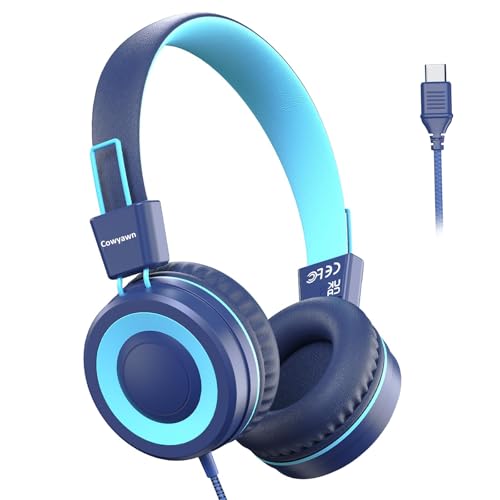
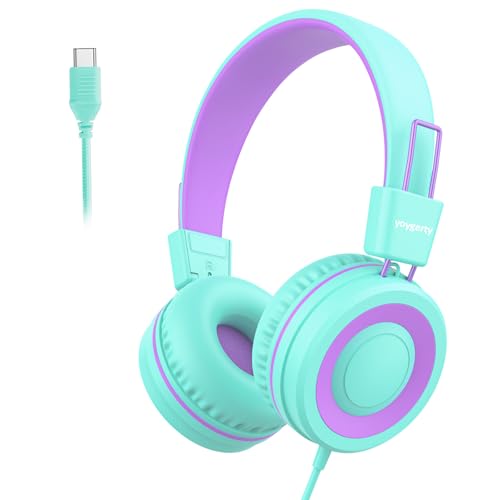
The remaining selected products are made specifically for children. That matters because an adjustable headband, softer cushions, foldability, and volume limiting can be more useful than advanced audio terminology. The yoygerty model offers child-focused fit and portability, but its supplied evidence does not list a limiter or microphone.
Check USB-C compatibility carefully
A wired USB-C headset does not need battery charging or Bluetooth pairing. That is a practical advantage for schoolwork, calls, travel, and gaming when the source device supports USB-C audio. JBL lists compatibility with USB-C PCs, phones, tablets, laptops, and gaming devices. Audio-Technica specifically mentions iOS and Android, while Kensington lists Windows, macOS, iOS, Android, and Chrome OS. These claims are still device-dependent: USB-C ports can differ in their audio support.
Some products use a direct USB-C cable, while NUBWO includes USB-C and 3.5mm connectivity. An adapter can be useful, but it may add another part to carry and does not necessarily mean the headphone itself has a USB-C audio connection.
Compare controls and microphones
For calls, online classes, and gaming chat, look for a documented microphone and control scheme. JBL’s three-button remote handles volume, playback, calls, and EQ presets. Audio-Technica lists play, pause, track, volume, and call functions. JVC describes a microphone and inline remote with volume and mute functions.
The control experience is less fully documented on the kids’ models. Bulktech lists a one-button controller, while several children’s models focus on listening and fit without specifying media controls. Do not assume that every USB-C cable includes a microphone, mute function, or track controls; use the listing evidence as the deciding factor.
Consider fit, comfort, and storage
On-ear headphones rest on the ears rather than surrounding them. Adjustable headbands and rotatable earcups can help with fit, especially for shared devices or growing children. Soft cushions are documented on the JBL, JVC, Kensington, Cowyawn, and other selected models.
Portability is not only about weight. A flat-folding hinge, tangle-free cable, or braided cord can make daily storage easier. Audio-Technica lists a weight of approximately 0.the current price, while JVC lists approximately 0.the current price and describes a single-sided tangle-free cable. Kensington’s six-foot cord can be convenient at a workstation but may be less tidy in a small travel bag. Use the documented dimensions and cable details to match the headphone to its normal setting.
Understand volume-limit claims
A volume limiter is a specialized feature, not a guarantee of safe listening in every situation. Kensington lists a 94dB maximum level. Volume can still depend on the source device, content, fit, and listening duration. Parents and educators should review device settings and listening habits as well as the headphone specification.
Methodology
This is a specification-based comparison using the supplied public listing data. The editorial criteria assess USB-C audio compatibility, on-ear design, controls and calls, comfort and portability, and specialized features such as volume limits or dual connectors. Products were selected only when their titles, features, and specifications together supported the requested category. No hands-on testing, customer sentiment, ratings, current listing information, popularity signals, or marketplace labels were used in the published scores.
Final Recommendation
JBL Tune 530C ranks first overall in this specification-based comparison under the published weighted criteria.
The final choice among the best usb-c on-ear headphones depends on the documented features that match your intended use.
JBL Tune 530C is the highest-scoring returned product and the first overall specification-based choice. Among the top usb-c on-ear headphones, it offers an unusually complete mix of Hi-Res audio support, EQ presets, microphone and three-button controls, soft on-ear cups, fold-flat storage, and a tangle-free cable. Audio-Technica ATH-S120C-BK is a better fit for shoppers prioritizing a lightweight fold-flat design, while JVC HAS33UCB is well suited to work calls and extended desk sessions.
Kensington is a practical family or school choice when a six-foot cord and 94dB limiter are useful. Buyers choosing any model should verify USB-C audio support on the destination device before purchase.
Frequently Asked Questions
Are the best usb-c on-ear headphones compatible with every USB-C port?
No. A USB-C port may support charging, data, audio, or a combination of functions. The supplied listings specifically note that some devices must support USB-C audio output and that a charging port is not necessarily compatible. Check the device manufacturer’s specifications before buying.
Do USB-C wired headphones need charging?
The selected products are wired designs and their listings do not describe battery charging or Bluetooth pairing as necessary. They draw their operating connection from the compatible device, but the device still needs to support USB-C audio.
Which selected model is best for children?
Bywulanda and Cowyawn also list 94dB limits, while yoygerty emphasizes adjustable fit and portability without listing a limiter.
What should I prioritize for online calls?
Choose a model that explicitly lists a microphone and controls. JVC adds a mute function, while JBL and Audio-Technica provide more detailed playback and call controls.
Is an on-ear design more portable than an over-ear design?
It can be, but portability depends on the specific construction. Several selected on-ear models fold flat, and some list lightweight materials or tangle-free cables. Compare the documented hinges, cable, weight, and dimensions rather than assuming every on-ear headphone has the same travel profile.