Buying Guide
Choosing among the best vented hard hats starts with the work environment, not the appearance of the shell. Public listings show meaningful differences in protection type, vent control, brim coverage, suspension, and accessory compatibility. This comparison is specification-based: it does not represent hands-on testing, independent certification verification, or customer-opinion analysis. Always confirm that the selected helmet matches your employer’s policy and the hazards identified for your job.
Match the protection type to the work
The first decision is the documented protection class and type. Most of the selected models list Type 1 Class C protection. Type 1 is intended for impacts from above, while Class C is the nonconductive classification commonly associated with vented hard hats. That does not mean every vented model is interchangeable for every electrical or industrial task. The 3M H-701SFV-UV, Ergodyne Skullerz 8973, Ergodyne Skullerz 8968, and Evolution Deluxe 6161 are examples of Type 1 designs in this list.
Type 2 is a different consideration because the listing documents protection from top, front, back, and side impacts. Klein Tools 60565 and SAFEBUILDER G2C are the selected Type 2 examples. Klein Tools 60565 is especially suited to at-height and confined-space applications because its listing combines Type 2 coverage with a chin strap and six-point suspension. SAFEBUILDER G2C also lists an EPS liner, chin strap, and rescue-oriented applications. Neither should be treated as universally superior; the right choice depends on the hazard assessment and required standard.
Also pay attention to the exact standard language. Some listings cite ANSI Z89.1-2014 or the R2019 revision, while Evolution Deluxe 6161 cites ANSI/ISEA Z89.1-2009. The standards reference is important when a workplace specifies a particular edition or certification marking. Product listings are not a substitute for checking the physical label and current employer requirements.
Decide whether you need adjustable or always-open vents
Venting can be either adjustable or always open. Adjustable systems appear on Klein Tools 60407RL, Klein Tools 60626, Klein Tools 60864BR, Klein Tools 60516, and SAFEBUILDER G2C. Adjustable vents let the wearer change airflow, and some listings specifically describe opening or closing them for changing weather. This can be useful when moving between hot outdoor work and cooler indoor or enclosed areas.
Always-open ventilation is a simpler approach. Ergodyne Skullerz 8968 documents always-open venting, while Ergodyne Skullerz 8973 describes adjustable venting. A fixed open design may be attractive when uncomplicated airflow is the priority, but it may provide less control in rain or dusty conditions. Conversely, closing vents can reduce airflow, so the wearer should use the adjustment in a way that remains appropriate for the environment and the manufacturer’s instructions.
The vent count or location also varies. Klein Tools 60864BR lists vents on the top, front, back, and sides, while SAFEBUILDER G2C describes five vents on each side. These details indicate how the manufacturer approaches airflow, but they do not establish a measured cooling performance comparison.
Choose cap-style, full-brim, or helmet-style coverage
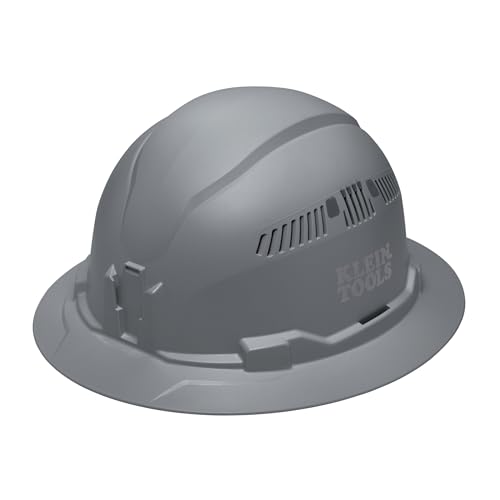
Cap-style hard hats, such as the 3M H-701SFV-UV, generally have a bill at the front and may be preferred for a lower-profile feel or compatibility with cap-attached accessories. Full-brim designs extend around the shell. Klein Tools 60407RL, Klein Tools 60626, Klein Tools 60864BR, Ergodyne Skullerz 8973, Ergodyne Skullerz 8968, and Evolution Deluxe 6161 document full-brim construction or coverage. Their listings describe protection from sun, glare, rain, or weather, depending on the model.
A full brim can be useful for outdoor construction, but it can also change how the helmet fits around other equipment. Check clearance with face shields, hearing protection, headlamps, and other required gear. Helmet-style products such as Klein Tools 60516 and Klein Tools 60565 use a different profile and may suit users who prefer a safety-helmet format, particularly when a chin strap is important.
Compare suspension and adjustment details
Suspension determines how the shell sits on the head and how easily it can be adjusted. Six-point systems appear on Klein Tools 60565, Ergodyne Skullerz 8968, and Evolution Deluxe 6161. Klein Tools 60565 lists a six-point suspension, while Ergodyne Skullerz 8968 specifies 36 ratchet adjustment points. Evolution Deluxe 6161 adds three-dimensional adjustment through harness-depth settings.
Four-point systems can still be useful when they fit the wearer and meet the job’s requirements. SAFEBUILDER G2C lists four-point suspension. A chin strap can add stability for work involving bending, climbing, rescue, or head movement. Klein Tools 60565 and SAFEBUILDER G2C both document chin straps, while Klein Tools 60516 lists a removable chin strap.
Look for a ratchet that can be adjusted while wearing gloves if that is relevant to your work. Klein Tools 60407RL and Klein Tools 60626 specifically describe one-handed adjustment with a large knob. Ergodyne Skullerz 8973 also lists one-handed adjustment.
Consider comfort and maintenance features
Comfort claims should be tied to documented features rather than assumed performance. Washable sweatbands and pads appear on Klein Tools 60407RL, Klein Tools 60626, Klein Tools 60516, Klein Tools 60565, 3M H-701SFV-UV, Ergodyne Skullerz 8973, and Ergodyne Skullerz 8968. These features may make routine cleaning easier, particularly for helmets used across long shifts or by multiple workers under a documented replacement and hygiene program.
Suspension style also affects the fit experience. Flexible open-frame systems are documented on several Klein Tools and Ergodyne models. The 3M SecureFit system is described as flexing and self-adjusting to the wearer’s head, with two height positions. These are useful specification differences, but fit remains personal. Try the helmet with the eyewear, hearing protection, hood, or other equipment used on the job.
Plan the accessory setup before buying
Accessory compatibility can determine whether a hard hat works with the rest of your PPE. Klein Tools 60407RL, Klein Tools 60626, Klein Tools 60864BR, Klein Tools 60516, and Klein Tools 60565 list front and rear mounts or universal slots for items such as headlamps, face shields, and hearing protection. The 3M H-701SFV-UV lists compatibility with 3M hearing, communication, and faceshield accessories. Ergodyne Skullerz 8973 lists headlamp slots and accessory mounting locations.
Check whether the accessory is included or merely compatible. Klein Tools 60407RL specifically includes a rechargeable headlamp, while several other products only document mounts or slots. Also verify that adding equipment does not interfere with the suspension, brim, chin strap, or required clearance.
Final recommendation
Klein Tools 60565 Type 2 Vented Safety Helmet ranks first overall in this specification-based comparison under the published weighted criteria.
Klein Tools 60565 is the highest-scoring returned product and the first overall specification-based choice among the best vented hard hats. Its documented Type 2 Class C protection, adjustable vents, six-point suspension, chin strap, washable pads, and accessory mounts give it a broad feature set for demanding work.
The top vented hard hats are not identical, so the best alternative depends on priorities. Choose Klein Tools 60407RL for adjustable airflow, full-brim coverage, and an included rechargeable headlamp. Choose Klein Tools 60626 for a full-brim accessory-ready design without the included light. The 3M H-701SFV-UV is the lighter cap-style option, while Ergodyne Skullerz 8968 emphasizes six-point adjustment and always-open airflow. For documented Type 2 coverage in a rescue-oriented format, SAFEBUILDER G2C is a practical alternative.
Before purchase, confirm the required ANSI classification, type, brim style, head-size range, accessory compatibility, and replacement policy. Ventilation is valuable, but it should be considered together with the complete PPE system and the conditions where the helmet will be used.
Frequently Asked Questions
Among the best vented hard hats, are vented hard hats suitable for electrical work?
The selected products are primarily listed as Class C, which is a nonconductive classification. Vented designs commonly use Class C because openings can affect electrical protection requirements. Do not assume that any vented helmet is appropriate for electrical hazards. Check the helmet label, employer rules, and the required protection class before use. If the task requires Class G or Class E protection, a listed Class C model may not be suitable.
What is the difference between Type 1 and Type 2 hard hats?
Type 1 protection is generally described around impacts from above. Type 2 products in this comparison document additional front, back, and side impact coverage. Klein Tools 60565 and SAFEBUILDER G2C are the selected Type 2 examples. The correct type depends on the worksite hazard assessment, not on ventilation alone.
Are full-brim hard hats better than cap-style models?
Neither style is automatically better for every task. Full-brim models such as Klein Tools 60407RL and Ergodyne Skullerz 8973 document broader sun and rain coverage, while the 3M H-701SFV-UV uses a cap-style profile. Select the style that fits the required protection, weather exposure, accessories, and clearance around other PPE.
Should I choose adjustable vents or always-open vents?
Adjustable vents provide more control when conditions change. Always-open ventilation, documented on Ergodyne Skullerz 8968, offers a simpler airflow design but may provide less control in rain or dusty areas. Review the manufacturer’s instructions and choose based on the actual environment rather than assuming that more airflow always means better protection or comfort.
How should a vented hard hat fit?
The suspension should sit securely and comfortably without relying on an excessively tight ratchet. Check the listed head-size range and test the fit with the accessories you will wear. A chin strap may be useful for work involving climbing, bending, rescue, or substantial head movement. Replace or maintain suspension components according to the manufacturer and workplace policy.