Buying Guide
The best lightweight hard hats are not necessarily the models with the smallest number in a listing. A useful comparison should consider the complete wearing system: shell, suspension, pads, chin strap, brim, and any included accessories. Public listing weights also vary in how they are measured, so treat them as a comparison signal rather than a substitute for checking the manufacturer’s current documentation.
Start with the required protection class
First identify the protection class required by the employer, site, or safety program. The selected products include Class C, Class G, and Class E examples. Class C models are commonly presented with venting and general-purpose use, while the Klein 60345 is a non-vented Class E model with a stated test level up to 20 kV. Do not select a helmet only because it is light if its class or impact type does not match the work.
The comparison also includes Type 1 and Type II designs. Type 1 models are described for top-impact protection. The SAFEBUILDER G2C is listed as Type II and includes an EPS liner, making it the relevant selected example when the work specification calls for broader side-impact coverage. Certification language should be checked against the current label and workplace requirements before use.
Compare cap-style and full-brim designs
Cap-style helmets generally have a shorter front profile and can be convenient where overhead clearance or accessory placement matters. The 3M H-701SFV-UV is a vented cap-style option with a 50-64 cm fit range and accessory compatibility. The Ridgeline HP44110V is another simple vented cap-style choice with a low listed weight.
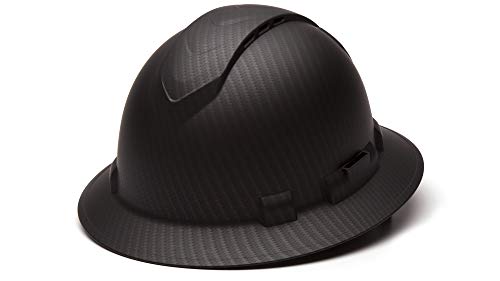
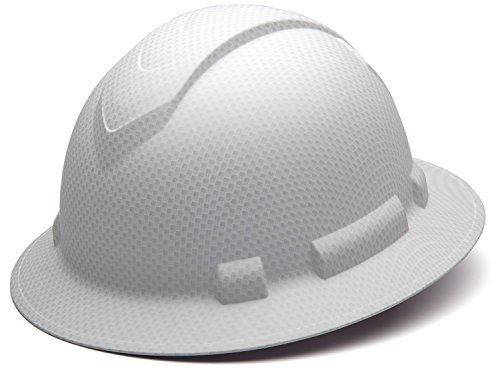
Full-brim models extend coverage around more of the shell. That can be useful for outdoor work where sun and rain are concerns. The Pyramex SL Series, Pyramex HP54116, Klein 60407RL, LANON LH666BW, and AFP HHA4782 all document full-brim designs. A wider brim can affect clearance, accessory placement, and the way the helmet feels during movement, so compare the design with the job rather than assuming one profile is universally better.
Check the suspension and adjustment range
Suspension determines how the shell sits and how easily the fit can be adjusted. The 3M system uses pressure-diffusion technology and offers two height adjustments. The Klein models use a flexible open-frame suspension, while the SAFEBUILDER G2C specifies four-point suspension and a 52-63 cm range. The AFP model uses six-point ratchet suspension, and the Pyramex HP54116 can be converted from four points to six points.
A ratchet is useful when adjustments must be made while wearing gloves, but the listing does not establish that every ratchet is equally easy to operate. Look for a size range that includes the intended wearer, then verify that the suspension is installed and adjusted according to the manufacturer’s instructions. Replaceable brow pads and suspension parts, noted for some Pyramex models, may also matter for maintenance.
Decide whether ventilation is appropriate
Venting can improve airflow, but it should be considered together with the required protection class and the working environment. The 3M H-701SFV-UV, Klein 60407RL, and Pyramex vented models document airflow-oriented designs. The SAFEBUILDER G2C describes multiple side vents and adjustable ventilation. By contrast, the Klein 60345 is non-vented, a feature that aligns with its listed Class E configuration.
Do not treat venting as an automatic comfort guarantee. The supplied data describes design features, not measured temperature reduction or hands-on comfort. Sweatbands, top pads, washable liners, and moisture-wicking materials are more useful evidence when comparing comfort features, but individual fit still matters.
Consider accessories and lighting
Accessory compatibility can reduce the need for straps or separate mounting solutions. The 3M model is described as compatible with cap-attached hearing protection, communication products, faceshields, and other accessories. Klein’s selected helmets have accessory mounts or universal side slots for lamps, hearing protection, and faceshields. The 3M listing also describes a front headlamp-clip arrangement, while the Klein 60407RL includes a rechargeable headlamp.
Included equipment adds capability but may also add weight, bulk, and another component to maintain. If lighting is not needed, a basic helmet may be simpler. If hands-free illumination is important, compare the mounting method and whether the light is included or optional.
Verify fit, labeling, and replacement needs
Before buying, confirm the size range, suspension configuration, certification markings, and whether a chinstrap or accessory is included. Listing information can differ by color or variant, and a marketplace page may not show every label detail. Replace a helmet after a damaging impact or when the manufacturer’s service guidance calls for replacement. A model described as lightweight is still protective equipment that must be used and maintained as directed.
Final recommendation
3M SecureFit H-701SFV-UV Vented Hard Hat ranks first overall in this specification-based comparison under the published weighted criteria.
The 3M SecureFit H-701SFV-UV is the first overall specification-based choice among these best lightweight hard hats because it combines a low listed weight, self-adjusting fit, washable sweatband, ventilation, and accessory compatibility. The SAFEBUILDER G2C is the stronger alternative when Type II coverage and a chin-strap-oriented work-at-height setup are priorities. For full-brim coverage, the Pyramex SL Series and AFP HHA4782 offer useful combinations of low listed weight, ratchet adjustment, and documented protection details.
Among the top lightweight hard hats, the Klein 60345 stands apart for its non-vented Class E configuration, while the Klein 60407RL is the practical lighting-focused choice. The Ridgeline options emphasize low listed weight, the LANON emphasizes FRP construction, and the Pyramex HP54116 offers suspension-conversion flexibility. Match the final selection to the required class, impact type, fit, and accessories rather than relying on weight alone.
Frequently Asked Questions
Which of these best lightweight hard hats has the lowest listed weight?
The Pyramex Ridgeline HP44110V, Pyramex Ridgeline Full Brim HP54117V, and Pyramex SL Series HP24110 each list an item weight of about 0.the current price. The figures come from public product listings and should be confirmed against the current manufacturer or seller information.
Are vented hard hats suitable for electrical work?
Suitability depends on the required protection class and the specific helmet’s certification. The selected 3M and vented Pyramex models are listed with Class C configurations, while the Klein 60345 is a non-vented Class E model. Follow the employer’s safety requirements and verify the helmet label before electrical work.
Is a full-brim hard hat better than a cap-style hard hat?
Neither design is universally better. Full-brim models such as the AFP HHA4782 and Pyramex SL Series provide a broader brim profile for the uses described in their listings. Cap-style models such as the 3M H-701SFV-UV may suit workers who prefer a shorter front profile. Choose according to clearance, weather exposure, accessories, and required protection.
What is the difference between Type 1 and Type II hard hats?
The listings describe Type 1 helmets in relation to top-impact protection. The SAFEBUILDER G2C is listed as Type II and is presented with broader side-impact coverage. Always check the exact standard marking and workplace specification because the appropriate type depends on the hazards identified for the job.
Should I choose the lightest helmet available?
Not automatically. Weight is only one factor. A correct fit, required protection class, suspension, brim style, ventilation, and accessory compatibility are also important. A slightly heavier model may be the more suitable choice if it provides the certification or worksite features the job requires.