Buying Guide
Choosing the best warm led bulbs starts with more than the word “warm” in a product title. Color temperature, brightness, socket type, dimming behavior, and bulb shape determine whether a lamp feels comfortable, useful, and compatible with the fixture. The products above are compared from supplied listing specifications rather than hands-on testing or customer opinion.
Choose the right color temperature
Kelvin (K) is the clearest way to compare warmth. Lower numbers produce more yellow or amber light, while higher numbers look whiter and cooler. The 2700K bulbs from GE, Linkind, Sylvania, Ascher, and evelor are conventional warm-white choices for bedrooms, living rooms, dining rooms, and lamps. They generally provide a familiar incandescent-like atmosphere while retaining useful room brightness.
A 3000K bulb, such as Consciot or Energetic, is still warm white but usually appears less yellow. That can be useful in kitchens, home offices, or rooms where you want a welcoming tone without a strongly amber cast. The 2000K Philips bulb and 1800K mfxmf bulb are specialty options. Their deeper amber appearance suits accent lighting and evening use, but it may not provide the neutral color needed for reading, food preparation, or detailed tasks.
Match brightness to the fixture
For general-purpose lighting, 750 to 800 lumens is the most common documented range in this selection. GE, Linkind, Sylvania, Consciot, and DE? No unselected products should be named; among selected products, Linkind, Sylvania, and Consciot document 800 lumens, while Ascher lists 750 lumens and Energetic lists 760 lumens. These outputs are appropriate starting points for many table lamps, floor lamps, and ordinary ceiling fixtures.
The evelor 100W-equivalent bulb is the high-output choice, listing 1,500 lumens. It can make sense in a larger room or a fixture designed for a brighter lamp, but users should check the fixture’s maximum wattage and physical clearance. More light is not automatically better in a small bedside lamp. Conversely, the Philips and mfxmf listings do not provide lumen figures, so they are better considered atmosphere bulbs than predictable replacements for a bright room lamp.
Check base and bulb shape
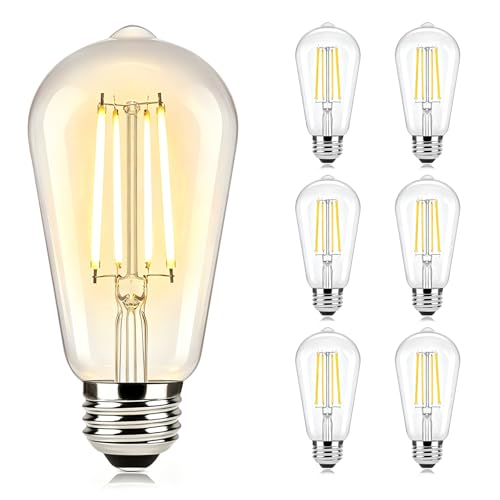
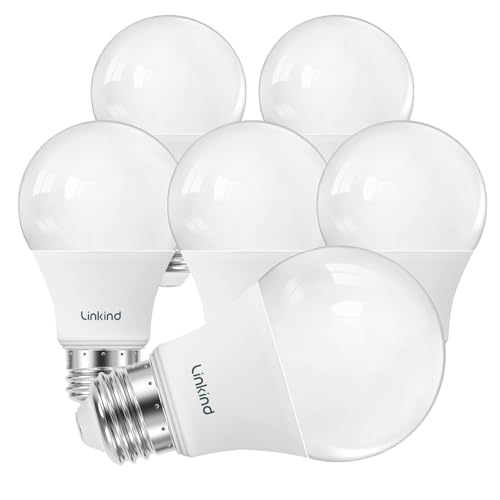
Most selected bulbs use the standard E26 medium base, which fits many common US lamps and household fixtures. Still, the base should be confirmed before ordering because an A19 shape does not guarantee compatibility with every socket or shade. The Ascher, Brightever, and Philips models use decorative visible-glass styling, while the other standard bulbs have a more conventional A19 appearance.
Clear decorative bulbs can enhance chandeliers, pendants, sconces, and open shades. They may be a poor fit when the bulb is hidden behind a small shade or when a frosted, diffuse appearance is preferred. Also check height: the Brightever ST58 listing gives a 5.19-inch height, which is taller than many standard A19 listings. Physical clearance is especially important in ceiling fans, enclosed shades, and compact lamps.
Decide whether dimming matters
Dimming is a major dividing line among the best warm led bulbs. GE, Linkind, Consciot, Brightever, Philips, and mfxmf document dimming support in their listings. Linkind specifies compatibility with most LED dimmers, Consciot specifies TRIAC compatibility, and Brightever states a 10% to 100% range. These details are useful, but compatibility is still dependent on the installed dimmer and fixture.
Non-dimmable bulbs can be a better fit for simple on-off circuits. Sylvania, Ascher, Energetic, and the 100W-equivalent evelor model are documented as non-dimmable or described without dimming support. Do not install a non-dimmable bulb on a dimmer-controlled circuit unless the listing and fixture instructions explicitly allow it. Consciot also states that smart dimmers are not compatible, so that model should be reserved for a suitable traditional control.
Compare efficiency and replacement intervals
LED bulbs use less power than their incandescent equivalents, but wattage and claimed replacement ratings vary. Selected 60W-equivalent models use between 6 and 10 watts, while the 100W-equivalent evelor uses 13 watts. The listing data also gives stated lifespans ranging from 10,000 hours to more than 25,000 hours. These are manufacturer or listing claims, not independently verified results, so they are best used for comparison rather than as a guarantee.
A longer stated lifespan may reduce how often a bulb needs to be replaced, which matters in high ceilings, grouped fixtures, or hard-to-reach lamps. Warranty terms also differ, including five years for GE, three years for Sylvania and Philips, and two years for Linkind and Consciot. Review the seller’s current eligibility and regional restrictions as well; some listings specifically exclude shipment to California.
Consider color rendering and visible design
Color rendering matters when you want furnishings, artwork, clothing, or food to appear more natural. Brightever documents a 90+ CRI, while several other selected models list CRI 80 or 80+. That does not make a CRI 80 bulb unsuitable for ordinary home lighting, but Brightever has the clearest advantage for decorative spaces where color appearance is a priority.
Visible filament bulbs are primarily a design decision. Ascher and Brightever provide Edison-inspired clear-glass appearances, and Philips uses a vintage spiral amber design. Frosted bulbs such as Sylvania diffuse the light and look more traditional. Choose based on whether the bulb will be seen, not only on its color temperature.
Final recommendation
Brightever Vintage Edison ST58 2700K Bulbs ranks first overall in this specification-based comparison under the published weighted criteria.
Brightever Vintage Edison ST58 2700K Bulbs is the first overall specification-based choice among these best warm led bulbs. It documents the most specification-aligned combination of high CRI, 850-lumen output, dimming range, 360-degree coverage, E26 compatibility, and a long stated lifespan. Its decorative shape makes it especially suitable for visible fixtures.
For a conventional household bulb, GE Relax 60W Equivalent Soft White A19 is the more familiar fit, with 800 lumens, dimming support, and a standard A19 profile. Linkind is another strong everyday option when an exact 2700K specification and smooth dimming are important. Choose evelor 100W Equivalent when brightness is the priority, or select Philips and mfxmf for deeper amber accent lighting. These are the top warm led bulbs here because each serves a documented use case rather than relying on a single generic warmth claim.
Frequently Asked Questions
Among the best warm led bulbs, what color temperature should I choose for warm room lighting?
A 2700K bulb is the most broadly useful starting point for warm room lighting. It is documented by GE, Linkind, Sylvania, Ascher, and evelor and is suited to bedrooms, living rooms, dining rooms, and many lamps. Choose 3000K when you want a warmer-than-neutral appearance with a somewhat whiter tone. Consider 1800K to 2000K only when a strong amber or evening accent effect is intended.
Are warm LED bulbs dimmable?
Some are and some are not. GE, Linkind, Consciot, Brightever, Philips, and mfxmf list dimming support, while Sylvania, Ascher, Energetic, and evelor’s 100W-equivalent model are non-dimmable or do not document dimming. Confirm the bulb and dimmer requirements together. Consciot specifically excludes smart dimmers, and Linkind notes that dimmer type can affect flicker behavior.
Is 800 lumens enough for a bedroom or living room?
It can be suitable for many individual lamps and ordinary household fixtures, but the correct output depends on room size, shade design, and how many bulbs the fixture uses. Several selected bulbs list 800 lumens, while the evelor 100W-equivalent model lists 1,500 lumens for applications needing more output. The Philips and mfxmf listings do not state lumens, so they should not be selected when a precise brightness target is essential.
What does E26 mean on a warm LED bulb?
E26 is the standard medium screw base used by many US lamps and household fixtures. It does not describe the bulb’s warmth or brightness. The A19 label describes the common bulb shape used by many selected products. Before buying, compare the base, shape, height, and fixture clearance with the existing bulb, especially when choosing taller decorative designs such as Brightever or Ascher.
Are decorative warm LED bulbs suitable for every fixture?
No. Clear-glass filament bulbs are intended to be seen and may be best in open pendants, chandeliers, sconces, or similar fixtures. A frosted A19 bulb is often a more conventional choice for shaded lamps. Check the fixture instructions, maximum wattage, enclosure requirements, and physical dimensions. The Brightever listing, for example, gives a taller ST58 profile, while the Philips listing emphasizes vintage glass styling rather than a whole-room replacement role.