Buying Guide
The best bi-pin led bulbs are not interchangeable simply because they share two pins. The socket designation, operating voltage, lamp shape, and fixture clearance all matter. This comparison covers G4 and GU5.3 MR16 formats. Treat each as a separate fit category before comparing brightness or efficiency.
Start with the base and voltage
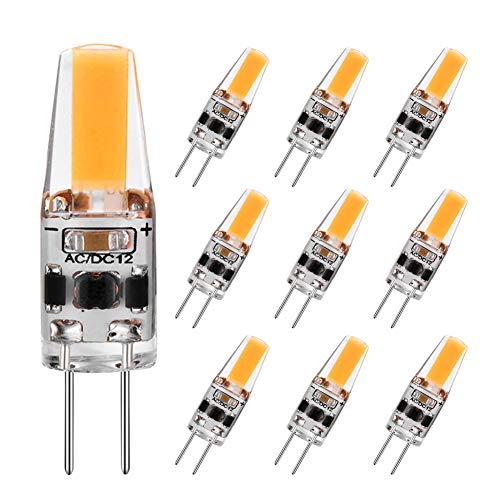
Read the marking on the existing bulb or fixture first. G4 products use a small two-pin base, and many selected examples are designed for 12V AC/DC systems. The Makergroup T3 G4 is unusual because its listing gives an AC10-18V/DC10-30V range. That wider range can be useful in low-voltage landscape projects, but it does not make the bulb suitable for household line voltage.
Most G4 options require a transformer or driver that delivers stable low voltage. BUBO, AIMEOKO, and the selected TAIYALOO G4 models document 12V AC/DC use, while K JINGKELAI lists AC/DC 12V-24V compatibility. A product designed for 12V should not be connected directly to a standard US household circuit. Conversely, the BROLSKUN G4 is explicitly a 110V-130V AC bulb and should not be placed in a 12V-24V fixture.
GU5.3 MR16 products such as Linkind and Feit Electric are low-voltage lamps intended for 12V AC/DC systems. Confirm voltage before purchase.
Match the light pattern to the fixture
A 360-degree beam is useful when the lamp sits inside a puck light, cabinet fixture, decorative socket, or landscape housing that distributes light around the bulb. Several G4 models document all-around coverage, including Makergroup, Gardencoin, BUBO, AIMEOKO, and TAIYALOO’s 2W G4. These patterns are suitable when you want surrounding illumination rather than a defined spot.
MR16 GU5.3 bulbs are a different design. Linkind lists a 40-degree beam angle, making it a focused spotlight for track, recessed, accent, and landscape applications. Feit Electric is also an MR16 product, so its reflector form is intended for directional lighting rather than the broad radial pattern described for several G4 lamps. Choose MR16 when the fixture is designed to aim light at a wall, path, display, or landscape feature.
Output should be considered with beam shape. Gardencoin lists 480 lumens and TAIYALOO’s 5W G4 lists 450 lumens, making them the brighter G4 choices on paper. Linkind lists 640 lumens, but that output is paired with a narrow 40-degree beam. A lower-lumen 360-degree bulb may spread light more broadly, while a higher-lumen spotlight may look brighter on a defined target.
Check dimensions before ordering
LED replacements can be longer or wider than the halogen bulbs they replace. BUBO specifically notes dimensions of 1.46 by 0.51 inches and warns that the bulb is larger than a traditional halogen lamp. Gardencoin lists a 1.65-by-0.67-inch size, and TAIYALOO’s 5W G4 lists dimensions of 1.77 by 0.63 inches. These measurements can matter in enclosed landscape housings, shallow puck lights, and decorative fixtures with narrow openings.
Other G4 products are also approximately 1.4 inches long, including AIMEOKO and TAIYALOO’s 2W model. Compare the selected bulb’s documented dimensions with the socket cavity, cover, and surrounding hardware. Do not assume that a bi-pin base guarantees a physical fit.
GU5.3 MR16 lamps have a reflector form and require a fixture made for that shape. Linkind lists dimensions of about 1.93 by 1.97 inches, while Feit Electric lists about 1.9 by 2.0 inches. Confirm the fixture opening and depth before ordering.
Decide whether dimming is required
Dimming is a system feature, not just a bulb feature. K JINGKELAI G4 is listed as dimmable, and Linkind lists a 10%-100% dimming range with most LED dimmers. These claims still require a matching control and compatible fixture.
Several other selected bulbs are non-dimmable or caution against dimmers. The RAYHOO listings warn that unstable 12V power or a dimmer may cause flicker or noise, and BUBO also calls for stable 12V operation. If a fixture currently uses a dimmer, identify the dimmer type before selecting a replacement. If dimming is unnecessary, a non-dimmable bulb may be the simpler specification match.
Compare color temperature and rendering
The selected bulbs are concentrated in warm-white temperatures. A 2700K product, such as AIMEOKO or Gardencoin, indicates a warmer appearance than a 3000K product such as BUBO, Linkind, or Feit Electric. The supplied listings describe these colors, but this guide does not independently compare appearance in a particular room or landscape.
Color-rendering information can help when the fixture illuminates finishes, plants, food, or decorative objects. K JINGKELAI and AIMEOKO list CRI above 85, while TAIYALOO’s 5W G4 lists CRI 80+. Other selected models list CRI 80 or similar values. These are specification claims rather than independent measurements, so use them as comparison points rather than guarantees.
Consider efficiency and replacement intervals
LED bulbs generally use less wattage than the halogen equivalents named in the listings. Examples include BUBO’s 2W replacement positioning, Gardencoin’s 4W replacement for 40W halogen, and Feit Electric’s 7W replacement for a 50W format. The actual energy result depends on operating hours, transformer losses, and the fixture system.
Stated lifespans vary. AIMEOKO lists more than 35,000 hours, while Makergroup and Gardencoin list 35,000 and 30,000 hours respectively. Linkind lists 25,000 hours, and Feit Electric lists a 22-year lifetime claim. These are manufacturer or listing claims rather than results from hands-on testing. Warranty terms also differ, so review the product listing if warranty coverage matters.
Practical selection checklist
Before choosing among the best bi-pin led bulbs, verify the base type, voltage, bulb dimensions, beam pattern, and dimmer compatibility. Then decide whether you need a warmer 2700K appearance or a slightly less warm 3000K option. For broad G4 illumination, consider Makergroup, Gardencoin, or BUBO. For a high-CRI warm G4, consider AIMEOKO or K JINGKELAI. For a focused MR16 beam, compare Linkind and Feit Electric. Base and voltage checks should override any general preference for brightness or lifespan.
Final Recommendation
Makergroup T3 G4 3W LED Bulbs ranks first overall in this specification-based comparison under the published weighted criteria.
The final choice among the best bi-pin led bulbs depends on the documented features that match your intended use.
Makergroup T3 G4 3W LED Bulbs are the first overall specification-based choice among these top bi-pin led bulbs because they combine a documented wide low-voltage range, 300 lumens, 360-degree coverage, and a 35,000-hour lifespan claim. They are suited to compatible low-voltage G4 landscape installations, not direct household-voltage wiring.
Choose Gardencoin when the priority is the highest listed G4 output and broad 360-degree coverage. TAIYALOO’s 5W G4 is a strong alternative for brighter warm-white landscape lighting with CRI 80+. BUBO is a balanced general-purpose G4 option, while AIMEOKO emphasizes warm color, high listed CRI, and long stated life. K JINGKELAI is the targeted choice when G4 dimming and higher listed CRI are important.
For a GU5.3 MR16 fixture, Linkind is the more flexible directional option because its listing includes a 10%-100% dimming range, while Feit Electric offers a non-dimmable alternative with 550 lumens and a long stated lifetime. Use the appropriate base and voltage for the fixture. Base and voltage checks should override any general preference for brightness or lifespan.
Frequently Asked Questions
What should I check before buying the best bi-pin led bulbs?
Check the base marking, voltage, dimensions, beam pattern, and dimmer requirements. G4 and GU5.3 are different socket formats. Also confirm whether the fixture uses a transformer and whether that transformer supplies the voltage stated by the bulb listing.
Can a G4 LED bulb replace a GU5.3 bulb?
Not based on the two-pin description alone. G4 and GU5.3 have different socket and lamp formats. A G4 bulb should be used in a compatible G4 fixture, while a GU5.3 MR16 belongs in a compatible GU5.3 fixture. Confirm the existing fixture marking before ordering.
Are all of these bulbs suitable for 12V landscape lighting?
No. Many selected G4 and GU5.3 products are listed for 12V AC/DC use, but the BROLSKUN G4 is listed for 110V-130V AC. Voltage must be matched precisely. Makergroup lists a wider low-voltage range, but it is still not a household line-voltage bulb.
Is a 360-degree beam better than an MR16 spotlight beam?
It depends on the fixture and goal. A 360-degree pattern can spread light around a G4-style lamp for cabinet, puck, or landscape applications. Linkind’s MR16 lists a 40-degree beam, which is more targeted for accent or spotlighting. Neither pattern is universally better; choose the one that matches the fixture’s reflector and the area you want to illuminate.
Which selected bulb supports dimming?
K JINGKELAI G4 and Linkind GU5.3 MR16 list dimmable operation. Compatibility with the actual dimmer and fixture still matters. Other selected products are non-dimmable or caution against dimmers, so confirm the listing and existing control system before installation.