Buying Guide
The best spiral led bulbs are not all intended for the same job. Some are decorative Edison-style lamps for exposed sockets, while others are bright utility bulbs with a spiral or corn-style body. Start with the fixture, then choose the light color, output, control features, and physical shape that match the room.
Confirm the socket and available space
Most decorative choices in this comparison use an E26 medium screw base. That includes Austin Coast, Feit Electric, Kiraralite, Philips LED, Lafoy, Leools, and BLINGCOLOR. An E26 base is common in US lamps, pendants, sconces, chandeliers, and ceiling-fan fixtures, but the socket alone does not confirm that the bulb will fit. Compare the bulb’s height and diameter with the shade or cage opening.
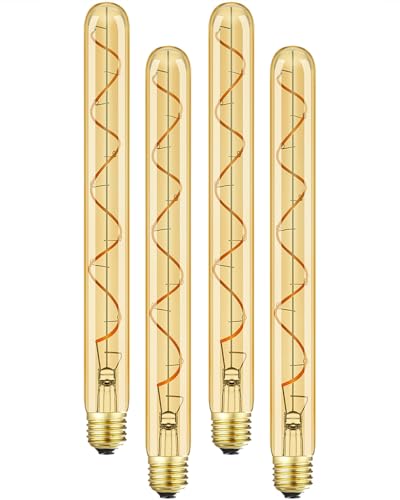
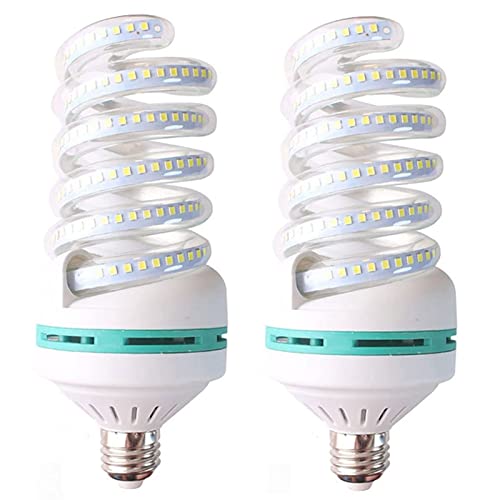
The Leools T10 is 11.8 inches long, so it is a statement bulb for tall or open fixtures rather than a general replacement. The Leools G25 globe is wider than a narrow ST19-style lamp and is aimed at globe applications such as vanities and ceiling fans. Edearkar is also a specialist option: its listed dimensions are about 7.87 inches high and 3.14 inches wide. Its E26/E27 base does not make it physically interchangeable with every decorative fixture.
Choose color temperature for the room
Color temperature strongly changes the appearance of a spiral filament. The warmest selected options are the 2000K Philips bulbs, the 2200K Leools and BLINGCOLOR bulbs, and the 2700K Austin Coast and Lafoy bulbs. These tones are suited to bedrooms, dining areas, accent lamps, hospitality spaces, and vintage décor where a golden glow is desirable.
Feit Electric documents 5000K daylight, while Kiraralite lists 4000K natural white. Those options are better suited to kitchens, bathrooms, offices, or other spaces where a cleaner, more neutral appearance is useful. Edearkar lists 6000K daylight white and targets garages, warehouses, workshops, and similar utility areas. Do not select a daylight bulb simply because it has a high watt-equivalent claim; the color should also suit the room and fixture.
Match lumens to the lighting task
Lumens describe listed light output more directly than incandescent watt equivalence. Austin Coast and Kiraralite each document 600 lumens, while Feit Electric lists 500 lumens. Those outputs can work for general use in smaller fixtures, but the number of bulbs and the fixture shade still affect the result.
BLINGCOLOR and the Philips ST19 each list 400 lumens. Leools G25 also lists 400 lumens, and Lafoy lists 300 lumens. These products are more naturally positioned as accent, ambient, or decorative lighting unless several bulbs are used together. Philips A19 does not provide a lumen figure in the supplied evidence, so brightness should not be assumed from its appearance.
Edearkar is in a different class at a documented 2800 lumens. It is the logical choice among the selected products for a garage, barn, warehouse, or workshop that needs substantial illumination. Its 6000K color and non-dimmable design make it less appropriate for a dining room or mood-lighting installation.
Check dimming requirements
If the fixture is connected to a dimmer, confirm both bulb support and dimmer compatibility. Austin Coast, Feit Electric, Kiraralite, Philips LED ST19, Lafoy, Leools T10, Leools G25, and BLINGCOLOR document dimming in their listings. Austin Coast gives a lowest brightness of 10%, Feit Electric describes a 100% to 10% range, and Leools G25 describes 0% to 100% dimming.
Dimming language is not identical across products. The supplied evidence commonly says compatibility with most dimmers, so the actual wall control and installation still matter. Edearkar is explicitly non-dimmable and should be reserved for a switched circuit unless the product’s documentation says otherwise. Philips A19 documents smooth dimming to warmer tones but does not provide the same output detail as several other products.
Consider efficiency and replacement intervals
LED bulbs generally use less power than comparable incandescent products, but compare the documented wattage and output rather than relying only on a replacement label. Austin Coast lists 6 watts for 600 lumens, Feit Electric lists 5.5 watts for 500 lumens, and BLINGCOLOR lists 6 watts for 400 lumens. Lafoy lists 4 watts for 300 lumens. Edearkar uses 30 watts but provides much higher listed output, so its role is utility illumination rather than low-output accent lighting.
Stated life spans vary. Austin Coast, Kiraralite, Lafoy, and Leools G25 list approximately or up to 25,000 hours. Leools T10 lists up to 20,000 hours, Feit Electric up to 17,000 hours, and Philips ST19 an average of 15,000 hours. Philips A19 does not provide a life figure in the supplied evidence. These are listing specifications, not independent durability tests.
Match the bulb to the fixture’s visual purpose
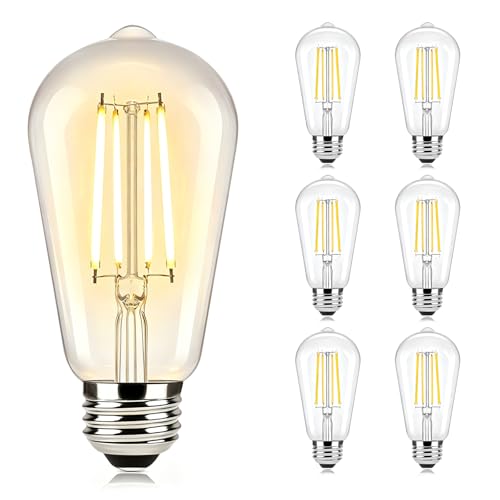
Clear or amber glass and visible filaments are central to the decorative Edison format. The Philips, BLINGCOLOR, Kiraralite, Austin Coast, Lafoy, and Leools products document vintage or antique styling. Use these where the bulb is meant to be seen. A warm 2000K to 2700K bulb can support a softer look, while 4000K or 5000K can make a decorative fixture more functional for work areas.
For a compact lamp, Lafoy’s T45 format may be easier to place than the long tubular Leools T10. For a globe shade, Leools G25 provides the clearest documented match. For a utility fixture, Edearkar’s high-output corn format is more relevant than a 300- or 400-lumen accent bulb. This category therefore has no single ideal shape for every installation.
How this comparison was scored
The editorial ranking uses five category-specific criteria: decorative spiral design and fixture fit, documented brightness and light character, dimming and control, efficiency and stated lifespan, and base compatibility. The weights total 100. Scores use only the supplied feature and specification fields. This is a specification-based comparison, not a hands-on test, and it does not use customer opinions or volatile marketplace information.
Final Recommendation
Austin Coast ST58 Dimmable Spiral Edison Bulb, 4-Pack ranks first overall in this specification-based comparison under the published weighted criteria.
The final choice among the best spiral led bulbs depends on the documented features that match your intended use.
Austin Coast ST58 Dimmable Spiral Edison Bulb is the first overall specification-based choice among the selected products. Its 2700K warm white color, 600-lumen output, E26 base, dimming down to 10%, and stated 25,000-hour average life give it the most balanced profile for common decorative installations. It is a particularly sensible starting point for a chandelier, pendant, wall sconce, or exposed socket where the spiral filament is part of the look.
The top spiral led bulbs for a different room may be better served by another specialist. Choose Feit Electric for 5000K daylight, Kiraralite for a six-bulb 4000K set, BLINGCOLOR or Philips LED ST19 for amber accent lighting, and Leools G25 for a globe fixture. Lafoy is a lower-output ambient option, while Edearkar is the high-output utility choice. Check dimensions, socket type, dimmer compatibility, and color temperature before ordering.
Frequently Asked Questions
What are the best spiral led bulbs for a warm decorative room?
Austin Coast, Lafoy, BLINGCOLOR, Philips LED ST19, Philips A19, and the Leools options document warm or amber color temperatures from 2000K to 2700K. Austin Coast offers the most specification-aligned listed balance of warmth, output, dimming, and E26 compatibility. For a deeper amber appearance, consider a documented 2000K or 2200K option such as Philips LED ST19 or BLINGCOLOR.
Are these spiral bulbs dimmable?
Most selected decorative bulbs document dimming, including Austin Coast, Feit Electric, Kiraralite, Philips LED ST19, Lafoy, Leools T10, Leools G25, and BLINGCOLOR. The claimed dimming ranges differ, and compatibility is commonly stated as applying to most dimmers. Edearkar is explicitly non-dimmable. Confirm the bulb and dimmer requirements together before installation.
Which selected bulb is brightest?
Edearkar lists 2800 lumens, substantially more than the 300 to 600 lumens documented for most decorative choices. It also uses 30 watts, has a 6000K daylight color, and is intended for garages, warehouses, barns, workshops, and similar spaces. Its size and non-dimmable design make it a poor match for many exposed decorative fixtures.
What base do the decorative bulbs use?
The main decorative selections document an E26 medium screw base. Edearkar lists E26/E27 compatibility. Always compare the bulb base with the fixture socket and check the available height and width. A matching base does not guarantee clearance inside a shade, cage, ceiling fan, or enclosed fitting.
Is a higher watt-equivalent bulb always better?
No. Watt-equivalent language describes an approximate incandescent replacement class, while lumens are the more useful listed measure of light output. A 300- or 400-lumen bulb may be appropriate for ambient décor, whereas a utility area may need the 2800 lumens listed for Edearkar. Color temperature, dimming, shape, and fixture design are also important.