Buying Guide
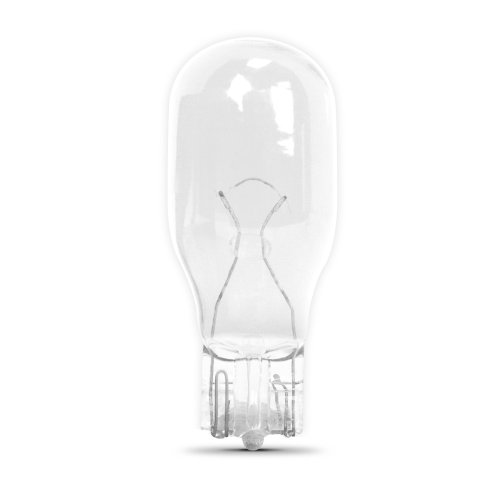
The best wedge incandescent bulbs are selected by fit first, not by appearance alone. A wedge bulb can be intended for a vehicle dashboard, an exterior marker lamp, an RV fixture, or a low-voltage landscape system. Those uses may share a push-in base while requiring different voltage, wattage, physical dimensions, or brightness. Treat the product names in this comparison as specification references, then verify the original bulb and the fixture label before installing a replacement.
Match voltage before wattage
Voltage is the first screening step. The landscape products selected here are generally listed at 12 volts, including the Feit Electric BPLV518/4, Feit Electric BPLV522/4/RP, Diximus DX-11W, Diximus Malibu ML18W4C, PWEOW 7-watt and 4-watt T5 lamps, and the MUQIULIA 0005. The Honoson 5-watt quarter-wedge lamp is also listed at 12 volts. These products belong in a compatible low-voltage circuit, not in a standard household socket.
The CEC Industries 194 and Eiko 40427-10 are listed at 14 volts. That distinction matters for miniature automotive applications. A 14-volt bulb should not be treated as a universal substitute for every 12-volt wedge lamp, even when the base looks similar. Compare the vehicle or equipment specification, and do not infer compatibility from the pack label alone.
Confirm the wedge size and shape
Wedge terminology describes how the lamp connects, but it does not guarantee one universal physical size. The landscape listings use T5 terminology, while the CEC 194 is identified as T3.25 and the Eiko lamp as T3-1/4. Honoson describes its product as a 1/4 wedge base without giving a T-series designation. These distinctions are useful because a bulb can have the right voltage but still be too long, too wide, or shaped differently for the socket and reflector.
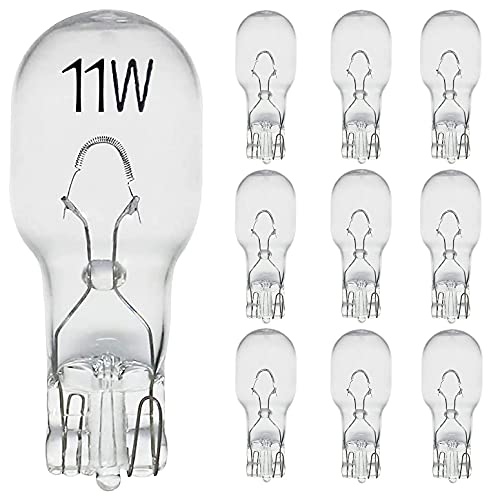
Several listings provide dimensions. Feit Electric gives the BPLV518/4 as approximately 1.5 inches long and 0.6 inches in diameter. PWEOW lists its 7-watt T5 at approximately 1.26 inches long and 0.62 inches wide. The Diximus 4-watt model is listed at about 1.5 inches in height with a 0.62-inch width, while the MUQIULIA 11-watt bulb is listed at approximately 1.42 by 0.62 inches. Use these figures as comparison points rather than assuming that similar T5 labels eliminate the need to measure.
Choose wattage for the fixture
Wattage affects the electrical load and the intended light level. The selected landscape range spans 4 watts, 5 watts, 7 watts, 11 watts, and 18 watts. The PWEOW 4-watt model is the lower-wattage landscape choice, while the Honoson quarter-wedge is a 5-watt option for compact RV, cabinet, deck, and related uses. PWEOW’s 7-watt lamp occupies the middle of the range. The 11-watt products from Diximus, Feit Electric, and MUQIULIA suit fixtures specified for that level, and the 18-watt Feit and Diximus lamps are intended for higher-wattage landscape applications.
Do not increase wattage simply to seek more light. The fixture, transformer, wiring, and socket must support the selected rating. Where a listing supplies lumens, the Diximus 11-watt bulb is listed at 140 lumens and the Diximus 18-watt bulb at 264 lumens. Other products describe light color or general brightness without a lumen figure, so their output should not be assumed to match those numbers.
Consider color and dimming
Incandescent wedge lamps are often chosen for their familiar warm appearance, but the supplied listings use different descriptions. MUQIULIA specifies soft warm-white light, the Diximus listings describe warm-white output, and Feit Electric’s BPLV522/4/RP is identified as 3000K bright white. The CEC and Eiko automotive lamps are listed as clear rather than with a color-temperature number.
Dimming is documented for both Feit products and MUQIULIA. That does not mean every fixture or controller will dim identically; the dimmer and system still need to be compatible. If matching an existing landscape run, color appearance can be as important as wattage, especially when replacing only one failed lamp.
Review life and outdoor construction details
Stated life varies in the evidence. CEC lists 600 life hours for the 194 lamp, Feit lists a 1,000-hour average rated life for the 18-watt BPLV518/4 and up to 1,000 hours for the 11-watt BPLV522/4/RP, and HC Lighting lists 500-plus hours for its 7-watt T5 lamp. Life figures are listing specifications, not independent test results.
For outdoor use, the Diximus products describe encapsulation intended to keep moisture away, while Feit Electric identifies the BPLV518/4 as an outdoor landscape bulb and the BPLV522/4/RP as suitable for damp locations. These statements support application screening, but they do not replace checking the fixture’s own environmental requirements.
Pick a pack size that fits the job
Pack size is a practical consideration when several lamps use the same socket. The 20-packs from Honoson and PWEOW provide more spares for multiple fixtures or future replacements. The 10-packs from CEC, Diximus, MUQIULIA, and Eiko suit larger replacement jobs without requiring a single-bulb purchase. Feit’s four-packs may be appropriate when only a few lamps are needed. Pack quantity does not establish bulb quality, so it should be considered after electrical and dimensional compatibility.
Final Recommendation
CEC Industries 194 14V Glass Wedge, 10-Pack ranks first overall in this specification-based comparison under the published weighted criteria.
CEC Industries 194 14V Glass Wedge, 10-Pack is the first overall specification-based choice among these best wedge incandescent bulbs because its voltage, T3.25 shape, C-2F filament, glass wedge construction, applications, and stated life are unusually well documented. For 12-volt landscape systems, Feit’s BPLV518/4 is the clearest 18-watt option, while Diximus’s 11-watt and 18-watt packs offer useful bulk replacement formats with listed lumen details. PWEOW’s 4-watt and 7-watt T5 lamps cover lower and middle wattage needs, and MUQIULIA is a sensible warm-light alternative. These are top wedge incandescent bulbs only when their electrical and physical specifications match the existing fixture.
Before purchase, read the original bulb marking, measure the lamp if its size is uncertain, and confirm the voltage and wattage on the fixture or transformer. For automotive lamps, cross-reference the bulb number and base designation. For landscape lamps, verify whether the system expects T5 or another wedge format. This approach is more reliable than choosing solely from a photograph or a generic wedge-base description.
Frequently Asked Questions
What should I check before buying the best wedge incandescent bulbs?
Check voltage, wattage, base designation, bulb dimensions, and application. A T5 landscape lamp, a T3-1/4 automotive lamp, and a quarter-wedge RV bulb may all be push-in designs but are not automatically interchangeable. Also compare color description and dimming requirements when appearance matters.
Are 12-volt and 14-volt wedge bulbs interchangeable?
They should not be assumed interchangeable. The selected landscape products are listed at 12 volts, while the CEC Industries 194 and Eiko 40427-10 are listed at 14 volts. Match the replacement to the equipment or vehicle specification and the original lamp marking.
Which selected bulbs are intended for landscape lighting?
Feit Electric BPLV518/4, Feit Electric BPLV522/4/RP, both Diximus landscape products, both PWEOW T5 products, and MUQIULIA are listed for low-voltage or landscape applications. The Honoson 5-watt quarter-wedge bulb also lists landscape use along with RV, automotive, deck, and cabinet applications.
Does a higher wattage always mean a better wedge bulb?
No. Wattage must match the fixture and system. The selected landscape products range from 4 to 18 watts because different fixtures call for different electrical loads and intended output. A higher-rated lamp may be unsuitable even if it physically fits. Where available, use the listing’s lumen information and the fixture’s original specification together.
Are these bulbs tested for real-world life or brightness?
No. This is a specification-based comparison using supplied public listing data. Stated life, lumens, construction, compatibility, and application claims are reported as listing evidence rather than independent measurements or hands-on test results.