Buying Guide
The best wireless bookshelf speakers are powered stereo systems that combine Bluetooth with a built-in amplifier. That means the main decision is not simply whether a model is wireless; it is how well the speaker system fits the sources, room, and control method you already use. Every product selected here is described as a powered or active bookshelf speaker system, so no separate stereo amplifier is required for the listed setup.
Start with the listening space
For a desk, near-field monitors such as the Edifier MR3 can make sense because the listing emphasizes monitoring, video editing, headphone output, balanced TRS input, and app-based sound modes. The MR3 also has a stated 52Hz–40kHz response, but that figure should be treated as a specification rather than a promise of a particular room result.
Larger rooms may benefit from a system with more documented output or a dedicated low-frequency section. The Edifier S355DB uses powered stereo speakers with an 8-inch wireless subwoofer and 150W audio. The ULTIMEA BS-3 instead uses a 5.25-inch woofer, a separate midrange driver, a tweeter, and 70W RMS in its powered bookshelf system. These designs occupy different positions: one adds a separate subwoofer, while the other keeps the three-way speaker arrangement in the main system.
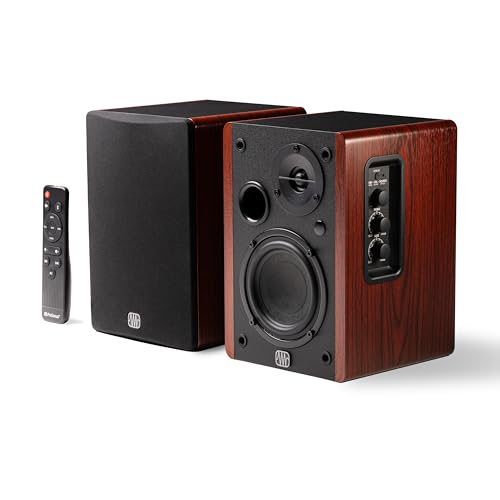
Bluetooth is useful for phones, tablets, and computers, but wired inputs determine whether a speaker can serve as the center of a broader system. For a TV, optical or HDMI ARC can be more direct than analog cabling. The ULTIMEA BS-3 lists HDMI ARC, optical, USB, and RCA. The Edifier R1280DBs lists optical and coaxial inputs, while the PreSonus Eris Accent BT adds USB-C, optical, RCA, AUX, and coaxial connections.
For a turntable, check the turntable’s output type before connecting anything. The Audioengine A5+ listing specifies compatibility with record players that have built-in preamps. The Klipsch R-51PM includes a switchable phono/line input with a ground screw terminal, and the R-40PM lists phono input with a ground screw terminal as well. Other Bluetooth systems may require a line-level signal, an external phono preamp, or a turntable with Bluetooth transmission.
Compare driver layouts
Driver size and layout provide useful context, but they do not independently describe the complete listening result. The Edifier MR3 uses 3.5-inch mid-low drivers and 1-inch tweeters. The PreSonus Eris Accent BT uses a 4-inch woofer and 13mm silk dome tweeter with a stated 2.8kHz crossover. The Klipsch R-40PM uses 4-inch woofers and a 1-inch LTS tweeter with a 90-by-90-degree Tractrix horn.
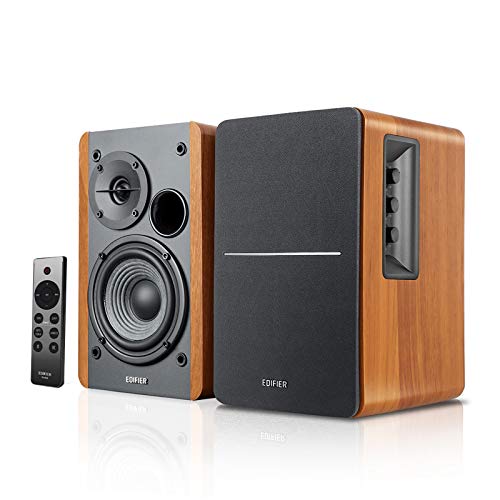
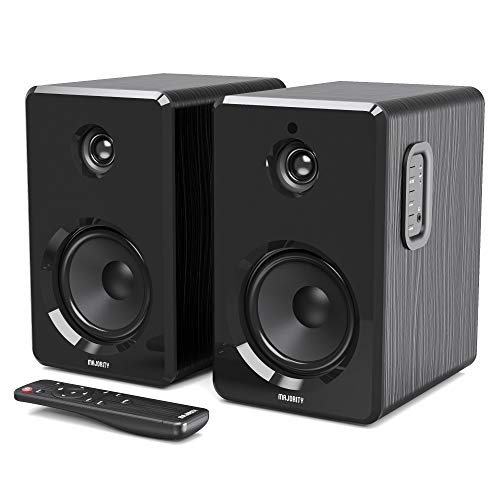
A three-way design divides duties among a woofer, midrange, and tweeter. That is the documented approach in the ULTIMEA BS-3. A 2.1 system takes a different route by placing low-frequency reproduction in a separate subwoofer, as shown by the Edifier S355DB. Conventional two-way pairs remain common: the Audioengine A5+, Edifier R1700BTs, Edifier R1280DBs, and Majority D40 all use listings that describe a woofer or bass driver alongside a tweeter or high-frequency section.
Consider adjustment and control
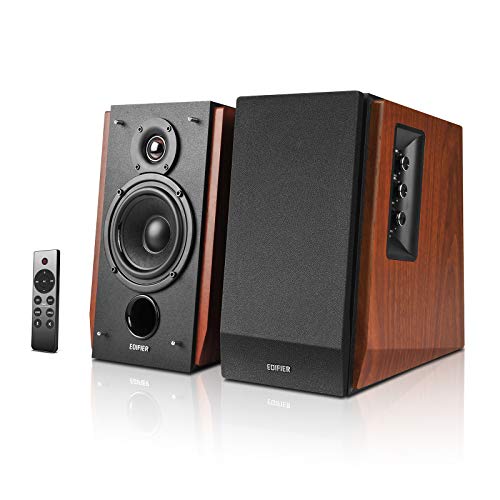
Physical controls are helpful when the speakers serve several sources. The Edifier R1700BTs and R1280DBs include side-panel EQ controls, while the PreSonus Eris Accent BT lists front-panel volume, treble, bass, power, and source controls. The S355DB and BS-3 extend adjustment through an app, with the S355DB offering four sound effects and custom EQ and the BS-3 listing modes for music, movies, games, and daily listening.
A remote can be useful for TV or across-room listening. The PreSonus, Edifier R1700BTs, Edifier R1280DBs, Majority D40, and ULTIMEA BS-3 listings all document remote control. If you mainly listen at a desk, app or front-panel access may matter more than a remote. If the system is connected to a television, remote source switching and volume control may be more practical.
Check expansion options
A subwoofer output lets you expand a two-speaker system later with a compatible powered subwoofer. The Edifier R1700BTs and R1280DBs both list subwoofer outputs with crossover-related functions, while the PreSonus Eris Accent BT and ULTIMEA BS-3 also document sub-out connections. The S355DB already includes a wireless subwoofer, so its design is different from a pair intended for later expansion.
Also check the physical layout. A conventional pair needs space for two cabinets and a connection between them. The S355DB adds a third enclosure, while models such as the MR3 and Majority D40 are described as compact or desktop-friendly. Dimensions vary substantially across the candidates, so compare the supplied measurements with the shelf, desk, or console where the system will sit.
Final recommendation
ULTIMEA BS-3 3-Way Powered Bookshelf Speakers ranks first overall in this specification-based comparison under the published weighted criteria.
The Edifier S355DB is the highest-scoring returned product and the first overall specification-based choice among these best wireless bookshelf speakers. Its 2.1 layout, 8-inch wireless subwoofer, 150W audio, Hi-Res support, multipoint Bluetooth, DSP, app EQ, remote, and physical controls give it the broadest documented feature set.
The ULTIMEA BS-3 is the next choice for a TV-and-music setup because HDMI ARC, three-way drivers, app modes, Bluetooth 6.0, and subwoofer output cover a wide range of sources. Choose the Audioengine A5+ when a simpler, high-powered system with RCA and AUX inputs suits a vinyl or desktop setup. The PreSonus Eris Accent BT is better aligned with creative work and mixed desktop sources, while the Klipsch R-40PM and R-51PM emphasize their distinct horn or phono-and-USB connection designs.
Among the top wireless bookshelf speakers, the Edifier R1700BTs and R1280DBs are practical choices when side-panel EQ, remote control, and subwoofer expansion matter. The MR3 is the most explicitly monitor-oriented option, and the Majority D40 is notable for USB and SD playback. Confirm your source outputs, required digital connections, available placement, and whether a separate subwoofer is appropriate before choosing.
Frequently Asked Questions
Are the best wireless bookshelf speakers completely cable-free?
No. The selected systems use wireless Bluetooth for compatible source devices, but powered speakers still require electrical power. Many also use a cable between the left and right speakers or include wired inputs. The Edifier S355DB adds a wireless subwoofer connection, but its main speakers still form a powered system.
Which selected speakers work with a TV?
Several do, but the connection type differs. The ULTIMEA BS-3 lists HDMI ARC and optical. The Edifier R1280DBs lists optical and coaxial, and the PreSonus Eris Accent BT lists optical, coaxial, USB-C, RCA, and AUX. Check that the TV supports the selected output and use the speaker’s documented input type.
Can I connect a turntable to these speakers?
Yes, when the turntable provides a compatible output. The Audioengine A5+ listing refers to turntables with built-in preamps, while the Klipsch R-51PM and R-40PM list phono inputs with ground terminals. A turntable without a suitable line-level or phono connection may need an external phono preamp.
Do I need a separate amplifier?
Not for the powered models selected here. Their listings describe built-in amplification or powered operation. You may still need source-specific equipment, such as a phono preamp for a turntable without a built-in preamp, or a compatible powered subwoofer when using a sub-out connection.
What is the difference between a two-way, three-way, and 2.1 system?
A two-way speaker divides frequencies between a woofer or bass driver and a tweeter. The ULTIMEA BS-3 lists a woofer, dedicated midrange, and tweeter, making it a three-way design. The Edifier S355DB is a 2.1 system because its powered stereo speakers are paired with a separate subwoofer.