Buying Guide
The best wood soup bowls come down to how a set handles real broth, how solid the build feels, and whether the size matches the soups you actually serve. Below is a practical, specification-based walkthrough of what to weigh before you choose.
Match Capacity to the Soup You Serve Most
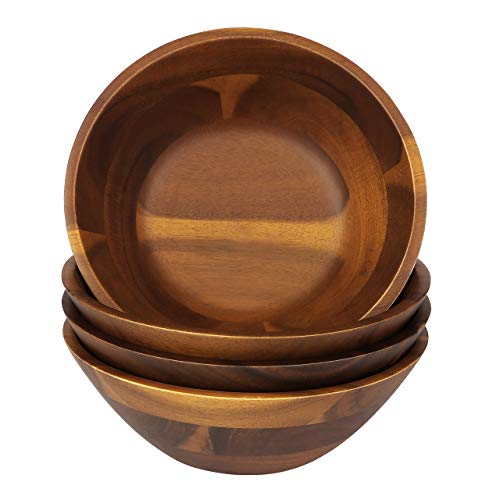
Wood soup bowls sit on a spectrum from shallow 6 to 8 inch plates to deeper 4.5 to 5.5 inch ramen-style bowls. Miso, small rice sides, and dipping portions are comfortable in 3.5 to 4.5 inch bowls such as the Luxshiny and Baluue lidded sets, which keep portion sizes modest. For ramen, pho, and udon, deeper profiles like the Rainforest Bowls teak set at 5.5 by 3.5 inches provide the broth depth that noodles need without spilling. If you mostly plate salads or lighter broths, a wider 7 to 8 inch acacia set such as Wrightmart or Lavaux Designs gives more surface area without the height.
Choose the Right Wood for Durability
Wood species affects both feel and longevity. Teak, used in the Rainforest Bowls ramen set, is widely noted for density and water resistance, which suits boiling soup and frequent washing. Acacia, used by AIDEA, Wrightmart, Lavaux Designs, and the Tioncy small bowl set, offers a harder surface than many softwoods and a varied grain that hides everyday wear.
Look for Food-Safe Finishes and Heat Behavior
Any wood bowl intended for hot soup should have a food-safe finish specified by the maker. Wood naturally insulates, which means the outer wall stays cooler than a ceramic or metal bowl would, but it also means the bowl itself should not go in the microwave or dishwasher. Hand-washing and air-drying keeps the finish intact across years of service.
Decide Whether a Lid Adds Real Value
Lidded designs such as the Baluue, Luxshiny, and PRETYZOOM miso bowls help keep soup and rice warmer at the table and protect against dust and spills between servings. They make the most sense for individual miso or rice service where a cover is part of the traditional presentation.
Think About Set Count and Storage
Smaller two-piece sets like Rainforest Bowls, Baluue, Luxshiny, and BUNNY IN BOX suit couples or singles who want a focused ramen or miso setup.
Care and Long-Term Use
Hand-washing with mild soap, towel-drying, and avoiding prolonged sunlight are the most common care notes across these listings. Oiled acacia sets such as AIDEA may benefit from occasional re-oiling, while coated sets like Lavaux Designs are designed to skip that step. None of the bowls above are rated for microwave, oven, or dishwasher use, so plan for hand care as part of owning any of them.
Final Recommendation
Rainforest Bowls Javanese Teak Ramen Set of 2 ranks first overall in this specification-based comparison under the published weighted criteria.
The final choice among the best wood soup bowls depends on the documented features that match your intended use.
For a specification-based top pick, the Rainforest Bowls Javanese Teak Ramen Set stands out as the first overall choice thanks to its solid teak construction, deep 5.5 inch profile, and rated ability to handle boiling soup alongside everyday durability. Among top wood soup bowls overall, the Wrightmart Solid Acacia Set of 4 and Lavaux Designs Jointless Acacia Set of 4 are strong secondary choices when you want larger, joint-free acacia bowls for shareable servings, while the JapanBargain Set of 4 and AIDEA Acacia Set of 4 work well for families that need multiple matching miso and rice bowls at once.
Frequently Asked Questions
Among the best wood soup bowls, what size wood bowl works best for ramen and pho?
Look for a diameter around 5 to 6 inches with a depth near 3 to 3.5 inches so the broth and noodles both fit comfortably. The Rainforest Bowls teak ramen set at 5.5 by 3.5 inches is a clear example of that shape.
Are wooden bowls safe for hot soup?
Wooden bowls from the listings above are described as food-safe with finishes such as natural oil or plant-based coatings, and several makers specifically rate their bowls for hot service. Always follow the maker’s care notes, which generally include hand-washing only and avoiding microwaves.
How do I clean and maintain wood soup bowls?
Hand-wash with mild soap and warm water, towel-dry promptly, and let them air-dry fully before stacking. Oiled sets like AIDEA may benefit from occasional re-oiling, while coated sets like Lavaux Designs are designed to maintain their finish without extra oil.
Should I choose acacia, teak, or jujube wood for soup bowls?
Teak is dense and water-resistant, which suits daily hot soup use as seen in the Rainforest Bowls set. Acacia offers hardness and varied grain across sets like AIDEA, Wrightmart, Lavaux Designs, and the Tioncy small bowl set.
Do lidded wood bowls actually keep soup warmer?
A fitted lid helps trap steam and slow heat loss between spoonfuls, which is most useful for smaller miso or rice servings like those in the Baluue, Luxshiny, and PRETYZOOM sets. For deep ramen or pho where you eat continuously, a lid is less critical than bowl depth and insulation.