Buying Guide
The best wood staircase handrails are not selected by wood species alone. A useful comparison starts with the staircase layout, the wall structure, the desired grip profile, and how much installation work the project can accommodate. The products above include solid pine, red oak, beech, and multi-section designs, so the right choice depends on the dimensions and finish you need.
Measure the run before choosing a rail
Measure the usable wall line rather than relying only on the stair width. A short rail can work for a small landing, a few steps, or a corridor transition, while a longer rail is more appropriate for a continuous stair run. The BalaHou listing specifies a 10-foot rail in four sections, and the Purife listing identifies a 7-foot option while describing a broader 1-to-10-foot range. These formats can reduce the need to join several unrelated pieces, but longer or sectional rails require careful positioning.
For compact installations, the SELEWARE 36-inch rail and the YEOOE 4-foot model are easier to match to a short wall section.
Compare wood species and finish requirements
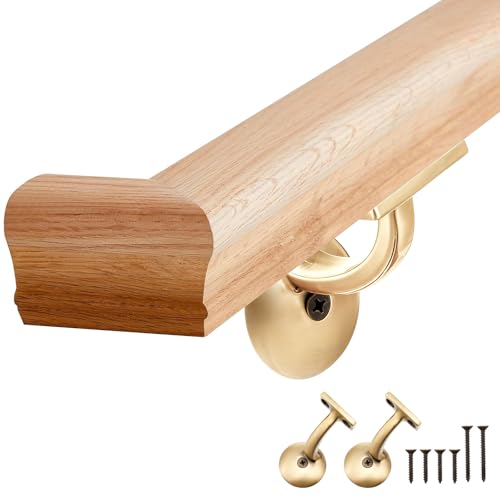
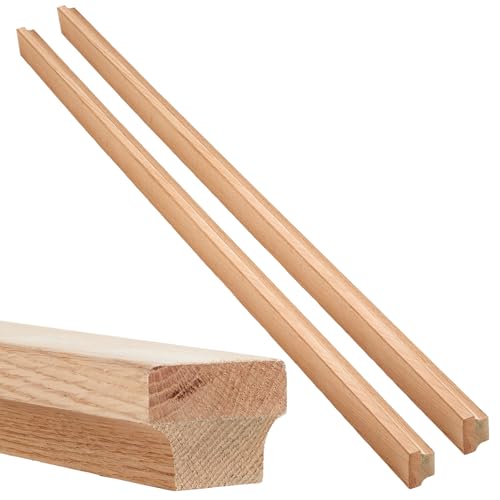
Red oak and beech give shoppers alternatives to pine when appearance and tactile character matter. The Maasechs rail is unfinished red oak, which is useful when you want to stain or coordinate the handrail with existing trim. Its pre-sanded surface can be customized, but finishing becomes part of the project. The CroBlissful two-pack is also red oak, although the listing describes the rails as sanded rather than fully finished.
Several pine products have a coating or painted surface. JuneFanwei describes an environmental-protection coating, while KEPMOGOH describes water-based paint and easy cleaning. BalaHou lists a smooth, durable, water-resistant coating. These statements describe the supplied product specifications; they do not replace checking whether a particular finish is appropriate for your environment. For exterior placement, confirm exposure suitability, fastener compatibility, and local installation requirements.
Choose the grip profile deliberately
Grip shape affects how the rail feels in the hand. The BalaHou handrail uses a half-round design, JuneFanwei describes a semicircular handle, and Henka presents a round or oval profile. The Maasechs product uses a 6010 profile with wall returns, giving it a more traditional architectural appearance. CroBlissful provides listed width and height dimensions that can help shoppers compare its more substantial straight profile with slimmer round rails.
Rounded ends and edges may be useful where hands frequently contact the rail, but the listing language should not be treated as a substitute for checking the finished piece yourself. If a user prefers a continuous rounded grip, start with Purife or Henka. If matching interior millwork is the priority, the Maasechs profile deserves closer attention.
Check brackets, fasteners, and wall structure
Included hardware can simplify planning, but it does not guarantee that the supplied fasteners suit every wall. BalaHou lists stainless steel brackets, screws, and a drill bit. JuneFanwei lists stainless-steel brackets, screws, and a drill. KWDOBUUS includes brackets, expansion screws, and instructions. SELEWARE is distinctive because its black metal brackets are described as already mounted to the rail.
Before drilling, locate suitable studs or use an appropriate wall-anchoring method. Confirm bracket spacing, wall clearance, rail height, and whether the installation is horizontal, inclined, or used in another orientation. That is a reason to verify the exact variant and physical measurements before installation.
Decide between a single piece and sections
Single-piece rails generally avoid a visible joint, while sectional rails may be easier to transport or fit into a long layout. The KWDOBUUS is a two-section, 5-foot rail, BalaHou is supplied in four sections for a 10-foot run, and CroBlissful supplies two separate 6-foot rails. Sectional products can be useful for split stairways or paired runs, but they need accurate alignment and secure support at each mounting point.
A pack is not automatically better than a single rail. CroBlissful’s two-pack is most relevant when two matching rails are needed, yet its listing says mounting hardware is not included. By contrast, a complete kit may reduce parts shopping but still requires checking the wall, anchors, and local code requirements.
Final recommendation
BalaHou 10-Foot Wooden Stair Railing ranks first overall in this specification-based comparison under the published weighted criteria.
BalaHou 10-Foot Wooden Stair Railing is the first overall specification-based choice among these best wood staircase handrails because it combines a long four-section format, rounded grip design, coated pine, stainless-steel mounting components, and a broad indoor application list. It is especially compelling for an extended run where a short single rail would not be enough.
For a more traditional wood appearance, KWDOBUUS offers solid oak, rounded edges, and a complete hardware package. JuneFanwei is a practical compact kit, while Maasechs is the better fit for an unfinished red oak profile that will be stained. Purife is the most flexible choice for shoppers comparing indoor and outdoor placements and multiple documented lengths. Together, these are among the top wood staircase handrails for covering different layouts without treating one material or profile as universally best.
Frequently Asked Questions
What should I measure before buying the best wood staircase handrails?
Measure the wall run, not just the stair tread width. Note the start and end points, corners, landings, desired wall clearance, and locations of studs or suitable anchors. Also check whether the listed rail length is a single piece or multiple sections. BalaHou, KWDOBUUS, and CroBlissful use sectional or multi-piece configurations, so the joint layout matters.
Are wood staircase handrails suitable for outdoor use?
Some selected listings describe indoor and outdoor applications, including Purife, JuneFanwei, YEOOE, KWDOBUUS, and Henka. That description alone does not establish suitability for every climate. Confirm the finish, protect exposed wood as appropriate, use compatible exterior hardware, and follow local requirements for stairs, decks, porches, or ramps.
Is unfinished red oak a good choice for a staircase handrail?
Maasechs documents a solid unfinished red oak rail that is pre-sanded and intended for further customization. It can be a good choice when you want to match a stain or interior trim, but it adds finishing work. CroBlissful also describes red oak rails that are sanded and can be cut to length, while its listing says mounting hardware is not included.
Do included brackets mean installation is complete?
No. Included brackets and screws reduce parts planning but do not confirm compatibility with your wall. Check stud locations, anchor type, bracket spacing, wall clearance, rail height, and the condition of the supplied hardware. Products such as BalaHou, JuneFanwei, KWDOBUUS, and YEOOE list mounting accessories, but the installer remains responsible for selecting a secure installation method.
Which handrail profile is easiest to grip?
That depends on personal preference and hand size. Henka, Purife, JuneFanwei, and BalaHou describe rounded, round, oval, semicircular, or half-round profiles. Maasechs uses a 6010 profile, while CroBlissful lists a straight rectangular-style size. Compare the stated dimensions and edge treatment with the user’s needs rather than assuming one profile fits everyone.