Buying Guide
Choosing among the best workout step platforms starts with matching the platform’s dimensions and adjustment system to the way you plan to train. Public listings show a wide range: some designs are compact and self-storing, while others use long, health-club-size decks. The right choice depends less on a single headline feature and more on how height, grip, surface area, construction, and storage work together.
Choose the right height range
Basic platforms may offer two settings, such as 4 and 6 inches, which can be practical for introductory cardio, strength movements, and general home exercise. The Amazon Basics platform follows this simpler format. Other models provide three levels, commonly 4, 6, and 8 inches. That arrangement appears on the VEVOR, BalanceFrom, ZENY, and Freestyle STEP circuit models.
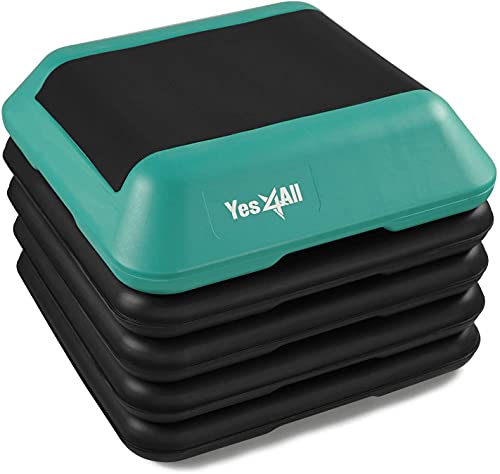
A wider range can be useful when you want more progression. The Reebok platform uses three click-and-lock positions from 5.9 to 9.8 inches, while the Yes4All high step lists five settings from 4 to 12 inches. Higher settings may require more careful control and sufficient room around the platform, so do not select the tallest option solely because it has the largest number. Consider the exercises you can perform comfortably and the clearance available in your room.
Platform length and width affect foot placement and the amount of room available for movements beside or across the deck. They are suited to users who prefer a broad aerobic deck, but their larger footprints can be more demanding to store.
Mid-size choices can offer a compromise. The STOODER platform is listed at 33.5 by 12.8 inches, and the BalanceFrom model at 31 by 11.5 inches. Compact options such as the 18-inch Fitvids and 16-inch Yes4All high step are easier to position in tight spaces, though their smaller surfaces may feel less accommodating for wide movements. Measure the available floor area, including room to step off safely, before ordering.
A textured or nonslip top is a common feature across the selected platforms. Several compact models also document diamond, honeycomb, or circular-textured surfaces. These details can help provide traction, but the listings do not establish performance under every shoe, floor type, or workout intensity.
Look below the platform as well. Rubber or nonskid feet are listed on many models, including Amazon Basics, BalanceFrom, STOODER, and Fitvids. Risers with their own nonskid feet may help keep the assembled platform in place and protect floors.
Compare construction and stated capacity
Construction details vary from high-density polyethylene to ABS and polypropylene. These materials are useful specification differences, but material names alone do not prove long-term performance.
Capacity figures are also listing claims rather than independent test results. Selected products state limits ranging from 275 to the current price. The Reebok listing does not provide a capacity in the supplied specifications, so it should not be compared on that measure. Choose a product whose documented limit fits your intended use without treating the number as a guarantee of every movement.
Plan for storage and portability
Self-storing risers are helpful when the platform will remain in a living room, bedroom, or shared space. Amazon Basics, VEVOR, STOODER, and the compact Fitvids model describe storage beneath or within the platform. STOODER goes further with a folding design, making it especially distinct for apartment storage. Larger platforms may still be worthwhile, but their dimensions and listed weights should be considered before moving them frequently.
Portability can also mean ease of setup rather than just low weight. Detachable or stackable risers let you change the height, but they create separate components unless the design provides a storage solution. Check whether the risers lock, stack, or fit beneath the deck, and keep them together between sessions.
Match the design to your routine
For general cardio and strength work, a conventional adjustable platform such as Reebok, VEVOR, or BalanceFrom provides multiple documented height choices. If resistance-band circuits are part of your plan, the Freestyle STEP circuit model specifically lists a band notch. For high-step progression in a compact format, Yes4All offers the most extensive stated height range. For limited storage, STOODER and the compact Fitvids model document the clearest space-saving designs.
Methodology
The ranking uses only supplied public listing evidence. Scores assess height adjustability, surface grip and floor stability, platform size, construction and stated capacity, and storage and portability. The editorial score does not use ratings, current listing information, purchase activity, marketplace badges, or customer sentiment. This is not a hands-on test; specifications may contain inconsistencies, so notable uncertainty is identified where relevant.
Final Recommendation
Reebok Multipurpose Adjustable Workout Step Platform ranks first overall in this specification-based comparison under the published weighted criteria.
Reebok Multipurpose Adjustable Workout Step Platform is the first overall specification-based choice among these best workout step platforms because it combines three click-and-lock heights, a broad listed deck, a textured surface, visual target zones, and documented multipurpose use. For smaller rooms, STOODER’s folding construction and the compact Fitvids design are easier to organize.
The top workout step platforms are not interchangeable. Select by routine and available space: choose Yes4All for a high adjustment range, Freestyle STEP circuit for its band notch, VEVOR for under-platform riser storage, or BalanceFrom for a longer mid-size deck. Before purchasing, verify the current listing, assembled dimensions, stated capacity, and whether the platform’s height and surface area suit your intended exercises.
Frequently Asked Questions
Beginners may prefer a model with a lower starting height, a nonslip or textured top, and stable feet. Two-height models can be simpler to configure, while three-height designs allow more progression. The Amazon Basics, STOODER, and BalanceFrom listings document lower starting settings and grip-focused features. Start with a height that permits controlled movement and keep the surrounding floor clear.
A wider or longer deck can provide more usable room for stepping and full-body movements, but it also takes more floor and storage space. A compact platform may be more practical if your workout area is limited. Width should be matched to the movements you intend to perform, not treated as an automatic quality measure.
There is no single height that fits every user or routine. Lower settings can be useful for introductory step work, while higher settings increase the vertical challenge and may require more control. The selected products list ranges from 3.5 to 5.5 inches on the compact Fitvids model up to 4 to 12 inches on Yes4All. Follow the supplied adjustment instructions and choose a level that allows stable, controlled movement.
Removable or stackable risers are useful when you want to change intensity or store the platform more easily. They are not essential for every routine, especially if you plan to use one fixed height. Models such as VEVOR and Amazon Basics describe under-platform storage, while STOODER documents built-in riser storage in a folding design. Always ensure the risers are correctly seated before exercising.
Storage depends on both the assembled footprint and how the risers are managed. STOODER documents a folding platform with built-in riser storage. The compact Fitvids model is listed at 18 by 11 inches and stores its two risers underneath. VEVOR and Amazon Basics also describe under-platform riser storage. Compare the folded or stored dimensions with your available closet, under-bed, or corner space before deciding.