Buying Guide
Choosing among the best two-shelf utility carts starts with the work pattern, not just the headline capacity. A cart for warehouse supplies has different needs from one used beside a desk, in a kitchen, or for occasional garage projects. The products selected here are all documented as two-tier or two-shelf rolling carts, but their dimensions, shelf styles, wheel layouts, and materials vary substantially.
Match capacity to the actual load
Capacity is the clearest dividing line. The Rubbermaid BRUTE Large lists a 750-pound capacity, while Tooremine states the current price. VEVOR’s large flat-top cart documents separate 200-pound and 400-pound limits for its two trays, which is useful when heavier equipment must stay on the bottom. MaxWorks and WEN each provide a 500-pound total rating, with both also documenting the current price per shelf.
A total rating is not the same as permission to put the entire load on one shelf. When a listing provides separate limits, use those limits for planning. When it does not, distribute the load rather than assuming one tray can carry the total. Also consider cargo dimensions: long shelves can help with handles and boxes, while deeper tub shelves are more useful for loose hand tools, bottles, and cleaning supplies.
Choose flat, lipped, or deep tub shelves
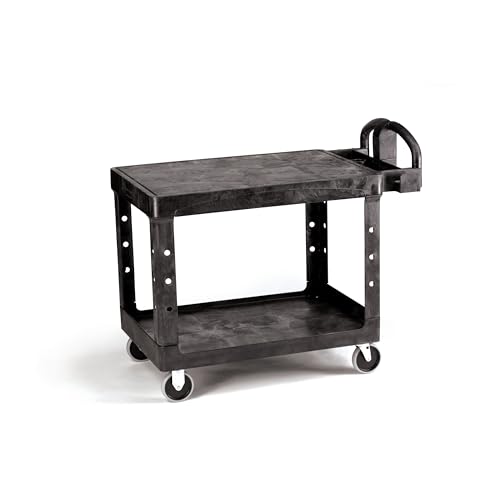
Flat shelves are convenient for large items and can create a broad work surface. The Rubbermaid Medium uses flat shelves, and the large VEVOR cart has a flat top intended for tools, cargo, or laptops. These designs are easier to load with wide objects, but small loose items may need bins or other organization.
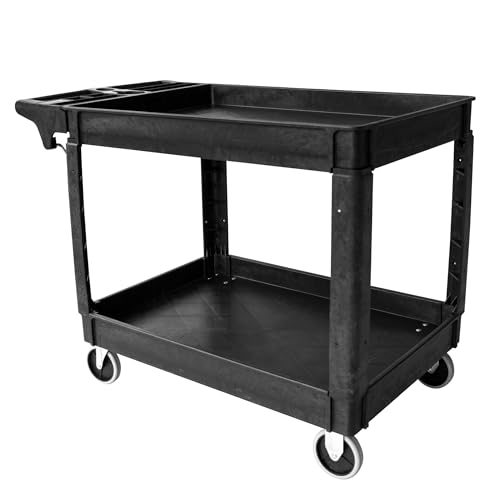
Lipped and tub-style shelves offer more containment. Rubbermaid BRUTE Large and Tooremine use lipped shelves, while MaxWorks documents 3-inch-deep trays. The ELAFROS 550-pound cart lists 2.4-inch-deep tub shelves, and the narrow VEVOR cart lists 4.25-inch-deep trays. Raised edges and tray walls can help when the cart is pushed across a work area, although they reduce the completely flat loading surface.
Shelf spacing deserves equal attention. The narrow VEVOR model lists 19.29 inches of clearance, while the compact VEVOR model lists 25.2 inches. Measure the tallest container or toolbox you expect to store before choosing a shelf arrangement.
Evaluate wheel layout and stopping control
Wheel configuration affects steering. Four swivel casters allow the cart to turn in tight spaces, as documented by ELAFROS and the compact VEVOR model. Mixed configurations, such as two fixed and two swivel casters, emphasize directional tracking. Rubbermaid BRUTE Large uses two fixed locking casters and two swivel casters, while MaxWorks and WEN list two fixed and two swivel casters.
Locks matter when loading, unloading, or using the cart as a stationary workstation. Several selected carts specify two locking wheels, including the large VEVOR, YITAHOME, ELAFROS, and both VEVOR models. A lock can hold the cart in place, but it does not remove the need to load it evenly or keep heavy items low.
Wheel size is another specification to compare. Five-inch casters appear on many commercial-size carts and may provide more clearance than the four-inch wheels listed for the compact VEVOR model. The supplied listings describe non-marring or floor-protective materials for some models, which may be preferable for finished indoor surfaces.
Consider construction and location
Structural foam and polypropylene dominate this comparison. Rubbermaid describes high-density structural foam that resists denting, chipping, peeling, and rust. The MaxWorks, ELAFROS, YITAHOME, Tooremine, and VEVOR listings describe polypropylene construction with varying resistance to moisture, stains, scratches, or corrosion. These claims support use in garages, maintenance areas, warehouses, and some outdoor settings, but the exact environment still matters.
If the cart will remain outdoors, look for a listing that specifically documents weather-oriented protection. YITAHOME describes rain and sun protection, while several other plastic carts describe waterproof or rust-resistant construction. For indoor offices or homes, weight and footprint may matter more than maximum capacity. The compact VEVOR is listed at the current price, much lighter than the commercial-size models.
Use organization features to reduce clutter
A cart can be more useful when its handle and shelf structure organize small items. Rubbermaid BRUTE Large and Medium list molded-in holsters, hooks, notches, or compartments. The large VEVOR cart includes compartments, tool racks, a cup holder, and pegboard-style holes. MaxWorks lists hardware bins and a cup holder, while WEN lists handle compartments and a cup holder.
These features should be matched to the work. Hooks and notches are useful for tools, bottles, or maintenance accessories; a flat top is better for larger equipment; and deep trays are more appropriate for supplies that could shift. Do not assume a cart includes accessories that the listing does not identify.
Measure doorways, aisles, storage bays, and turning areas. The large choices are roughly 40 to 46 inches long and can occupy substantial floor space. YITAHOME and the narrow VEVOR cart are listed at about 17 inches wide. By contrast, the large Rubbermaid model is substantially broader according to its supplied dimensions.
Assembly information also varies. MaxWorks describes quick assembly, VEVOR describes simple assembly, YITAHOME specifies three installation steps, and the compact VEVOR listing includes clear instructions. These are listing claims rather than independent assembly tests, so confirm included hardware and instructions before purchase.
Final recommendation
Rubbermaid BRUTE Large 2-Shelf Service Cart ranks first overall in this specification-based comparison under the published weighted criteria.
Rubbermaid BRUTE Large 2-Shelf Service Cart is the highest-scoring specification-based first choice among the best two-shelf utility carts. Its 750-pound documented capacity, structural-foam construction, locking casters, lipped shelves, and molded tool storage create the most specification-aligned overall specification mix for demanding facility, warehouse, and maintenance work.
Tooremine is the alternative when the highest stated capacity and a large flat top are the priority. The large VEVOR model is a strong choice for users who want a mobile workstation with explicit shelf capacities and extensive organization. MaxWorks and ELAFROS provide useful deep-tray formats, while the compact VEVOR, YITAHOME, and WEN models address narrower or lighter-duty requirements.
Among the top two-shelf utility carts, the right choice depends on load distribution, shelf containment, available floor space, and whether the cart must remain stable during loading. Prioritize documented specifications that match your work rather than selecting solely by the largest headline number.
Frequently Asked Questions
What should I look for in the best two-shelf utility carts?
Start with total and per-shelf capacity, then compare shelf dimensions, tray depth, wheel layout, locking casters, and overall width. A cart with a lower capacity may be more practical if it fits the intended aisle and provides better containment for the items you carry. Also check whether the handle includes compartments, hooks, or a cup holder if onboard organization matters.
Are deep shelves better than flat shelves?
Neither style is universally better. Deep or lipped shelves help contain bottles, tools, and loose supplies during movement. Flat shelves provide a more open surface for wide equipment and can be easier to load from different angles. The Rubbermaid Medium and large VEVOR cart document flat shelf surfaces, while MaxWorks, ELAFROS, Tooremine, and the narrow VEVOR cart document lipped or deeper tray designs.
Do two locking wheels hold a loaded cart securely?
Two locking wheels can help keep a cart stationary during loading or unloading, and several selected carts document that configuration. However, wheel locks do not replace even weight distribution or safe handling. Keep heavier items on the lower shelf when appropriate, stay within the documented capacity, and use the locks on a stable surface.
Which cart is better for a narrow aisle?
Compare the listed width as well as the wheel arrangement. YITAHOME and the narrow VEVOR cart are listed at roughly 17 inches wide, making them more space-conscious than many large-format models. The compact VEVOR is also relatively light and uses four swivel casters. Actual turning clearance will depend on the surrounding aisle and the cart’s loaded condition.
Can these carts be used outdoors?
Several listings describe plastic construction as waterproof, rust-resistant, or suitable for indoor and outdoor use. YITAHOME specifically describes rain and sun protection, while Tooremine, ELAFROS, and VEVOR describe related resistance properties. Those statements support outdoor-oriented consideration, but exposure, storage, and local conditions can affect service life. Verify the manufacturer’s current use guidance for permanent outdoor placement.