Buying Guide
The best plastic service carts are defined less by a single headline capacity than by how the shelves, casters, handle, and frame work together for the intended task. The products above are all semantically eligible service carts, but their layouts are not interchangeable. A warehouse cart for cartons may need deep shelves and a high load rating, while a kitchen or office cart may benefit more from compact dimensions and easy access.
Start with the load rating
Check whether the listing gives a total capacity, a per-shelf capacity, or both. VEVOR’s selected three-tier model states the current price total, while the selected two-tier VEVOR gives the current price per shelf. Torin states the current price total and the current price per shelf. Those details are more useful than a total number alone because a cart can be overloaded on one shelf even when the combined load remains below its headline rating.
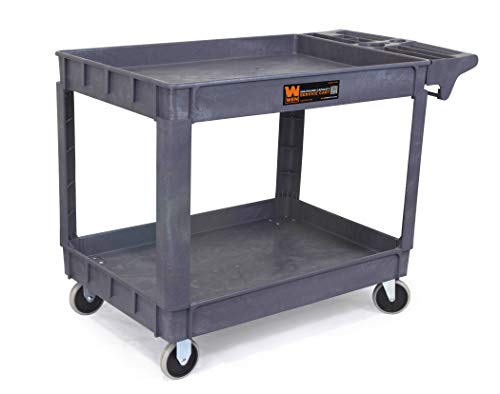
Several listings use different capacity figures in different fields. BRLJUNEO shows the current price in its title but the current price in a feature, so buyers should resolve that discrepancy before assigning a working load. Tooremine states the current price in the title but does not provide shelf-by-shelf limits in the supplied evidence. For heavy equipment, favor a cart with explicit distribution guidance and keep the load evenly spread, as WEN specifically describes its capacity.
Choose two shelves or three
Two-shelf carts generally give each level more open vertical space and can be easier to load with large containers, boxes, or tools. The VEVOR two-shelf model, Torin, MaxWorks, and Tooremine fit this format. Their layouts are appropriate when the main goal is moving fewer, larger items or using the top as a work surface.
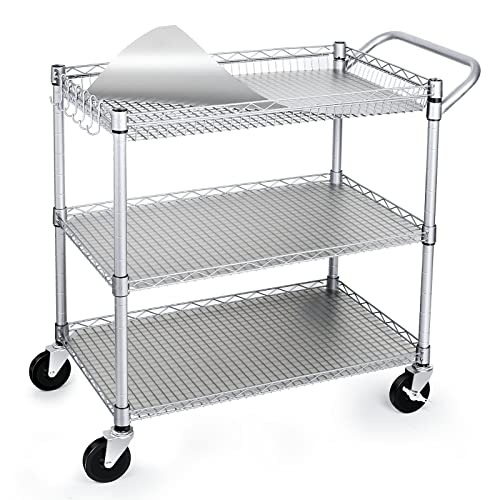
Three-tier carts improve sorting. VEVOR’s three-tier design, TUFFIOM, WORKPRO, and BRLJUNEO can separate supplies by task or destination. WORKPRO documents 12.25-inch height between tiers and raised edges, while BRLJUNEO describes raised tray sides and open fronts. These details can help when frequent loading and unloading matters. The trade-off is that a three-tier cart may offer less uninterrupted surface area than a flat-top two-shelf design.
Consider flat-top storage
A flat top is useful for oversized tools, equipment, laptops, or boxes that do not sit comfortably in a deep tray. ELAFROS documents a 42.5-by-25-inch overall size and a flat surface, while Tooremine describes a large flat top and backboard. VEVOR’s wider two-shelf model also describes a flat top measuring 37 by 25.4 inches and built-in compartments.
Flat-top carts need a different loading strategy from lipped service shelves. The ELAFROS listing documents rounded corners, two locking casters, tool holders, and a cord wrap, which add organization around the open surface. A buyer should still confirm that the intended cargo can remain stable during movement because the supplied evidence does not establish results under particular operating conditions.
Evaluate casters and stopping control
Look for wheel diameter, swivel arrangement, and brakes. Many selected carts use 5-inch wheels, while WORKPRO uses four swivel casters and two brakes. The VEVOR three-tier cart also specifies two locking casters and 360-degree movement. MaxWorks identifies non-marring casters but does not specify locking behavior in the supplied feature points, so it should not be assumed to have the same stopping control.
Wheel construction can matter on finished floors. WEN describes non-marring casters, and several other listings mention thermoplastic rubber wrapping, shock absorption, noise reduction, or floor protection. These are listing claims, not independent test results. They can help with initial comparison, but the floor type, threshold height, turning space, and loaded weight still affect suitability.
Inspect material and maintenance claims
Polypropylene is common across this category because the listings describe it as resistant to rust, stains, scratches, dents, chips, water, or corrosion. The exact claims vary by product. WORKPRO combines PP trays with aluminum-alloy frames, while BRLJUNEO uses polypropylene shelves and aluminum uprights. The all-polypropylene construction described for several heavy-duty carts may appeal where wipe-down maintenance is important.
Easy-clean surfaces are repeatedly documented, but that does not mean every chemical or cleaning method is suitable. Use the manufacturer’s care instructions when available. If the cart will be used outdoors, note that some listings describe indoor and outdoor suitability, but the supplied evidence does not provide weather-exposure limits.
Match the handle to daily use
A molded or ergonomic handle can make pushing easier to control. VEVOR’s selected carts describe ergonomic handles with storage compartments, and Tooremine lists slots for tools, cups, or bottles. ELAFROS adds four tool holders and a cord wrap. BRLJUNEO uses side handles, while WORKPRO documents two stable handles.
These features are valuable when the cart doubles as a mobile workstation, cleaning station, or tool organizer. They should not be treated as proof of reduced fatigue or superior performance because this comparison is based on specifications rather than hands-on testing. Also check the cart’s height and width against doorways, aisles, shelving, and the intended storage location.
Final Recommendation
VEVOR 3-Tier 550-Lb Plastic Service Cart ranks first overall in this specification-based comparison under the published weighted criteria.
The final choice among the best plastic service carts depends on the documented features that match your intended use.
The VEVOR 3-Tier 550-Lb Plastic Service Cart is the first overall specification-based choice. It combines a stated 550-pound capacity, three lipped shelves, two locking casters, 5-inch wheels, a storage-equipped ergonomic handle, and accessory-ready side holes. Among the top plastic service carts, it offers one of the most complete combinations of capacity, organization, movement control, and maintenance information.
Choose the VEVOR 2-Shelf 550-Lb Cart when shelf-level capacity and deep lipped storage matter more than a third tier. WEN is the better documented fit for broad surfaces, while ELAFROS is the clearer flat-top choice for oversized cargo. TUFFIOM gives another high-capacity three-shelf option, and WORKPRO is a sensible lower-capacity alternative with open-front access.
For compact service areas, BRLJUNEO provides three shelves in a narrower footprint, but its conflicting capacity figures should be clarified. Torin and MaxWorks are straightforward two-shelf choices, while Tooremine emphasizes a flat upper work surface. Always compare the cart’s stated limits with the actual size, weight, and distribution of the items you plan to move.
Frequently Asked Questions
What should I look for in the best plastic service carts?
Start with documented total and per-shelf capacity, then compare shelf dimensions, wheel design, brakes, handle features, and material claims. A cart with a high headline rating may still be unsuitable if its shelves are too small or its footprint cannot fit the workspace.
Are two-shelf or three-tier plastic carts better?
Two-shelf carts usually suit larger individual items and open work surfaces. Three-tier carts are better for sorting supplies into categories. The right choice depends on whether you prioritize uninterrupted shelf area or separated storage.
Do plastic service carts have locking wheels?
Many selected models document two locking wheels or casters, including VEVOR, Torin, WORKPRO, ELAFROS, and BRLJUNEO. MaxWorks identifies non-marring casters but the supplied feature evidence does not confirm locks, so verify the specific listing before buying.
Can these carts be used outdoors?
Some listings describe their polypropylene carts as suitable for indoor and outdoor use, including VEVOR’s larger two-shelf model and ELAFROS. However, the supplied evidence does not specify weather limits, so outdoor buyers should review care and exposure guidance.
Use the most specific manufacturer guidance and seek clarification when title and feature fields disagree. BRLJUNEO is an example: its supplied title and feature text state different maximum capacities. Do not assume the higher figure is the correct working limit.