Buying Guide
The best rubber utility carts are not all designed for the same route, surface, or load. Service carts use shelves and swivel casters for indoor work, while garden carts use larger tires and open beds for outdoor hauling. Start by deciding whether you need a contained shelf system, a broad flat platform, or a bed that can carry loose or oversized material.
Match the cart to the work area
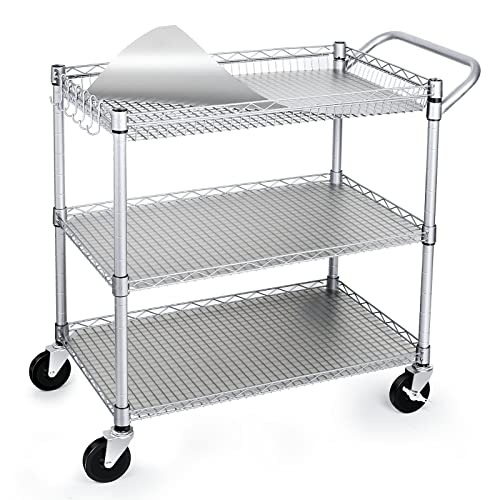
For kitchens, offices, classrooms, cleaning routes, and warehouse aisles, a multi-shelf service cart is usually the more practical design. The Rubbermaid 3-Shelf Rolling Service Cart and ELAFROS 3-Shelf Heavy-Duty Rolling Cart separate supplies across levels, reducing the need to stack items. Their rounded or contained shelf designs can also help keep smaller objects from sliding during movement.
A two-shelf cart is more suitable when the load is bulky or when the user wants a larger uninterrupted surface. Rubbermaid 2-Shelf Utility Cart includes lipped shelves and tool-oriented molded features. VEVOR 2-Shelf 550-Pound Utility Cart and EliteEdge Large Flat-Top Plastic Utility Cart also emphasize heavy-duty transport, but their layouts differ: VEVOR uses a contained upper shelf, while EliteEdge provides a broad flat-top format.
Compare stated capacity carefully
Load capacity is useful only when it matches the way items will be distributed. Global Industrial states a per-shelf capacity when evenly distributed, while Wanmwill states an overall capacity. VEVOR documents both a per-shelf figure and an overall maximum. These figures should not be treated as interchangeable because shelf-level limits, overall limits, and evenly distributed loads describe different conditions.
The garden carts have a different capacity pattern. BILT HARD states a 400-pound capacity, and Sekey states a 1000-pound capacity. Those figures are relevant to hauling yard materials in an outdoor bed, not to placing a concentrated object on an indoor shelf. Follow the manufacturer’s stated limits and distribute loads rather than assuming the overall figure applies to every part of the cart.
Understand wheel and caster designs
Wheel size and construction affect where a cart is most useful. The selected indoor carts document non-marking, thermoplastic rubber, or rubber-coated casters. Rubberized caster surfaces are described as helping absorb vibration, reduce noise, and protect floors, although the supplied evidence does not establish identical performance across models.
Larger casters can be useful for thresholds and less uniform surfaces, but the listing evidence should guide the comparison. Global Industrial, VEVOR, and several other service carts specify 5-inch wheels. The ELAFROS three-shelf model specifies 4-inch casters, which supports a compact indoor format but gives it less wheel-size advantage than the 5-inch models.
Garden carts take a different approach. BILT HARD and Sekey use 10-inch rubber tires and rotating handles, with the listings describing movement across outdoor terrain such as grass, gravel, or dirt. These carts are better suited to yard materials than office or foodservice routes. They also require more storage space because their beds and wheel assemblies are larger.
Choose shelves, trays, or a convertible bed
Shelves are best when loads need sorting and frequent access. Rubbermaid 3-Shelf Rolling Service Cart provides three levels, while ELAFROS adds dedicated spaces for cables, bottles, and small items. A two-tier cart can be easier to load with large containers, and lipped shelves can help contain supplies during movement.
Tray-style carts deserve attention when tools and small parts are part of the job. Global Industrial documents a deep top tray, screwdriver holders, a drill or cup holder, hooks, and a tablet or cell phone holder. These features make the cart more task-oriented than a basic open shelf, though they also make the layout less flexible for unusually large cargo.
For outdoor work, a convertible bed can be more useful than shelves. Sekey’s removable mesh sides allow the cart to become a flatbed, while BILT HARD also documents removable sides. This configuration supports oversized items such as lumber or fence posts, but it does not provide the separated storage that an indoor service cart offers.
Measure doorways, aisle widths, storage corners, and turning areas before choosing a cart. Narrower designs such as Wanmwill can make better use of confined workspaces, provided the shelf dimensions fit the intended containers.
Brakes are useful when a cart must remain in place for loading or service. VEVOR, EliteEdge, Wanmwill, and the ELAFROS models document locking or braked wheels. A brake does not replace careful load placement, and the supplied listings do not provide independent testing of holding force, so treat it as a stationary-use feature rather than a guarantee against movement on every surface.
Final recommendation
Sekey 1000-Pound Steel Garden Cart ranks first overall in this specification-based comparison under the published weighted criteria.
Sekey 1000-Pound Steel Garden Cart is the highest-scoring returned product and the first overall specification-based choice in this comparison.
Among the best rubber utility carts, the right final choice depends on the documented features that match your intended use. Sekey is suited to large outdoor loads and convertible flatbed use. Rubbermaid 2-Shelf Utility Cart is the leading indoor option because it combines a stated 500-pound capacity, 5-inch thermoplastic rubber casters, lipped shelves, and extensive tool organization. It is a practical fit for demanding service work.
Choose Rubbermaid 3-Shelf Rolling Service Cart when three-level access matters more than a clearly stated maximum capacity. Choose BILT HARD 400-Pound Steel Garden Cart for outdoor garden hauling at a smaller stated load limit than Sekey. For a narrower indoor body, Wanmwill provides a useful combination of stated capacity, braked casters, and modular storage. Global Industrial is a good fit when tray depth and tool holders matter more than a fully open shelf layout.
These top rubber utility carts cover distinct use cases rather than one universal design. Confirm the cart’s dimensions, surface compatibility, capacity conditions, and assembly requirements before purchase.
Frequently Asked Questions
What are the best rubber utility carts used for?
They are useful for moving supplies, tools, cleaning equipment, foodservice items, warehouse materials, and garden loads. Indoor service carts such as Rubbermaid 2-Shelf Utility Cart use shelves and casters, while BILT HARD 400-Pound Steel Garden Cart and Sekey 1000-Pound Steel Garden Cart use larger rubber tires and open beds for outdoor hauling.
Are larger rubber wheels better for every cart?
Not necessarily. Larger wheels can be advantageous for outdoor or uneven surfaces, as shown by the 10-inch tires on BILT HARD and Sekey. Smaller casters can be more suitable for compact indoor routes and tight turning spaces. The right choice depends on the floor, thresholds, load, and available clearance.
Should I choose a two-shelf or three-shelf cart?
Choose two shelves when you need room for bulky containers or a more open loading area. Choose three shelves when sorting smaller supplies and accessing multiple levels is more important. Rubbermaid 2-Shelf Utility Cart emphasizes heavy-load and tool use, while Rubbermaid 3-Shelf Rolling Service Cart emphasizes multi-level storage.
Do all carts with rubberized wheels have the same capacity?
No. Wheel material and load capacity are separate specifications. Compare the stated overall capacity, per-shelf limit, bed limit, and any evenly distributed-load condition. For example, Global Industrial documents a per-shelf rating, while VEVOR documents both a per-shelf figure and an overall maximum.
What should I measure before buying?
Measure the narrowest doorway, aisle, elevator, storage space, and turning area on the route. Also compare the cart’s overall width and length with the dimensions of the items it must carry. Wide models such as EliteEdge provide more surface area, while narrower models may be easier to position in confined work areas.