Buying Guide
The best three-shelf utility carts are not interchangeable. A cart designed for moving cartons through a warehouse has different priorities from a narrow organizer for craft supplies or a powered station for office equipment. Start with the load, then check how the shelves contain items, how the casters move, and whether the overall dimensions fit the intended route.
Match capacity to the actual load
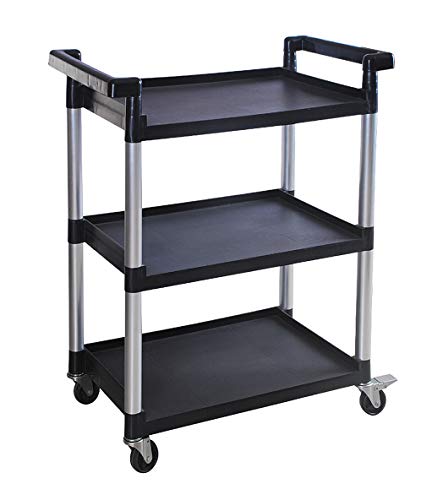
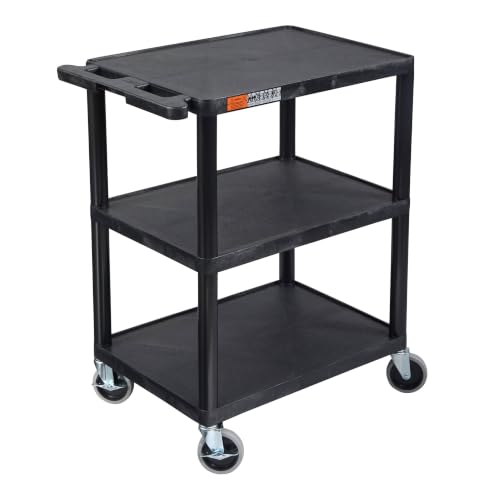
Capacity figures are useful only when read carefully. Some listings provide a combined maximum, such as 225, 300, or the current price. Others give a per-shelf rating, which may be more helpful if the load will be distributed unevenly. The VEVOR 3-Tier Plastic Service Cart is listed at the current price, making it the most substantial choice in this comparison for documented load capacity. The Luxor HE42-B follows with a stated 400-pound capacity.
Do not assume that a high total figure means every shelf can carry the same amount. The VEVOR JYS3 lists the current price for its top tray and the current price for each lower tray. Pearington’s powered PAVC4 lists the current price for the top shelf and the current price for each lower shelf. Those details matter if you plan to place a printer, toolbox, appliance, or other concentrated load on the upper level.
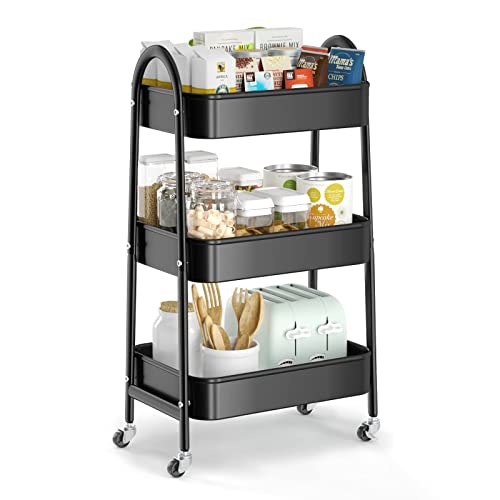
For lighter supplies, basket-style carts can be easier to organize. EAGMAK documents the current price per shelf, while TOOLF and ALVOROG document the current price per shelf. These ratings are better aligned with toiletries, craft materials, office supplies, books, and similar items than with dense cartons.
Choose flat shelves or baskets
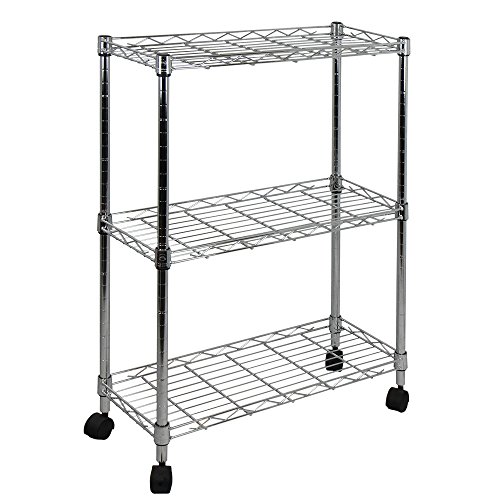
Flat shelves accept boxes, equipment, trays, and longer objects with fewer shape restrictions. Luxor’s STC222-B uses three flat shelves with retaining lips, and the VEVOR JYS3 describes its top as a mobile workstation. Oceanstar adds raised borders to its shelves, combining a flatter loading surface with some edge containment.
Basket shelves are useful when the load includes small or loose objects. EAGMAK uses three deep mesh baskets, while TOOLF and ALVOROG add hanging accessories around their three main tiers. Mesh also provides airflow, which may be useful for laundry items, produce, toiletries, or supplies that benefit from ventilation. The trade-off is that basket walls and mesh floors can make large flat packages less convenient to place.
Retaining lips and raised borders help reduce sliding, but they do not replace careful loading. If the cart will cross thresholds or be pushed quickly, keep heavy items low and avoid treating a small edge as a guarantee that an object will remain in place.
Evaluate caster layout and stopping control
Most selected carts use four casters, commonly with two locking wheels. That arrangement allows the cart to move when unlocked and stay positioned when the brakes are engaged. The VEVOR service cart uses 5-inch swivel casters, while several other models use 3.75- or 4-inch wheels. Larger wheels may provide more clearance over minor floor transitions, but the supplied specifications do not establish a universal performance result.
Caster type also affects steering. The VEVOR JYS3 lists two swivel and two fixed casters, while the MaxWorks cart lists four non-marring swivel casters. An all-swivel arrangement can support turning in compact areas; a mixed arrangement may provide a more directional push. Consider the route, doorway width, floor surface, and whether the cart will be parked beside a workstation.
Handles are another practical distinction. Luxor STC222-B has a molded push handle, MaxWorks provides handles on each side, and the larger VEVOR cart includes an ergonomic handle with a storage compartment. A handle that is easy to reach and aligned with the cart’s center can be more useful than an added accessory when the cart is regularly repositioned.
Consider materials and cleaning needs
Plastic and structural foam carts can be appealing in areas where moisture, stains, or easy wipe-down matter. The selected VEVOR models describe polypropylene as waterproof, rust-proof, or corrosion-resistant, and Luxor states that the HE42-B shelves and legs resist scratches, dents, and rust. These are listing claims, not independent test results, but they identify the maintenance features documented for each product.
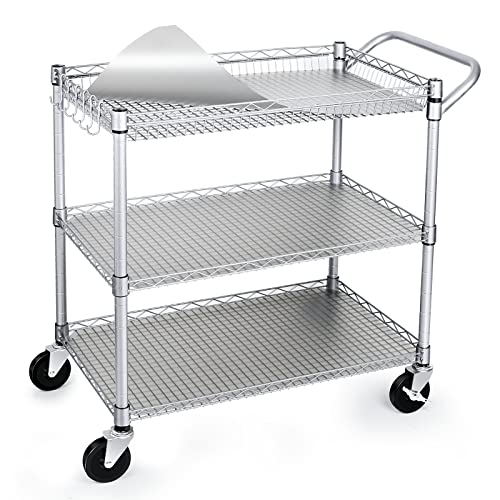
Metal carts provide a different construction approach. Oceanstar uses chrome-plated steel, EAGMAK uses metal with an anti-rust treatment, and TOOLF and ALVOROG use metal frames or baskets. Mesh baskets promote airflow, but their openings may not suit very small items unless those items are placed in containers.
Assembly varies across the group. Several listings describe simple assembly, while TOOLF specifically states screwless, no-tool assembly. Luxor STC222-B explicitly requires assembly. If the cart is needed quickly or will be moved between locations, check the assembly description before choosing based only on capacity.
Measure the full route, not just the storage location. A cart must clear doors, corners, counters, and furniture while loaded. The large VEVOR service cart is intended for heavier work but has a much larger listed footprint than compact carts such as TOOLF and ALVOROG. The Pearington carts are listed at 27.75 inches wide and 18.25 inches deep, while the smaller metal organizer designs occupy substantially less floor area.
Shelf spacing determines what can stand upright. The VEVOR JYS3 lists 12-inch tray spacing, and Pearington PAVC4 lists 14.5 inches between the bottom and middle shelves and 14 inches between the middle and top. Oceanstar is the most adaptable here because its shelf height is adjustable. Use those specifications to compare the height of bottles, boxes, bins, or equipment before ordering.
Final recommendation
VEVOR 3-Tier Plastic Service Cart, 550-Lb Capacity ranks first overall in this specification-based comparison under the published weighted criteria.
The final choice among the best three-shelf utility carts depends on the documented features that match your intended use.
VEVOR 3-Tier Plastic Service Cart, 550-Lb Capacity is the highest-scoring returned product and the first overall specification-based choice. It combines the most specification-aligned documented load rating in this group with large locking casters, lipped shelves, a handle compartment, and accessory-ready side holes.
Among the top three-shelf utility carts, the Luxor HE42-B is the better fit for a structural-foam commercial-style build and the VEVOR JYS3 offers a balanced compact work surface. Choose Pearington PAVC4 when integrated power is central to the setup. For lighter household or creative storage, EAGMAK, TOOLF, and ALVOROG offer basket layouts and accessory features without the footprint of the larger service carts. Oceanstar is the most flexible choice when adjustable shelf height matters.
This is a specification-based ranking, not a hands-on test. Before purchase, verify the current listing, dimensions, capacity distribution, wheel configuration, and assembly details for the exact version available in the US.
Frequently Asked Questions
What should I look for in the best three-shelf utility carts?
Prioritize the load rating, shelf type, caster control, dimensions, and materials. Check whether capacity is stated per shelf or for the entire cart. Also look for raised lips or basket walls if loose items may slide, and confirm that the cart fits through the spaces where it will be used.
Are flat shelves or mesh baskets better?
Flat shelves are generally easier for boxes, equipment, and larger containers because they provide a continuous surface. Mesh baskets offer more containment for loose supplies and can promote airflow. The better design depends on the shape and weight of the items, not simply on the material.
Do three-shelf carts usually have locking wheels?
Many selected products document two locking wheels, including the Luxor, Pearington, EAGMAK, TOOLF, and ALVOROG carts. However, locking-wheel details vary by model, so confirm the specification rather than assuming every three-shelf cart includes brakes.
Which selected cart is best for electronics?
The Pearington PAVC4 is the clearest fit because its listing documents a three-outlet power strip and an 8-foot cord. Its top shelf has a lower stated capacity than the lower shelves, so place heavier equipment according to the documented shelf ratings.
Can a utility cart replace a fixed shelving unit?
It can provide movable storage, but it is not identical to fixed shelving. A cart needs clearance for movement, may require braking when parked, and has a stated load limit. Use the documented capacity and dimensions to decide whether mobility is more useful than the greater stability or size of stationary shelving.