Buying Guide
The best sheet binding machines differ mainly by binding method, document capacity, and workflow. Comb machines punch holes for plastic spines. Thermal machines use adhesive covers and heat. Wire machines create a 3:1 hole pattern, while coil machines use spiral spines and may include powered insertion.
Choose a binding method
Comb binding suits reports, manuals, school work, and documents that may need pages added or removed. The TIANSE, Binditek, OFFNOVA, and MAKEASY comb models support common Letter, A4, or A5 formats. Their maximum capacities reach 350 to 450 sheets, but those figures require appropriately sized combs. Included 3/8-inch or 1/2-inch combs hold substantially fewer pages.
Thermal binding avoids punching. The OFFNOVA and Hoqqf thermal models document capacities around 500 sheets and use compatible adhesive covers. OFFNOVA adds no-preheat operation, digital controls, a completion alert, air cooling, and auto shut-off. Hoqqf lists PTC ceramic heating, infrared detection, a hand press, and overtime protection.
Wire binding is suitable for formal reports and booklets. The OFFNOVA and RAYSON models use 3:1 systems and list capacities up to 120 sheets. OFFNOVA supports wire, coil, and click spines, while RAYSON lists coil, click, and wire-o compatibility.
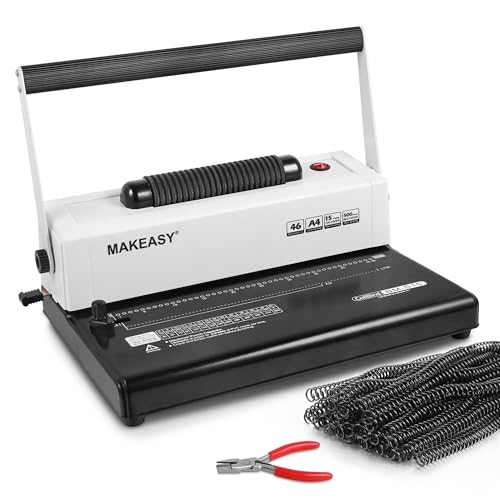
Coil binding suits notebooks, planners, and documents that need to open and turn pages easily. Binditek and MAKEASY use electric coil insertion. Binditek lists 46 disengageable pins, a 20-sheet punch limit, and a stated 500-sheet maximum with 2-inch coils. Its included 5/16-inch coils are intended for shorter documents.
Compare punch and binding capacity
Punch capacity is the number of sheets perforated in one cycle. Binding capacity is the largest finished document using the correct spine or cover. These figures are different. Most selected comb and wire models punch 10–12 sheets, while the coil models list 15 or 20 sheets. Thermal models do not use a punching stage.
Several listings specify limits around 80 gsm or 20-pound paper. Cover, textured, and PVC materials generally have lower limits. Do not assume the ordinary paper rating applies to thicker covers.
Support for Letter, A4, and A5 is useful for mixed office work. Several selected comb and coil models explicitly cover these common formats. RAYSON is more focused because its listing specifies a Letter-size maximum.
Hole patterns must match the spine. Comb models use 15-, 19-, or 21-hole arrangements. Wire models use 3:1 patterns, and coil models use 4:1 patterns with many holes along the page edge. Spines are not interchangeable across every design.
Look for alignment controls
Adjustable guides help position pages consistently. TIANSE lists 3 mm, 4 mm, and 5 mm margin settings. Binditek lists positions from 2 mm to 5 mm, while the selected OFFNOVA comb machine lists 3 mm, 4 mm, and 5 mm. The wire and coil models also document adjustable margins.
Disengageable pins add flexibility. Binditek’s coil model documents 46 fully disengageable pins and an open-ended design for larger or non-standard paper. A fixed-pattern machine may be simpler but provides less control over which holes are punched.
Review workflow and cleanup features
Manual machines differ in handle and guide design. TIANSE lists a high-leverage arm, OFFNOVA uses a dual-arm handle, and RAYSON uses a long lever with horizontal paper insertion. These are documented design features, not guarantees of a specific effort level.
Waste management also matters. Binditek, RAYSON, and the selected coil machine list waste compartments, while OFFNOVA’s wire model includes a paper waste box. Thermal machines avoid punch scraps but introduce heating and cooling steps. Some manual listings mention pre-oiled blades and recommend cleaning with test material or absorbent paper before use.
Consider included supplies
Starter supplies can make a machine usable immediately, but they do not define maximum capacity. Several selected models include combs, coils, wires, covers, pliers, or maintenance paper. Match the supplied spine size with your intended page count, and check which consumables are required for larger documents.
The best sheet binding machines are not identical winners for every workflow. A thermal model may suit large documents without punched holes, while a comb binder may be better for editable reports. Wire and coil designs are more appropriate when the finished format and page-turning behavior are priorities.
Final recommendation
Binditek 4:1 Spiral Binding Machine ranks first overall in this specification-based comparison under the published weighted criteria.
Among the best sheet binding machines, it offers a documented combination of punch capacity, 46 disengageable pins, adjustable margins, electric coil insertion, and a stated 500-sheet maximum with suitable coils. Its included coils are smaller, so buyers should plan consumables around the intended document thickness.
OFFNOVA Thermal Binding Machine 500 Sheets is the main alternative for users who want to avoid punching. It documents 450–500-sheet capacity, four paper sizes, no-preheat operation, cooling, digital controls, and auto shut-off.
For comb work, TIANSE 21-Hole Comb Binding Machine provides a balanced combination of capacity, common paper formats, adjustable margins, metal housing, and starter spines. Binditek 450-Sheet Comb Binding Machine is a useful alternative when margin control, a cast-iron base, and a waste drawer are priorities. Hoqqf Thermal Binding Machine 500 Sheets suits thick thermal documents, while OFFNOVA 3:1 Wire Binding Machine and RAYSON TD-132 cover distinct wire-binding needs.
For the top sheet binding machines using coils, Binditek provides broad documented customization, and MAKEASY 4:1 Coil Binding Machine is a simpler electric-inserter option.
Frequently Asked Questions
What are the best sheet binding machines for thick reports?
The selected thermal models document capacities of 450–500 sheets, and several comb and coil models also list high maximums with appropriately sized spines. Confirm the cover or spine specification before planning a large project.
Is a comb or thermal binder better for office documents?
A comb binder is useful when pages may need to be added or removed. A thermal binder avoids punched holes and uses adhesive covers. The better choice depends on the preferred finish, consumables, and editing needs.
Can these machines handle Letter and A4 paper?
Several selected comb and coil models explicitly support both Letter and A4, and some also support A5. RAYSON TD-132 specifies a Letter-size maximum. Check the hole pattern and guide settings before buying spines.
What does punch capacity mean?
Punch capacity is the number of sheets perforated in one operation under stated paper conditions. It is separate from binding capacity, which describes the largest finished document with the correct spine or cover.
Do included spines represent maximum capacity?
Usually not. Several listings include small combs, coils, or wires while separately stating a larger maximum with larger consumables. Check the included spine diameter and the replacement size needed for your target page count.