Buying Guide
The best utility service carts are defined by how well their documented capacity, shelf arrangement, wheels, and work features match the job. This comparison uses public listing data only. It does not represent hands-on testing, independent load verification, or customer-opinion analysis.
Match capacity to the intended load
Start with the stated maximum capacity, then consider how the load will be distributed. The EHONXI lists the highest capacity here at the current price, while the WDT lists the current price and the Rubbermaid BRUTE lists the current price. Those figures make them logical candidates for heavier warehouse, workshop, or commercial transport.
A high total rating does not automatically describe every shelf. The WDT provides a 990-pound total figure but does not give a shelf-by-shelf breakdown in the supplied evidence. By contrast, the two-shelf VEVOR lists the current price per shelf within its 550-pound maximum. The WEN specifies a 500-pound evenly distributed capacity. When loads are uneven, use the more detailed shelf information and leave room for safe handling rather than treating the headline number as a target.
Choose two shelves or three tiers
Two-shelf carts such as the Rubbermaid BRUTE, WEN, YITAHOME, ELAFROS, and two-shelf VEVOR provide wider vertical openings for larger cartons, toolboxes, and other bulky items. The two-shelf format can also make loading and unloading more direct.
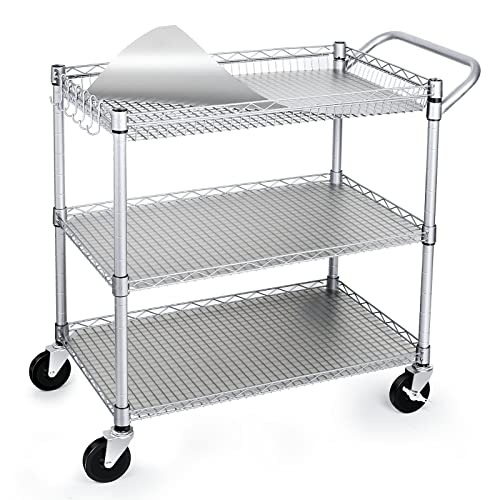
Three-tier carts separate supplies more clearly. The EHONXI, WDT, and three-tier VEVOR provide additional levels for tools, containers, or materials. The WDT adds one-inch shelf adjustment, which is useful when item heights vary. The EHONXI adds tray fencing, while the VEVOR uses lipped shelves. These raised edges can help keep items from sliding during movement, but the supplied data does not quantify their effectiveness.
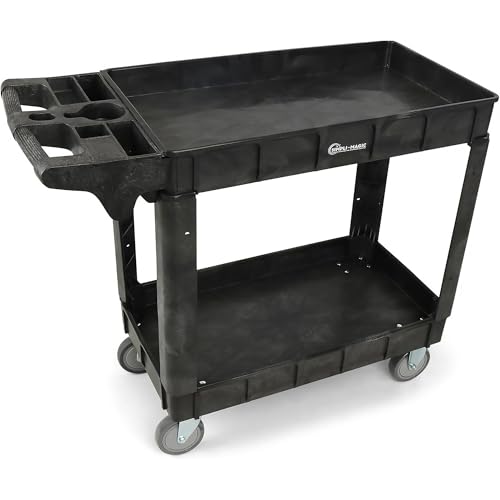
Deep shelves are another design choice. ELAFROS documents 2.4-inch-deep tub shelves, and SIMPLI-MAGIC describes deep shelves without giving a separate depth figure. This layout may help contain loose supplies. If you need to move tall items, compare the shelf spacing and overall dimensions rather than choosing by tier count alone.
Evaluate wheel size and stopping control
Wheel information matters as much as capacity. Several selected carts document five-inch casters, including the WEN, VEVOR models, YITAHOME, ELAFROS, and SIMPLI-MAGIC. Larger wheels can be a useful specification for moving across varied work surfaces, but the listing evidence does not establish real-world rolling performance.
Locking details vary. The two VEVOR models, YITAHOME, and ELAFROS list two lockable wheels or brakes. The three-tier VEVOR specifically describes brakes and quick-stop functionality. Rubbermaid BRUTE lists two pneumatic fixed locking casters and two pneumatic swivel casters. KLEIN TOOLS lists six-inch wheels with foot brakes on two wheels. These details are valuable when loading or parking the cart, especially in a busy work area.
Compare materials and maintenance claims
Polypropylene and structural foam appear frequently in this category. Treat each claim as listing evidence for material selection, not as an independent durability test.
Metal carts offer a different specification profile. EHONXI lists 14-gauge stainless steel, while WDT lists industrial-strength metal with a chrome-plated surface. KLEIN TOOLS emphasizes heavy-duty cart legs and a system built around MODBox accessories. Metal may appeal where a rigid work surface or industrial appearance matters, but the supplied data does not establish comparative longevity between materials.
Check dimensions, access, and storage space
Measure doorways, aisles, storage corners, and turning areas before choosing. The selected carts vary substantially in listed width and length. The WEN is listed at 40 by 17 inches, the two-shelf VEVOR at about 40.55 by 17.71 inches, and KLEIN TOOLS at 18 inches wide in its title. Rubbermaid BRUTE has a much broader listed footprint, while some specification fields across the category contain inconsistencies.
Look for features that reduce trips for small items. VEVOR models document handle compartments and side holes, WEN includes compartments and a cup holder, ELAFROS and SIMPLI-MAGIC list built-in handle storage and retrofit points, and Rubbermaid BRUTE includes hooks, holsters, and notches. KLEIN TOOLS adds rails, compartments, conduit notches, and pipe or conduit storage points for trade-focused tasks.
Assembly requirements differ. The VEVOR carts describe three-step installation, WEN lists a one-year limited warranty, Rubbermaid BRUTE lists a 10-year limited warranty, and SIMPLI-MAGIC lists a one-year manufacturer warranty. EHONXI, WDT, and KLEIN TOOLS provide different levels of service information in their listings. Confirm the current package contents and warranty terms before ordering because listing details can change.
Final recommendation
WDT 990Lbs Commercial Metal Utility Cart ranks first overall in this specification-based comparison under the published weighted criteria.
EHONXI 3-Tier Stainless Steel Utility Cart is the highest-scoring returned product and the best utility service carts choice when documented capacity and stainless-steel construction are the priority. Its 1,100-pound stated capacity, three tiers, reinforced wheels, and tray fencing give it the most specification-aligned specification profile for heavy workshop or warehouse work.
For commercial movement with locking pneumatic casters and molded tool storage, the Rubbermaid BRUTE is a compelling alternative. WDT is better suited to users who need adjustable shelves, while the three-tier VEVOR offers a balanced polypropylene design with the current price of stated capacity and accessory points. KLEIN TOOLS is the more specialized selection for MODBox users and trade-oriented workstation tasks.
Among the top utility service carts, the right choice depends on more than the headline capacity. Confirm the footprint, shelf spacing, wheel locks, material, and storage features against the work area and load type.
Frequently Asked Questions
What should I look for in the best utility service carts?
Prioritize a stated capacity that fits the intended load, shelf dimensions that match the items being moved, wheels appropriate to the floor, and locking control for loading or parking. Built-in compartments, hooks, lipped shelves, and accessory points can reduce the need for a second organizer. Also verify the cart footprint and any conflicting dimension fields before purchase.
Are two-shelf carts or three-tier carts better?
Two-shelf carts generally provide more vertical clearance for bulky items, while three-tier carts divide tools and supplies into more storage zones. The WEN and two-shelf VEVOR illustrate the first approach, while the EHONXI, WDT, and three-tier VEVOR illustrate the second. Choose based on item height and organization needs rather than tier count alone.
Which selected carts document locking wheels?
The Rubbermaid BRUTE lists locking pneumatic casters. The VEVOR models, YITAHOME, and ELAFROS describe two lockable wheels or brakes, and KLEIN TOOLS lists foot brakes on two wheels. Wheel-lock terminology and configuration differ, so check the current listing for the exact arrangement before ordering.
Is stainless steel necessary for a utility service cart?
Not necessarily. EHONXI documents 14-gauge stainless steel, while several other selected carts use polypropylene, structural foam, or metal frames. Stainless steel may appeal for a rigid, metal work surface, but plastic carts can offer documented corrosion-resistance or easy-clean claims. Match the material to the environment and load instead of assuming one material is universally better.
How much space should I reserve for a service cart?
Reserve more than the cart’s listed length and width so it can turn and be pushed safely. Compare the published dimensions with doorways, aisles, shelves, and storage areas. Because some supplied listings contain inconsistent dimension fields, confirm the current product measurements before committing to a tight space.