Buying Guide
The best bed risers are not chosen by height alone. A useful comparison starts with the furniture leg, the required clearance, the riser’s contact surface, and the way the pieces lock or sit under the furniture. The listings in this guide describe plastic, wood, and carbon-steel designs, but each material is paired with different fit and adjustment details.
Start with the actual lift
First decide how much additional clearance you need. A 2-inch riser is suited to a modest change, while 3- and 4-inch models create more room for storage or cleaning. A 5- or 6-inch model can provide substantially more clearance, but it also raises the center of the furniture and may be visually prominent. Do not assume the number in a product title always equals usable lift. EasyPAG lists a 5-inch outer height and a 4-inch actual rise because of its one-inch inner depth. TQVAI similarly identifies a 4-inch outer height and 3-inch inner height.
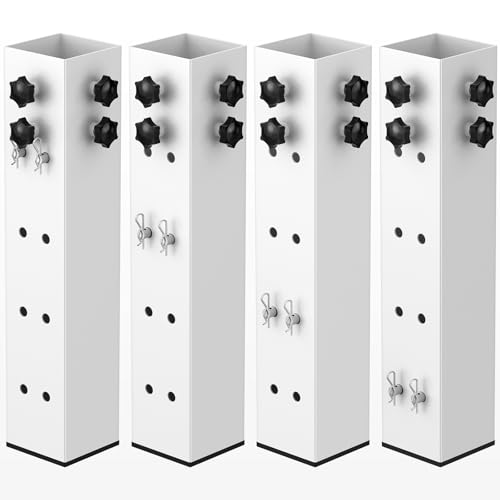
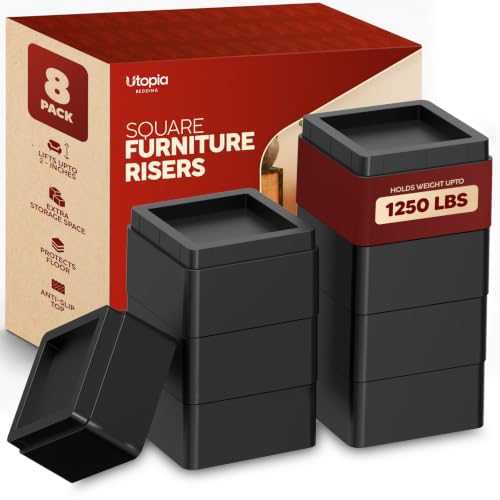
Adjustable and stackable designs are useful when the final height is uncertain. FOROIRON documents four settings from 3.2 to 11.2 inches, while the Utopia Bedding 3- and 5-inch set can be used separately or combined for an 8-inch elevation. HOME IT also combines 3- and 5-inch pieces for up to 8 inches. The Utopia Bedding 2-inch set can stack to 4 inches. Read the stacking instructions carefully: EclatBain states that its single 1.5-inch layer cannot be stacked, and its intermediate sections are used for the higher configurations.
Measure the furniture legs and riser opening
Fit is one of the most important checks before purchase. Measure the leg width, depth, or diameter rather than relying on the bed size. Slipstick CB672 lists openings for round feet up to 3 inches or square feet up to 2.1 inches. TQVAI lists compatibility with legs up to 2.95 inches in diameter, and EasyPAG lists a top opening for legs up to 3 inches.
Some risers use an L-shaped or half-wrapped design instead of a fully enclosed cup. Yookwutar, ANNKUT, and EclatBain document this approach. It can provide a broader placement surface for thick legs, but it makes exact positioning important. FOROIRON is more specific about fit, listing bed legs from 2.3 to 3.1 inches. Its side screws are intended to tighten around the compatible leg. The Yookwutar listing gives a 4.52-by-4.52-inch contact area, while ANNKUT 2-inch lists compatibility with furniture legs below 4.8 by 4.8 inches.
A stable riser should keep the leg centered and limit movement at the floor. Look for a recessed cup, surrounding edge, textured top, rubber bottom, or a combination of these features. Slipstick uses a one-inch recessed holder with a cushion pad and three rubber grips on the base. TQVAI describes a one-inch inner edge and built-in non-slip rubber pads. Utopia Bedding 2-inch includes separate anti-slip foam pads for the top and rubber pads for the bottom.
L-shaped risers rely more on correct placement because the furniture foot is not necessarily enclosed on every side. Their wider bases can still be useful for thick or unusually shaped furniture feet, provided the dimensions match.
Treat load capacity as a specification, not a guarantee
Published capacities are useful for comparing documented support, but they should not be treated as a promise that every installation is safe. Consider the combined weight of the furniture, mattress, occupants, and stored items, then follow the product’s placement and fit instructions. FOROIRON lists the current price for four risers, Yookwutar lists the current price, and ANNKUT 2-inch lists the current price. Other selected products list capacities from 1,250 to the current price.
Capacity alone does not resolve fit. A riser with a high stated limit may still be unsuitable if the leg is too wide, angled, tapered, or poorly centered. The metal FOROIRON model specifically describes straight-compatible dimensions and side-screw adjustment. Always use the more restrictive specification: the leg must fit the opening and the total furniture load must remain within the documented limit.
Choose material and installation style
Plastic is common among these products and may be light to handle. HOME IT and Utopia Bedding use polypropylene-based designs, while Slipstick adds steel reinforcement beneath the caster holder. Wood options such as TQVAI and EasyPAG provide a different appearance and document solid wood construction. FOROIRON uses carbon steel and requires selecting a height, inserting a clevis pin, placing the leg, and tightening screws.
Most block-style risers are placed under existing legs without tools, but lifting furniture can require assistance. TQVAI describes tool-free placement, while the metal design has more securing steps. For a bed, install all risers at the same height, keep each leg fully seated, and check that the furniture remains level before using the added storage clearance.
Final recommendation
FOROIRON Adjustable Carbon Steel Bed Risers ranks first overall in this specification-based comparison under the published weighted criteria.
The final choice among the best bed risers depends on the documented features that match your intended use.
FOROIRON Adjustable Carbon Steel Bed Risers is the highest-scoring returned product and the first overall specification-based choice. Its four height settings, carbon-steel construction, clevis pin, side screws, and floor pads make it the most technically flexible option, provided the leg fits the listed range. Among the top bed risers, Slipstick CB672 is the more specialized choice for casters, while Utopia Bedding 3- and 5-inch offers a straightforward stackable setup. Choose TQVAI or EasyPAG when a wood design is preferred, and choose ANNKUT 2-inch when a lower lift is enough.
Frequently Asked Questions
How do I choose the best bed risers for my furniture legs?
Measure the leg’s width, depth, or diameter and compare it with the riser’s opening or stated contact area. Also check whether the leg is straight, tapered, angled, round, square, or irregular. A recessed cup may offer more containment for compatible legs, while an L-shaped design may accommodate wider feet but needs careful positioning.
Are stackable bed risers better than fixed-height models?
They are more adjustable, but not automatically better. Stackable sets such as the Utopia Bedding 2-inch and 3- and 5-inch designs can provide more than one lift height. Fixed-height products can be simpler when the required clearance is known. Stacked pieces must be correctly aligned and used according to the listing’s instructions.
Can bed risers be used under sofas and desks?
Several selected products explicitly list sofas, couches, tables, desks, chairs, or cabinets as additional uses. Slipstick, TQVAI, Yookwutar, and ANNKUT describe furniture applications beyond beds. Confirm the leg shape, opening size, total load, and floor contact before using a riser under another item.
Do higher risers create more storage space?
A higher riser generally creates more vertical clearance, but the usable space depends on the riser’s actual lift and the shape of the furniture. EasyPAG distinguishes its 4-inch actual rise from its 5-inch outer height. Measure the clearance after installation before buying storage containers or placing a vacuum underneath.
What should I check after installing risers?
Confirm that every leg is fully seated, all four corners or all listed support points are at the same height, and the furniture is level. Check that the risers do not shift when the furniture is gently tested. Keep stored items from contacting the frame or blocking access, and recheck the setup if the furniture is moved.