Buying Guide
The best ball head monopods are easier to compare when the head and the monopod connection are treated as one support system. A ball head must hold the camera, permit fast repositioning, and lock securely without making the setup unnecessarily bulky. The products above are standalone heads that document monopod compatibility, with their own quick-release plates and threaded bases. That makes the comparison useful for photographers who already own a monopod and want to select a suitable head.
Start with the stated capacity
Capacity is the clearest first filter. A camera body alone may be light, but a long lens, cage, monitor, microphone, or other mounted equipment adds to the working load. The ARTCISE EB56S and INNOREL N52 each document a 66-pound-or-greater maximum, while the EB56S documents 88 pounds. The ARTCISE KB44 also documents 66 pounds. These specifications place the three large-ball models toward the heavy-duty end of this comparison.
The K&F CONCEPT BH-36, SIRUI GH30, SIRUI KS-5, K&F CONCEPT 28mm Metal Ball Head, and ARTCISE DB30-LS each document a 22-pound-class capacity, although their physical designs differ. The NEEWER GM36 documents 33 pounds, giving it more stated capacity than many compact heads. SmallRig 3034 documents 11 pounds, which can suit a lighter camera kit but leaves less room for a large lens or video accessories. Treat every stated capacity as a specification for the head, then confirm that the complete monopod and its fittings are also appropriate for the intended load.
Choose the right control layout
A simple ball lock can be quick, but separate controls can make composition easier. The NEEWER GM36 documents three lock knobs. The K&F CONCEPT 28mm Metal Ball Head uses two twist locks, and the SIRUI GH30 places its screw knobs on the side. Side controls may be easier to reach when the head is mounted low or when the camera occupies the top of a monopod.
The ARTCISE KB44 adds a drag/friction knob for tension adjustment. That feature is relevant when you want the ball to move with more controlled resistance before the main lock is tightened. The SIRUI KS-5 also documents a damping knob. The K&F CONCEPT BH-36 takes a different approach with a detachable handle and tilt limiter, giving the user an additional grip for repositioning.
The ARTCISE DB30-LS includes a removable handle as well. Its handle can be useful when the same head may be used with a camera, phone clip, or telescope, all of which are listed in the supplied compatibility information. A handle adds another component to carry, however, so it is most useful when that control style fits the shooting workflow.
Check the mounting standard
Most selected heads document a 3/8-inch bottom thread for attaching to a monopod, often with a 3/8-to-1/4-inch adapter. The NEEWER GM36, SIRUI GH30, SIRUI KS-5, K&F CONCEPT 28mm Metal Ball Head, and ARTCISE DB30-LS all document this type of connection. Before choosing, verify the thread on the monopod and whether an adapter is included.
Quick-release compatibility matters just as much as the base thread. Arca-style or Arca-Swiss plates appear across much of this selection. The ARTCISE EB56S includes one installed plate plus two extra plates, while the INNOREL N52 includes two quick-release plates. The ARTCISE DB30-LS also documents two plates. Multiple plates can simplify moving between devices, but they do not eliminate the need to check clamp dimensions and locking orientation.
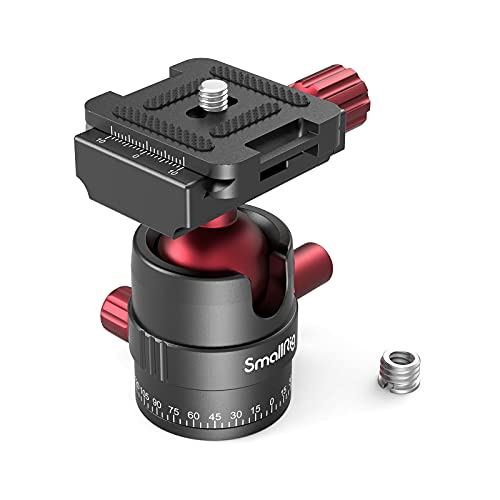
The K&F CONCEPT 28mm Metal Ball Head uses a 1/4-inch quick shoe, while the SmallRig 3034 documents an Arca-compatible plate. The SIRUI GH30 notes that plate specifications can vary among brands, so compatibility should be checked rather than assumed. This is especially important if your existing camera plate is already attached to a body or cage.
Match tilt and panorama features to the subject
A ball head is useful because it can change camera orientation quickly. Drop notches or U-shaped slots can make portrait positioning easier. The ARTCISE KB44 documents dual drop notches and up to 90-degree movement in those notches. The ARTCISE EB56S documents a U-shaped slot for 90-degree vertical shooting, and the NEEWER GM36 documents 90-degree tilt.
For panoramas, look for a separate rotating base and visible index marks. The ARTCISE EB56S, NEEWER GM36, SIRUI GH30, SIRUI KS-5, K&F CONCEPT BH-36, K&F CONCEPT 28mm Metal Ball Head, ARTCISE DB30-LS, and SmallRig 3034 all document panoramic rotation or marked control. The SIRUI GH30, SIRUI KS-5, ARTCISE DB30-LS, and SmallRig 3034 specifically provide 5-degree increments or indexed control in the supplied specifications.
A bubble level can help align the horizon before a sequence of images. The EB56S documents horizontal and vertical bubbles; the N52 documents double spirit bubbles; and the GM36, BH-36, and DB30-LS each document a bubble level. These features support setup, but they do not replace checking the camera position through the viewfinder or display.
Consider size and carrying weight
Larger balls generally occupy more space and may weigh more, while small heads can be easier to carry. The SIRUI KS-5 documents a 250-gram weight, and the K&F CONCEPT BH-36 documents 220 grams. The NEEWER GM36 documents 10.9 ounces. These are useful reference points for a portable kit.
The heavy-duty models trade compactness for larger balls and higher stated capacities. The N52 documents a 1.17-pound weight, and its 52mm ball is substantially larger than the 28mm and 29mm designs. The EB56S uses a hollow ball and cut-out clamp according to its specifications, describing those elements as weight-reduction features. The right choice depends on whether your priority is a large camera rig or a lighter monopod to carry for long periods.
Final recommendation
ARTCISE EB56S 56mm Low Profile Ball Head ranks first overall in this specification-based comparison under the published weighted criteria.
ARTCISE EB56S 56mm Low Profile Ball Head is the first overall specification-based choice among the best ball head monopods in this comparison. Its 56mm ball, 88-pound stated capacity, low-profile design, panoramic markings, vertical shooting slot, and included plates give it the broadest documented feature set for demanding camera rigs. The top ball head monopods also include the INNOREL N52 and ARTCISE KB44 for heavy equipment, while the NEEWER GM36 and SIRUI KS-5 are more compact alternatives.
Choose the INNOREL N52 when a 52mm ball, 66-pound capacity, and double spirit bubbles fit your setup. Select the ARTCISE KB44 if drag/friction adjustment and dual drop notches matter most. The K&F CONCEPT BH-36 is a practical choice for users who want a detachable handle and tilt limiter. For a lighter kit, the SIRUI KS-5, NEEWER GM36, or SmallRig 3034 provide documented panoramic controls with smaller bodies. Always confirm the head’s thread, plate standard, and stated capacity against the complete camera support system before use.
Frequently Asked Questions
Are these best ball head monopods complete monopods?
The selected entries are standalone ball heads designed to attach to a monopod through a 3/8-inch base thread or an included adapter. They do not include monopod legs. The product specifications identify monopod compatibility, but the camera support itself must be selected separately.
What capacity should a ball head monopod have?
Select a head whose stated capacity exceeds the combined camera, lens, and mounted accessories. The ARTCISE EB56S, INNOREL N52, and ARTCISE KB44 document much higher capacities than the SmallRig 3034. A higher capacity alone does not confirm compatibility with every monopod, so also check the monopod’s own capacity and mounting hardware.
Is an Arca-Swiss plate useful on a monopod head?
It can be useful when your camera cage, clamp, or other support equipment uses the same plate format. Several selected models document Arca-style compatibility, including the ARTCISE EB56S, INNOREL N52, SIRUI GH30, SIRUI KS-5, and SmallRig 3034. Plate dimensions and side-loading details can vary, so confirm the exact interface before relying on cross-brand compatibility.
Do I need a panoramic base?
A separate panoramic base is useful for controlled horizontal rotation and multi-image panoramas. The ARTCISE EB56S, NEEWER GM36, SIRUI GH30, SIRUI KS-5, K&F CONCEPT BH-36, and SmallRig 3034 document panoramic rotation or index markings. If you mainly need quick portrait or landscape positioning, a panoramic scale may be less important than the lock layout, tilt range, and plate system.
When is a low-profile design helpful?
A low-profile head places the camera closer to the support and can reduce the overall height of the assembly. The INNOREL N52, ARTCISE KB44, NEEWER GM36, SIRUI GH30, SIRUI KS-5, and SmallRig 3034 document low-profile characteristics. This design may be especially useful when you want a compact setup, but the larger low-profile heads can still add considerable weight because of their heavy-duty construction.