Buying Guide
Choosing among the best ac/dc multimeters starts with the type of current measurement you perform. Traditional lead meters are suited to voltage, resistance, continuity, diode, and other bench or panel checks. Clamp meters add a jaw for measuring current around a conductor, which can be useful when opening or interrupting a circuit is undesirable. The selected products include both designs, so compare the operating method as carefully as the headline voltage range.
Match the meter to the work
For broad electrical service, the Fluke 17B+ and Fluke 15B+ document AC/DC voltage to 1000V and current to 10A. The Fluke 17B+ adds frequency and temperature testing, while the 15B+ focuses on a core set of voltage, current, resistance, continuity, diode, and capacitance functions. These are conventional test-lead meters and do not document clamp-current operation.
For a more automated general-purpose tool, the Klein Tools MM420, AstroAI 6000-Count meter, and Crenova MS8233D document auto-ranging. The MM420 and AstroAI also document True RMS. True RMS is a useful specification to look for when the listing identifies work involving non-linear loads, but this comparison does not independently verify accuracy or performance. Crenova distinguishes itself by documenting both manual and automatic range modes.
Consider clamp access for current
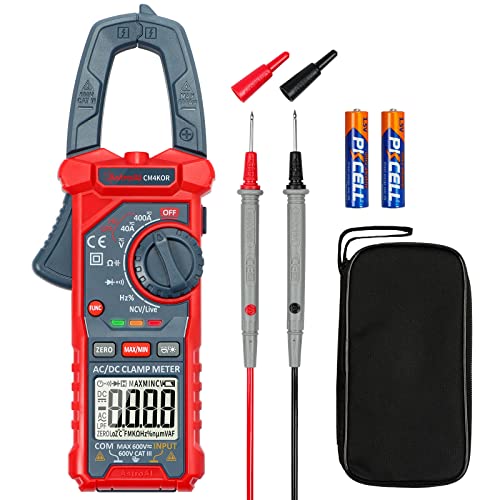
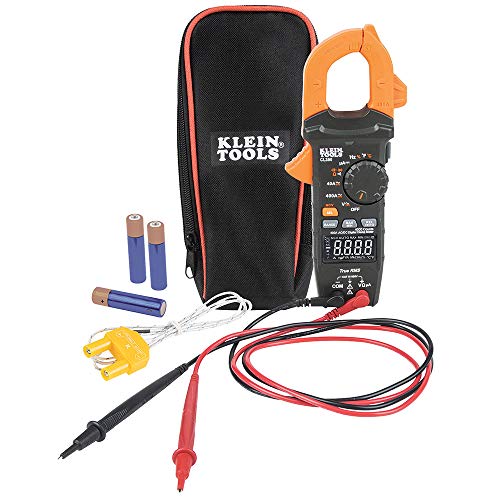
A clamp meter can measure current around one conductor through its jaw, while voltage and many other functions use test leads. The Klein Tools CL460S, Klein Tools CL390, KAIWEETS HT206D, FNIRSI DMC-100, and AstroAI CM4K0R all document this design. The FNIRSI DMC-100 lists clamp current up to 600A, while the CL460S lists 400A AC/DC current. The supplied evidence does not provide a maximum current range for the CL390, HT206D, or CM4K0R, so do not infer one from the product format.
The HT206D is especially differentiated by LowZ and a low-pass filter, both described for reducing ghost-voltage confusion or supporting variable-frequency-drive signals. The FNIRSI DMC-100 adds real-time curve recording and historical records. Those functions may matter more for intermittent-fault investigation than for a simple battery or outlet check.
Review safety documentation
Safety information should be read as a specification boundary, not as a substitute for correct procedure. Fluke 17B+, Fluke 15B+, Crenova MS8233D, AstroAI CM4K0R, and KAIWEETS HT206D provide explicit CAT or IEC information in the supplied listings. The MM420 includes leads with CAT III/CAT IV safety caps and lead-alert protection. AstroAI’s 6000-count meter, Crenova, and several other models list ceramic or dual-fuse protection.
The KAIWEETS HT206D and FNIRSI DMC-100 should not be treated as interchangeable on safety evidence: the former documents CAT III 600V and IEC 61010-1, while the latter’s supplied information emphasizes functions and recording but does not state a CAT rating. Similarly, the CL460S and CL390 have useful electrical features, but their supplied entries do not state a CAT rating. Always check the meter’s instructions and the circuit category before use.
Prioritize display and control features
Backlighting appears across several selected meters and can help when the listing’s intended use includes dim areas. The MM420 lists a backlit display, while the CL460S uses a transflective reverse-contrast LCD. The CL390 lists a reverse-contrast display, and the AstroAI CM4K0R and Crenova models list backlit screens. Data hold and auto shutoff are also documented on several models, helping users retain a reading or conserve battery power.
Smart mode on the CL460S automatically switches among continuity, voltage, current, and resistance without dial adjustment. Auto-ranging on the MM420, AstroAI, Crenova, HT206D, and other selected meters can reduce manual range selection. Manual control still has a place when a user wants to choose a specific range, which is why Crenova’s switchable manual/auto approach is notable.
Check included accessories and power
Included accessories can affect readiness. The Fluke 17B+ lists a type K thermocouple, the MM420 lists a thermocouple and batteries, and Crenova lists test leads, alligator clips, batteries, and a carrying box. The FNIRSI DMC-100 uses a built-in rechargeable battery with Type-C charging, whereas many other selected meters use replaceable AAA batteries. The right choice depends on whether you prefer charging or carrying spare cells.
Do not assume every model includes every accessory mentioned elsewhere in a brand’s range. This comparison uses only the supplied listing evidence for each specific ASIN. Also note that clamp jaws are intended for current measurement; the FNIRSI listing explicitly says voltage measurement must use test leads.
How this comparison was scored
The ranking is specification-based rather than a hands-on test, and it does not summarize customer opinions. Measurement coverage receives 25% of the editorial score, electrical safety features 20%, range automation and reading support 20%, specialized diagnostics 20%, and field practicality 15%. Scores use the supplied feature and specification fields. Volatile marketplace information was not used in the published criteria or product descriptions. Because the products serve somewhat different jobs, a lower-ranked clamp meter may still be the better fit for a current-measurement task than a higher-ranked traditional meter.
Final Recommendation
KAIWEETS HT206D 6000-Count TRMS Clamp Meter ranks first overall in this specification-based comparison under the published weighted criteria.
The Fluke 17B+ is the first overall specification-based choice among these best ac/dc multimeters because it combines 1000V AC/DC voltage, 10A current, CAT III 600V documentation, temperature testing, and a broad diagnostic function set. Choose the Klein Tools MM420 if True RMS, auto-ranging, lead-alert protection, and drop documentation are more useful to your workflow.
For clamp-based current work, the Klein Tools CL460S is the most automation-focused option, while the FNIRSI DMC-100 is the distinctive choice for documented graphing and stored records. The KAIWEETS HT206D fits users who need LowZ and LPF features. The Fluke 15B+ is a simpler high-voltage lead-meter choice, and the AstroAI 6000-Count and Crenova MS8233D cover broad home and automotive troubleshooting functions. These top ac/dc multimeters should be selected by measurement method, safety documentation, and the functions your circuit work actually requires.
Frequently Asked Questions
What should I look for in the best ac/dc multimeters?
Start with the AC/DC voltage and current ranges required for your work, then check whether you need a traditional lead meter or a clamp meter. True RMS, auto-ranging, backlighting, temperature, capacitance, frequency, NCV, and appropriate CAT documentation are useful differentiators when they are explicitly listed.
Are clamp meters included in this comparison?
Yes. The Klein Tools CL460S, Klein Tools CL390, KAIWEETS HT206D, FNIRSI DMC-100, and AstroAI CM4K0R document clamp-based AC/DC current measurement. Their voltage and many other measurements use test leads, and the listed maximum current capacity varies by model.
Is True RMS necessary for every electrical task?
Not necessarily. It is a useful specification when the meter is intended for non-linear loads or variable electrical signals, but the need depends on the circuit and the measurement task. The MM420, AstroAI 6000-Count, KAIWEETS HT206D, FNIRSI DMC-100, CL460S, CL390, and AstroAI CM4K0R document True RMS.
Which selected meter documents temperature testing?
The Fluke 17B+, Klein Tools MM420, KAIWEETS HT206D, FNIRSI DMC-100, AstroAI 6000-Count, Klein Tools CL390, and Klein Tools CL460S list temperature measurement or a thermocouple in the supplied evidence. The specific probe or temperature range varies, so check each listing before buying.
Can I compare safety ratings directly across every model?
Only where the supplied listing provides comparable information. Several products document CAT III 600V or IEC information, while others list fuses, insulated housings, or lead caps without stating the same meter rating. Follow the manufacturer’s instructions and use a meter appropriate for the circuit category.