Buying Guide
The best true rms multimeters should be selected by matching documented capability to the type of work you expect to perform. True RMS is useful when measuring AC signals that are not clean sine waves, but it is only one part of a meter’s specification. Range, safety protection, functions, interface, and power design all deserve attention.
Match the meter to the work
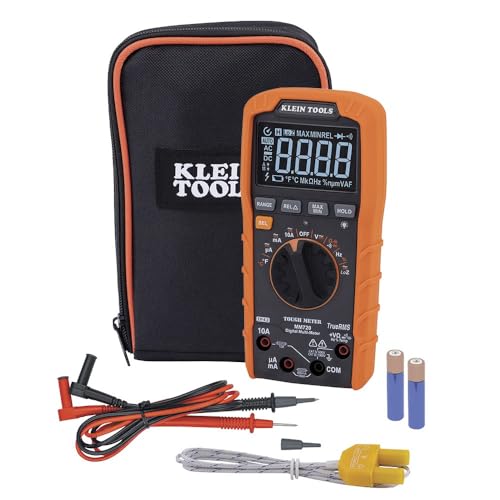
For broad electrical troubleshooting, the Klein Tools MM720, KAIWEETS HT118E, UNI-T UT161B, and Neoteck 6000 Counts models provide especially extensive coverage. Their listings document combinations of AC/DC voltage, current, resistance, continuity, diode, capacitance, frequency, duty cycle, and temperature functions. A broad function list can reduce the need to carry separate tools, although it can also make the interface more complex.
For focused electrician work, the Fluke 117 and Fluke 115 are more specialized choices. The Fluke 117 adds VoltAlert non-contact voltage detection, automatic AC/DC selection, and low input impedance for helping prevent ghost-voltage readings. The Fluke 115 emphasizes core field measurements and Min/Max/Average recording. Both document CAT III 600V safety ratings.
Home and automotive users may prefer the AstroAI 6000 Counts model or Klein Tools MM420. AstroAI documents battery, temperature, capacitance, frequency, and duty-cycle testing, while the MM420 adds lead-alert LEDs and a stated 6.6-foot drop specification. These features are useful when the meter will move between household circuits, vehicles, and general repair tasks.
Check voltage and current ranges
A higher maximum range is not automatically better for every job, but it can broaden the circuits a meter is specified to handle. The Klein Tools MM720 and UNI-T UT161B document 1000V AC/DC voltage measurement, while the KAIWEETS HT118E and Neoteck models document CAT III 1000V protection. The AstroAI 6000 Counts and Klein Tools MM420 list 600V measurement ranges.
Current capability also varies. Several selected models document 10A current measurement, while the product descriptions should be checked carefully for whether AC, DC, or both are covered. Do not infer a current range from the True RMS label alone. Follow the manufacturer’s instructions and the relevant safety markings for the specific measurement.
Pay attention to safety features
Safety information is one of the most important differences between listings. The KAIWEETS HT118E, UNI-T UT161B, KAIWEETS KM602, and Neoteck meter document CAT III 1000V/CAT IV 600V ratings. The Fluke 115 and Fluke 117 document CAT III 600V. The Klein Tools MM420 includes test leads with CAT III/CAT IV safety caps, but its listing does not provide the same meter-category detail.
Other protective features include ceramic fuses, overload protection, silicone covers, and lead-placement alerts. Non-contact voltage detection can help identify a live circuit without immediately contacting a conductor, but it should not replace the prescribed procedure for verifying a circuit’s condition. The Fluke 117’s VoltAlert, UNI-T’s NCV, AstroAI’s NCV functions, and the KAIWEETS models’ documented NCV features are examples of this design type.
Compare resolution and display design
Counts describe displayed resolution, not a guarantee that every measurement will be more accurate. The KAIWEETS HT118E lists 20000 counts, the FNIRSI DMT-99 lists 9999 counts, and several others list 6000 counts. The UNI-T UT161B also includes a 31-segment analog bar display, which can provide a visual indication of changing readings.
Display visibility matters in practical use. The Klein Tools MM720 and Klein Tools MM420 use high-visibility reverse-contrast displays, while the Fluke meters document large white LED backlights. The KAIWEETS KM602 uses a full-screen color display, and the FNIRSI DMT-99 uses a 2.4-inch HD TFT color screen. Backlights and flashlights are particularly relevant for panels, engine bays, and dim work areas.
Consider power and convenience
Traditional battery operation is simple, but rechargeable designs can reduce the need for frequent battery replacement. The KAIWEETS KM602 lists a built-in 1200mAh rechargeable battery, and the FNIRSI DMT-99 lists a 1500mAh rechargeable battery with Type-C charging. The KM602 also documents low-battery alerts and Min/Max/Average recording.
Auto-ranging is useful when the expected value is uncertain. Several selected products document auto-ranging, while the Neoteck model adds auto/manual dual-range switching. Smart identification goes further: the KM602 recognizes voltage, resistance, and continuity, and the FNIRSI DMT-99 documents automatic identification for several basic tests. These conveniences can speed routine checks, but manual control may still be preferable when you need a specific range or a repeatable procedure.
Review accessories and physical design
A kickstand, lead holders, magnetic options, a flashlight, or a storage case can affect day-to-day use. The Klein Tools MM720, MM420, KAIWEETS HT118E, and FNIRSI DMT-99 document storage or hands-free features. The KAIWEETS HT118E includes a durable case, while the FNIRSI model documents a rear-integrated kickstand and storage slots.
Before buying, verify the included leads, thermocouple, batteries, charging cable, and case against the current listing. Package contents can differ between versions, and accessories should not be assumed merely because a function appears in the product description.
Final Recommendation
KAIWEETS HT118E ranks first overall in this specification-based comparison under the published weighted criteria.
Klein Tools MM720 is the first overall specification-based choice among these best true rms multimeters because it combines 1000V measurement, LoZ, extensive functions, and a field-friendly display design. The Fluke 117 is a strong alternative for electricians who prioritize VoltAlert and LoZ, while the Fluke 115 offers a focused professional feature set. For high resolution and safety-category documentation, consider the KAIWEETS HT118E or UNI-T UT161B. The KAIWEETS KM602 and FNIRSI DMT-99 are compelling for rechargeable convenience and advanced displays. Together, these top true rms multimeters cover everyday household checks through more demanding technician workflows without relying on unsupported performance claims.
Frequently Asked Questions
What makes the best true rms multimeters different from basic meters?
True RMS meters are designed to calculate the effective value of AC signals more accurately when waveforms are distorted or non-sinusoidal. The supplied listings also show that models differ substantially in safety ratings, ranges, resolution, and functions. True RMS alone does not establish that one meter is suitable for every circuit.
Is a 6000-count meter enough for home troubleshooting?
A 6000-count meter can provide useful displayed resolution for many household and automotive tasks, but suitability depends on voltage and current ranges, safety category, and the functions you need. The AstroAI 6000 Counts, KAIWEETS KM602, and Neoteck models all document additional features beyond basic voltage measurement.
When is low impedance useful?
Low impedance can help reduce false readings caused by ghost or stray voltage. The Klein Tools MM720 and Fluke 117 specifically document LoZ-related functionality. Use the mode according to the manufacturer’s instructions because input characteristics can affect the circuit being measured.
No. Non-contact detection is a convenient preliminary feature documented on products such as the Fluke 117, UNI-T UT161B, and KAIWEETS HT118E, but it should not replace the required method for verifying electrical conditions. Follow the meter instructions and applicable safety procedures.
Do rechargeable multimeters make better choices?
Rechargeable models can be convenient when you want to avoid frequent battery changes. The KAIWEETS KM602 and FNIRSI DMT-99 document rechargeable batteries, while other selected meters use conventional battery designs. The better choice depends on whether charging access or replaceable batteries fits your work routine.