Buying Guide
The best adhesive industrial warning signs are chosen by matching the message and construction to the hazard, not by selecting the largest or most colorful decal. Start with the risk that must be communicated: electrical voltage, arc flash, rotating equipment, pinch points, heat, confined-space entry, chemical exposure, or restricted access. A technically durable sign with the wrong message is still a poor fit.
1. Match the wording to the hazard
Specific wording is the first buying criterion. The Victory Lane Graphics High Voltage Danger Labels identify a serious electrical hazard, while the SmartSign Arc Flash and Shock Hazard Label adds a PPE reminder. Those messages serve different communication tasks. For machinery, the Victory Lane Graphics Rotating Equipment Labels identify rotating equipment and include an entanglement graphic. The SmartSign Lockout Power Before Removing Guard Label goes further by stating an action before guard removal.
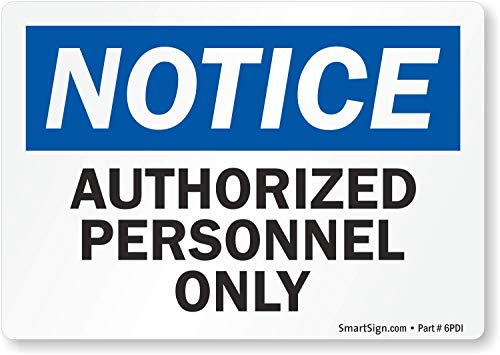
For locations involving possible hydrogen sulfide, the Victory Lane Graphics H2S Danger Labels name H2S directly. The Confined Space Labels similarly specify permit-only entry. These focused messages can be more useful than a generic caution because they tell personnel what kind of hazard or restriction is present. Choose a general access label, such as SmartSign Authorized Personnel Only, when the primary concern is who may enter rather than a physical hazard.
2. Check surface compatibility
Adhesive performance depends on the application surface and preparation. Several selected listings specify bonding to smooth metal, plastic, painted equipment, machinery, panels, tanks, doors, or other industrial surfaces. SmartSign also documents labels that conform to flat or curved surfaces. Before ordering, identify whether the destination is smooth, painted, curved, oily, dusty, or textured. Clean and dry the surface according to the product directions; the evidence supplied here does not establish adhesion on every substrate.
The ForraFun Pinch Point stickers are documented for metal, plastic, glass, coated surfaces, and slightly curved or uneven areas. That makes them flexible for individual machinery locations, but their small size should be considered if workers need to read the message from several feet away. Adhesive signs are not automatically suitable for rough or textured surfaces. The SmartSign floor sign explicitly excludes textured floors, illustrating why the destination matters.
3. Consider outdoor and industrial exposure
For outdoor equipment, process areas, and workshops, look for documented resistance rather than assuming all vinyl is equivalent. The Victory Lane Graphics electrical, confined-space, H2S, and rotating-equipment labels list combinations of waterproof, UV-resistant, weather-resistant, abrasion-resistant, chemical-resistant, oil-resistant, or grease-resistant construction. Their protective laminates are especially relevant where the sign may be wiped, exposed to sunlight, or contacted by industrial grime.
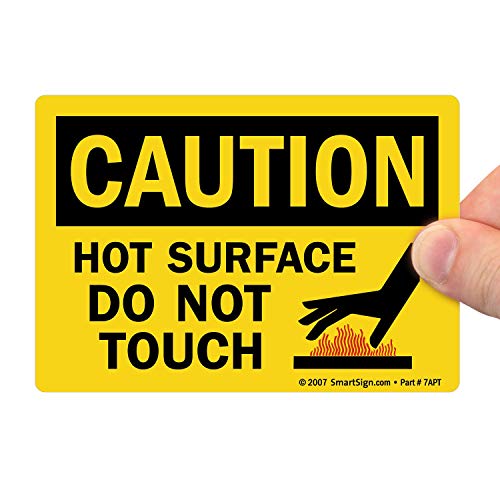
SmartSign’s selected labels use laminated vinyl, with claims covering weather protection, cleanability, and resistance to abuse. The D Sticky Company hazardous-voltage decals are described as weatherproof. By contrast, the SmartSign Hot Surface label has less construction detail in its listing. It remains suitable for a compact, clearly identified heat warning based on the supplied evidence, but buyers needing a demanding outdoor specification should favor a product with more explicit environmental documentation.
4. Select a readable size and layout
Size should follow viewing distance and available mounting space. The 5-by-7-inch labels are a useful middle format for panels, doors, and equipment. The 5-by-10-inch Lockout label provides more horizontal room for a longer instruction. The 3.5-by-7-inch Rotating Equipment label is narrower while retaining a substantial height, which may help on guards or machinery faces.
Small labels have a different purpose. The 1.5-by-3-inch ForraFun stickers can mark multiple pinch points close to the hazard. The 3-by-5-inch D Sticky Company decals and 3.5-by-5-inch SmartSign labels suit equipment with limited space. Compare the sign’s dimensions with the intended viewing distance, line length, icon size, and surrounding equipment. A compact sign may fit better but offer less distance visibility.
5. Use pack quantity strategically
Pack size affects installation planning. Five-packs work well when the same message belongs at several entry points or pieces of equipment. The 10-pack Rotating Equipment labels and 50-piece Pinch Point set are better suited to repeated marking across a production area. Single-label formats are appropriate for one door, panel, or machine, but ordering several may be necessary for a consistent facility-wide program.
Do not treat a larger pack as automatically better. First determine how many locations require the exact same warning. Different hazards should not be substituted merely because one product supplies more pieces. The message, surface, and exposure remain more important than quantity.
6. Review compliance language carefully
Some listings describe an OSHA-style or ANSI-style visual format, while others make narrower construction or message claims. This comparison reports those supplied descriptions and does not independently certify regulatory compliance. Confirm your facility’s signage program, applicable requirements, and placement rules before installation. Also verify that the chosen message accurately reflects the hazard and that the sign is not being used as a replacement for required controls, procedures, training, or protective equipment.
Final Recommendation
SmartSign Lockout Power Before Removing Guard Label ranks first overall in this specification-based comparison under the published weighted criteria.
The final choice among the best adhesive industrial warning signs depends on the documented features that match your intended use.
Victory Lane Graphics High Voltage Danger Labels is the highest-scoring returned product and the first overall specification-based choice. Its 5-by-7-inch format, electrical hazard wording, UV laminate, waterproof vinyl, and permanent adhesive create a well-supported combination for panels, switchgear, and related equipment. The Victory Lane Graphics Confined Space Labels and H2S Danger Labels are stronger when the hazard is specialized, while the SmartSign Lockout label is preferable when the sign must communicate an action.
Among the top adhesive industrial warning signs, the best match still depends on the site. Select the Rotating Equipment labels or ForraFun Pinch Point stickers for machinery, SmartSign Hot Surface for compact heat marking, and SmartSign Authorized Personnel Only for access control. For several electrical locations, the D Sticky Company pack offers a smaller documented format. Confirm surface condition, viewing distance, exposure, and required wording before applying any sign.
Frequently Asked Questions
How do I choose the best adhesive industrial warning signs for outdoor equipment?
Prioritize listings that explicitly document waterproof, weather-resistant, UV-resistant, abrasion-resistant, chemical-resistant, oil-resistant, or grease-resistant construction. The Victory Lane Graphics electrical, confined-space, H2S, and rotating-equipment labels provide the most extensive combinations in this selection. Also confirm that the surface is smooth and clean enough for the adhesive, and check whether the sign will face direct sunlight, washdown, oils, or other exposure.
Are adhesive vinyl signs suitable for curved machinery?
Several selected products document use on curved surfaces. SmartSign lists flat-or-curved installation for its laminated labels, and the ForraFun Pinch Point stickers are described for slightly curved or uneven areas. However, the evidence does not establish suitability for every radius or surface texture. Measure the area, clean it thoroughly, and avoid assuming that a product designed for smooth curved surfaces will bond to rough, porous, or heavily contaminated equipment.
Should I use a large sign or several small labels?
Use a larger sign when people need to recognize the hazard from farther away or when the message contains an instruction. The 5-by-7-inch and 5-by-10-inch products support that use. Several small labels are more appropriate when the same localized hazard appears at many points, such as pinch zones on conveyors or equipment. The ForraFun 50-piece set is documented for repeated machinery marking, but its 1.5-by-3-inch format is not equivalent to a distant-view sign.
Do these signs replace lockout procedures or protective equipment?
No. The supplied evidence describes warning communication and adhesive construction; it does not establish that any label replaces procedures, training, guards, lockout controls, or PPE. A sign should identify the hazard or instruction at the relevant location. For electrical or machinery applications, use the sign as part of the facility’s broader safety system and verify wording and placement with the responsible safety professional.
When is a specialized hazard message preferable to a general warning?
Use specialized wording when the hazard is known and personnel need a precise instruction or identification. H2S, confined-space permit entry, rotating equipment, arc flash, lockout, and hazardous voltage are all distinct examples in this selection. A general access-control label is more suitable when the primary message is restricted entry. Selecting the most accurate message helps prevent ambiguity, but the wording should always match the actual site condition.