Buying Guide
The best adjustable dish racks are not interchangeable: some expand across a sink, some extend across a countertop, and some can be used inside the sink itself. The right choice depends on where water should go, how much tableware you usually wash, and how much clearance your kitchen provides. Start by identifying the rack’s operating position before comparing accessory counts or finishes.
Measure the sink and surrounding clearance
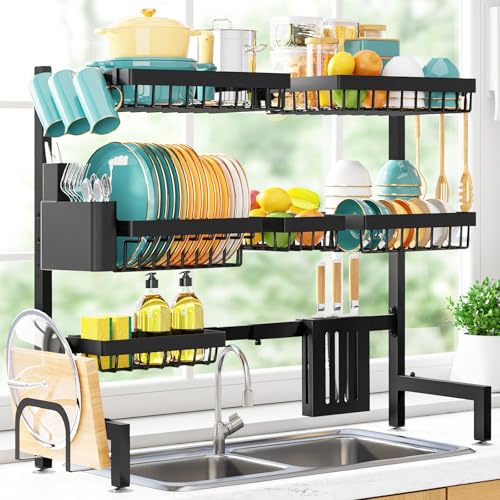
Measure the sink’s inside length, outside span, and available counter depth. For an over-sink rack, also measure from the counter to the bottom of any cabinet and check the faucet height. The Sakugi 3-Tier Over-Sink Rack extends from 31.5 to 39.5 inches and reaches 30.5 inches in listed height, so it needs substantially more vertical and horizontal room than the Sakugi Compact In-Sink Rack. The latter adjusts from 15.4 to 24 inches and is intended for smaller layouts.
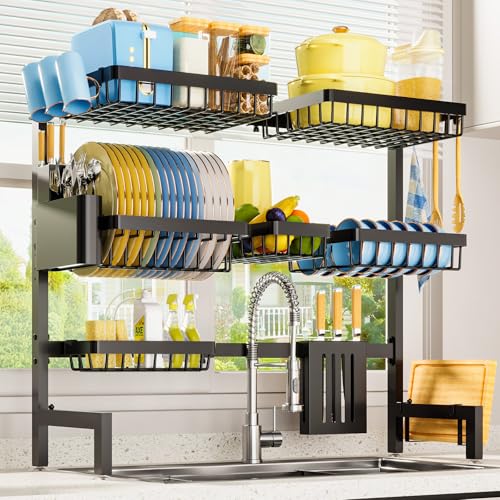
Do not rely on a general statement such as “fits most sinks.” The Kitsure Large Over-Sink Rack specifies a sink width below 33.9 inches, while the SAYZH 2-Tier Over-Sink Rack extends to 33.5 inches and recommends at least 26.5 inches of cabinet-to-counter clearance. These figures illustrate why a few minutes with a tape measure can prevent an unsuitable purchase.
Choose over-sink, counter, or in-sink placement
Over-sink designs put dishes above the basin and let water fall directly into it. This can preserve counter space, but the rack must bridge the sink securely and leave room for the faucet. The Sakugi 3-Tier Over-Sink Rack, Kitsure Large Over-Sink Rack, and SAYZH 2-Tier Over-Sink Rack are designed around this elevated arrangement.
Countertop designs usually provide a drip tray and spout. They are easier to reposition, but the counter must have enough depth and a drainage route to the sink. The Urackify Extendable Dish Rack uses a drip tray and inclined tray section, while the SNTD Expandable Counter Rack uses an angled drip tray and adjustable extension feet. The SAYZH Expandable Counter Rack also uses a sloped drainboard and drain spout.
In-sink or multi-position racks are useful when counter space is especially limited. The Sakugi Compact In-Sink Rack can be placed inside the sink, over the sink, or on the counter. That flexibility is valuable, although its compact dimensions are better suited to lighter daily loads than to a large family’s full dishwashing cycle.
Match the adjustment mechanism to your layout
Length adjustment is the most common feature, but the useful range varies widely. The Sakugi 3-Tier Over-Sink Rack has the broadest documented span in this selection. The Kitsure Large Over-Sink Rack and SAYZH 2-Tier Over-Sink Rack also cover relatively wide sinks. These models make sense when the rack must bridge a substantial basin, provided the maximum size does not exceed the available space.
Adjustable support legs add another dimension. The SNTD Expandable Counter Rack uses adjustable extension feet, the Kitsure Adjustable 15.6–25.2-Inch Rack uses adjustable support legs, and the GSlife Large 2-Tier Rack lists support legs extending from 15 to 23 inches. This design can help a rack sit over differently sized sinks, but correct positioning and a level supporting surface remain important.
For narrow counters, the GSlife Narrow 2-Tier Rack keeps its width to seven inches and changes length from 15.7 to 20.7 inches. That is a different kind of adjustability: it preserves side-counter space while adding vertical storage. The trade-off is a smaller stated capacity intended for one or two people.
Consider drainage before accessory quantity
A rack that holds many dishes is less useful if its drainage path does not suit the counter. Look for a sloped tray, a spout that reaches the sink, or an elevated over-sink layout. The Urackify Extendable Dish Rack uses a drip tray and inclined tray, and its raised feet are intended to fit over most sinks. The SNTD Expandable Counter Rack lists a drain spout from 6.06 to 8.54 inches and raised attachments for sinks with lips.
A rotating spout can make counter placement easier. Both GSlife designs in this comparison document 360-degree or rotating spouts that direct water from different positions. That feature may be useful when the sink is not directly in line with the rack’s default outlet. However, the counter slope, sink rim, and spout reach still determine whether water will actually enter the basin.
Compare storage zones with your dish mix
Dedicated slots are useful when you regularly dry plates, bowls, cups, knives, or cutting boards together. The Sakugi 3-Tier Over-Sink Rack has baskets plus dedicated utensil, cutting board, and knife holders. The Kitsure Large Over-Sink Rack adds three multipurpose baskets, a utensil holder, knife holder, cutting board holder, and five hooks.
Simpler racks can be easier to arrange. The Kitsure Adjustable 15.6–25.2-Inch Rack focuses on an extendable frame, a removable draining board, and general space for dishes and utensils. The GSlife Narrow 2-Tier Rack uses an upper plate tier, lower shelf, and side utensil holder. Choose the more elaborate layout when you want fixed zones; choose a simpler one when you prefer flexibility or wash fewer kinds of cookware.
Check stability and cleaning details
Look for silicone or rubber feet, suction cups, screw locks, or other documented supports. The Kitsure Large Over-Sink Rack lists four suction cups. The SAYZH 2-Tier Over-Sink Rack uses anti-slip feet, while the Sakugi Compact In-Sink Rack uses non-slip rubber covers on its supporting bars. These features support positioning but do not remove the need to confirm a compatible sink edge.
Maintenance features also matter because dish racks remain wet. Several selected models describe rust-resistant coated metal, stainless steel, removable holders, or detachable drainage components. The Sakugi 3-Tier Over-Sink Rack and Kitsure Large Over-Sink Rack specify 304 stainless steel. The Kitsure Adjustable 15.6–25.2-Inch Rack and SAYZH Expandable Counter Rack emphasize detachable parts or no-tool assembly. Removable components can make it easier to reach trapped water and food residue.
Final recommendation
Sakugi 3-Tier Over-Sink Rack ranks first overall in this specification-based comparison under the published weighted criteria.
The Sakugi 3-Tier Over-Sink Rack is the highest-scoring returned product and the first overall specification-based choice among the best adjustable dish racks. Its wide 31.5- to 39.5-inch range, three-tier structure, direct drainage, and 304 stainless steel construction give it the most specification-aligned documented combination for large sink areas.
For a slightly smaller but still highly organized over-sink setup, the Kitsure Large Over-Sink Rack is a strong alternative, especially when removable baskets and multiple holders are useful. The SNTD Expandable Counter Rack is better suited to buyers who want a detailed counter storage layout and a directed drainage system. In very narrow kitchens, the GSlife Narrow 2-Tier Rack is a more targeted choice, while the Sakugi Compact In-Sink Rack offers the most placement flexibility for small spaces.
These are the top adjustable dish racks in this comparison, but the final decision should follow your measurements rather than the ranking alone. Confirm the rack’s minimum and maximum span, height, faucet clearance, support surface, and drainage direction before ordering.
Frequently Asked Questions
Among the best adjustable dish racks, what should I measure before buying an adjustable dish rack?
Measure the sink’s inside length and width, the available counter depth, and the distance from the counter to the bottom of nearby cabinets. Also check faucet height and the position of the sink rim. Over-sink racks such as the Sakugi 3-Tier Over-Sink Rack can be tall and wide, while compact models such as the Sakugi Compact In-Sink Rack require a different type of fit. Compare your measurements with both the minimum and maximum adjustment range.
Are over-sink racks better than countertop racks?
Neither placement is universally better. Over-sink racks can keep wet dishes above the basin and preserve counter space, but they require compatible sink edges and overhead clearance. Countertop racks can be easier to reposition and often include a drip tray and spout, but they use counter area. The Urackify Extendable Dish Rack and SNTD Expandable Counter Rack document directed drainage, while the Kitsure Large Over-Sink Rack is designed for elevated sink use.
Which adjustable rack is suited to a small kitchen?
The Sakugi Compact In-Sink Rack is suited to compact kitchens because it can be used inside the sink, over the sink, or on the counter and adjusts from 15.4 to 24 inches. The GSlife Narrow 2-Tier Rack is another focused option when the available side-counter width is only seven inches. Both have less documented capacity than the larger multi-tier systems, so they are more appropriate for smaller daily loads.
Does stainless steel make a dish rack maintenance-free?
No. The selected listings describe stainless steel or rust-resistant coatings, but any rack used around water still benefits from regular cleaning and drying. The Sakugi 3-Tier Over-Sink Rack and Kitsure Large Over-Sink Rack specify 304 stainless steel. Other selected racks use coated metal, plastic drainboards, or detachable parts. Follow the maker’s care directions and inspect trays, spouts, feet, and joints for trapped water or residue.
How much adjustment range do I need?
Choose a range that covers your measured sink or counter position without forcing the rack to its extreme limit. Wider ranges, such as the Sakugi 3-Tier Over-Sink Rack’s 31.5 to 39.5 inches, suit broader sink spans. A narrow rack such as the GSlife Narrow 2-Tier Rack may be more appropriate when the main constraint is side-counter width. Adjustment range should be considered alongside height, support design, and drainage reach.