Buying Guide
Choosing among the best 7-inch diamond saw blades starts with the material and the tool. A blade intended for porcelain tile may use a continuous rim and fine grit, while a blade for concrete or brick usually uses segmented or turbo sections to create space for debris and airflow. The products in this comparison are all listed as 7-inch diamond blades, but their documented designs are not interchangeable for every job.
Match the blade to the material
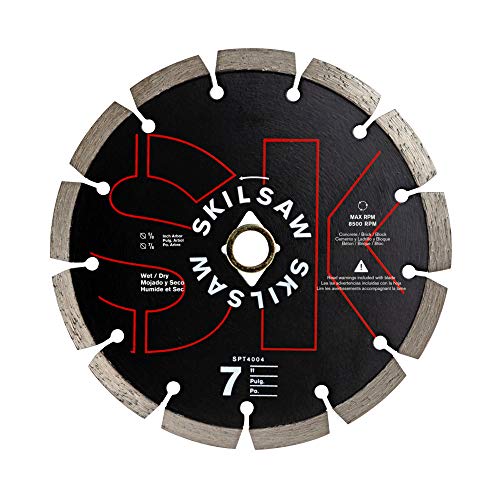
For concrete, block, brick, pavers, and general masonry, segmented blades are consistently represented in the selected group. The Makita B-69624, Diablo DMADS0700, EZARC 7-inch Segmented Diamond Blade, SKILSAW SPT4004, and Whirlwind USA blade all identify masonry materials in their supplied evidence. Segments create gaps around the rim, and several listings connect those gaps with debris removal or cooling.
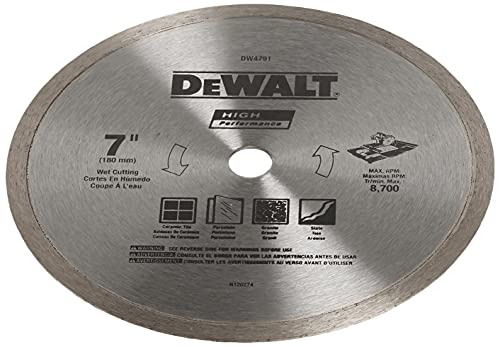
Tile and delicate stone require a different emphasis. The Bosch DBC0701 uses a continuous rim, fine diamond grit, and a softer matrix for ceramic tile, porcelain, slate, and marble. The DEWALT DW4791 is specifically documented for wet cutting of tile and stone, with a thin kerf and 5 mm diamond segment height. These details make them more targeted than a general masonry blade when the work involves finish-sensitive tile.
Turbo designs provide another option for mixed projects. The POWERTEC 14001 lists porcelain, ceramic tile, granite, marble, masonry, brick, slate, and cement backer board, while the EZARC Turbo blade and EDiamondTools TB70X focus on hard stone and masonry. A turbo rim can suit mixed stone and masonry work, but the listing should still confirm the material you plan to cut.
Check arbor fit before buying
Arbor compatibility is a basic safety and usability checkpoint. The Diablo DMADS0700, POWERTEC 14001, SKILSAW SPT4004, and Whirlwind USA blade provide useful arbor information. Diablo lists DM 7/8-inch and 5/8-inch compatibility and includes a 5/8-inch bushing. POWERTEC lists a 7/8-inch arbor with adapter rings for 20 mm and 5/8-inch fits. SKILSAW specifies both 5/8-inch and 7/8-inch arbors.
The EZARC Turbo blade lists a 1-inch arbor and a 5/8-inch copper adapter washer, while the EZARC segmented model documents a 7/8-inch arbor. The Makita B-69624 and DEWALT DW4791 listings supplied here do not state an arbor size. That does not establish incompatibility, but you should verify the tool and blade specifications before ordering.
Decide between wet and dry cutting
Wet cutting can be important for tile and stone work, while dry cutting may be more convenient for outdoor masonry or tools that do not support water. The Bosch listing does not specify wet-or-dry flexibility, and the DEWALT DW4791 is described for wet cutting. Several other selected products list both wet and dry use.
Do not treat a wet-or-dry statement as permission to ignore the saw manufacturer’s instructions. Confirm that the blade, guard, arbor, and tool are approved for the intended method. Dry cutting masonry can create dust, so suitable protective equipment and dust-control practices remain important.
Compare rim design and cutting priorities
Continuous rims are oriented toward a consistent edge on tile and stone. Segmented rims prioritize material removal and airflow for masonry. Turbo rims use a textured or raised cutting edge and are represented here for mixed stone and masonry applications. Within each design, the available evidence varies: Bosch provides fine-grit and matrix details, Makita provides 13 mm segment information, and several products provide 10 mm segment heights.
Thin kerf or thin-body claims may indicate a design aimed at lower cutting resistance or reduced material waste, but they should not be treated as a guarantee of results. POWERTEC describes an ultra-thin turbo mesh design, and DEWALT lists a thin kerf. Use those details as comparison points rather than promises of identical performance on every saw.
Construction details help distinguish a well-documented blade from one with only a broad description. Diablo identifies a hardened disc body, a strong bond, and impact-resistance features. EZARC identifies 75Cr alloy steel and heat-pressed sintered diamond tips on its segmented blade. Whirlwind USA lists hot-press construction, while several products specify diamond segment height or thickness.
These are specification signals, not hands-on test results. This guide does not claim a verified service life, cutting speed, vibration level, or finish quality beyond what each public listing states. Claims such as longer life or faster cutting are listing statements, not independently confirmed conclusions.
Final recommendation
POWERTEC 14001 7-inch Turbo Mesh Diamond Blade ranks first overall in this specification-based comparison under the published weighted criteria.
POWERTEC 14001 7-inch Turbo Mesh Diamond Blade is the first overall specification-based choice among the best 7-inch diamond saw blades.
Its documented material range, turbo mesh design, adapter-ring compatibility, and wet-or-dry use give it the most specification-aligned combined profile under the published criteria. The Diablo DMADS0700 is a strong alternative when dual-arbor compatibility and masonry construction details matter. Makita B-69624 is a focused option for concrete, block, brick, and pavers, while Bosch DBC0701 is more specialized for tile and marble because its continuous rim, fine grit, and softer matrix are directly documented for smooth cuts.
The top 7-inch diamond saw blades are not identical substitutes. Choose the rim type and material coverage first, then verify arbor dimensions, maximum speed, and wet-or-dry requirements for your specific tool. The rankings reflect supplied specifications, not customer sentiment or hands-on testing.
Frequently Asked Questions
Among the best 7-inch diamond saw blades, are 7-inch blades suitable for both tile and concrete?
Some are, but not all. The POWERTEC 14001 lists tile, stone, brick, masonry, and cement backer board, and the EZARC Turbo blade lists granite, marble, concrete, and brick. Bosch DBC0701 is more specifically oriented toward tile and stone, while Makita B-69624 is more clearly focused on general masonry. Match the blade to the material rather than assuming every 7-inch blade has the same use range.
Is a segmented blade better than a continuous rim?
Neither design is universally better. Segmented blades are represented for concrete, block, brick, and pavers because their gaps support debris clearance and airflow. The Bosch DBC0701’s continuous rim is documented for precise cuts in ceramic tile, porcelain, slate, and marble. The correct choice depends on the material and the edge quality required.
How do I confirm arbor compatibility?
Compare the blade’s listed arbor size with the tool’s arbor and use only an adapter or bushing supplied or approved for that setup. Diablo lists DM 7/8-inch and 5/8-inch compatibility, SKILSAW lists 5/8-inch and 7/8-inch, and the EZARC Turbo blade lists a 1-inch arbor with a 5/8-inch adapter washer. If the listing does not state an arbor size, verify it before purchase.
Can I use a wet-or-dry blade dry indoors?
A wet-or-dry designation does not remove dust or tool-safety concerns. Follow the saw and blade instructions, use the guard, and apply suitable eye, respiratory, hand, and hearing protection for the work. Dry cutting masonry may produce significant dust, so outdoor use or an appropriate dust-control setup may be preferable.
What should I check besides the diameter?
Check the arbor, maximum RPM, rim design, material list, segment or kerf dimensions, and whether wet or dry cutting is supported. EDiamondTools TB70X lists a 2.5-inch cutting depth, while EZARC Turbo lists a maximum 8,700 RPM. Those specifications can matter more than diameter alone when matching a blade to a project.