Buying Guide
The best app-controlled dehumidifiers are not interchangeable. A unit sized for a bedroom has different priorities from one intended for a basement, crawl space, or whole-home moisture problem. Start with the space, then compare capacity, drainage, controls, and installation requirements.
Match capacity to the space
Listing coverage figures are useful starting points, but they are not guarantees of performance in every home. The selected models range from smaller household formats to units listing coverage of several thousand square feet. For a bedroom, office, or bathroom, a compact model may be easier to place. Larger basements and open living areas generally benefit from a higher listed pint capacity and a continuous-drain connection.
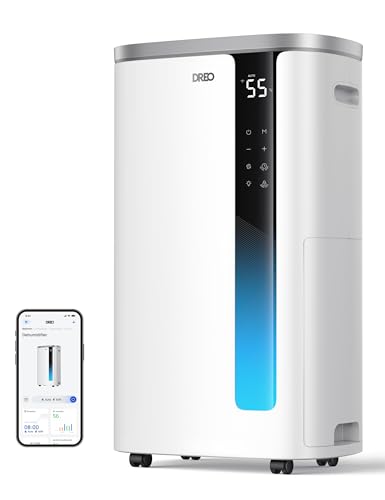
The Sijipt lists 100 pints per day and coverage up to 6,000 square feet, while the DREO lists 73 pints and up to 2,000 square feet. Those figures show why capacity and claimed coverage should be read together rather than treated as the same measurement. The ALORAIR Sentinel HD55S WiFi is a different category within the group: its listing gives both saturation and AHAM capacities and positions it for crawl spaces. That specialty design is more relevant when the unit will remain installed in an enclosed area.
Check the app experience you actually need
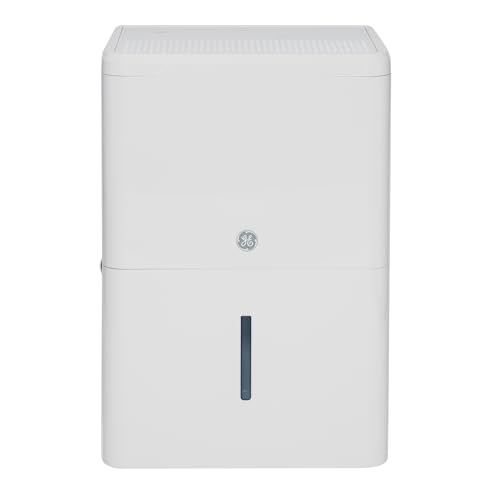
Every selected model documents app-based control, but the functions vary. Basic smart operation may include remote power, humidity adjustment, mode changes, or timers. GE adds SmartHQ support with Alexa and Google Assistant, while Midea lists SmartHome control with Alexa and Google Assistant. DREO goes further in the supplied evidence by listing energy-use and power-cost monitoring in its app.
Before buying, confirm the connection requirements. A remote app is most useful when the unit is difficult to reach, such as in a basement or crawl space. For a nearby bedroom unit, a clear control panel and readable humidity display may matter just as much.
Plan drainage before placing the unit
A water tank is convenient when you cannot access a drain, but continuous drainage is usually better for long unattended operation. Most of the selected household units provide a hose connection. The DuraComfort and Midea models add built-in pumps, which can help when the drain is elevated or farther away. DuraComfort specifically lists pumping up to 16.4 feet, and Midea lists a 16-foot drain tube.
Tank size also affects maintenance. DREO lists a 7L tank, while several other models list reservoirs around 4.5L or less. A larger tank may reduce emptying frequency, but it does not remove the need to position the unit on a stable, level surface and verify that the hose route is suitable. Auto shutoff and full-tank alerts are useful safeguards; they appear in the supplied specifications for multiple selections.
Consider noise and placement
Noise claims are most relevant when the dehumidifier will run near people. KEGIAN lists 35dB, HUMILABS lists 38dB in sleep mode, and DR.PREPARE lists a 38dB sleep mode. These figures make those models attractive on paper for bedrooms or nurseries. DREO lists 41dB, while DuraComfort lists a range up to 48dB.
Do not compare a sleep-mode figure directly with a high-speed figure as though they were identical operating conditions. Also consider physical dimensions, wheels, and handles. GE and DuraComfort are among the larger, heavier household designs, while the Midea Cube uses a distinctive lift-and-twist form intended to improve storage flexibility.
Review automation and maintenance features
Useful automation includes a humidistat, automatic mode, timers, auto restart after a power interruption, and auto defrost for cooler conditions. GE lists Smart Dry, which adjusts fan speed based on room humidity. Uthfy lists automatic humidity sensing and several modes, including laundry drying and sleep. DR.PREPARE combines automatic humidity control with a 24-hour timer and child lock.
Washable or reusable filters can simplify routine care, but they still need cleaning. Look for a filter reminder or clear maintenance instructions where provided. Auto defrost is especially relevant in cooler basements and crawl spaces, though it does not mean every unit is designed for every low-temperature environment. The ALORAIR models are the most installation-focused options here, with corrosion protection, automatic defrost, and listed safety certification.
Final recommendation
DREO Max 73 Pint Smart Dehumidifier ranks first overall in this specification-based comparison under the published weighted criteria.
The final choice among the best app-controlled dehumidifiers depends on the documented features that match your intended use.
DREO Max 73 Pint Smart Dehumidifier is the highest-scoring returned product and the first overall specification-based choice. Its combination of listed capacity, 7L tank, continuous drainage, quiet operation, app energy monitoring, and automatic features gives it the broadest documented utility. Among the top app-controlled dehumidifiers, DR.PREPARE is a strong balanced alternative, DuraComfort and Midea are better suited to pump-based drainage, and ALORAIR is the more specialized choice for crawl spaces. For a quieter bedroom-oriented setup, compare KEGIAN and HUMILABS by their listed noise modes and tank arrangements.
Frequently Asked Questions
What should I look for in the best app-controlled dehumidifiers?
Prioritize a capacity appropriate to the room, reliable drainage options, the app functions you need, and automatic humidity control. A washable filter, auto shutoff, timer, and auto defrost can also reduce routine involvement. If the unit will run near a bed, compare documented sleep-mode noise figures rather than relying on general quietness wording.
Are app-controlled dehumidifiers useful in basements?
Yes, especially when the unit is out of the way or needs monitoring while you are elsewhere. A hose connection is important for extended operation, and a built-in pump may be necessary when the drain is elevated. Models such as DuraComfort and Midea document pump-based drainage, while the ALORAIR Sentinel HD55S WiFi is specifically positioned for crawl spaces and basements.
Do all smart dehumidifiers support voice assistants?
No. The supplied listings specifically document Alexa or Google Assistant support for some models, including GE, Midea, HUMILABS, and DuraComfort. Other products focus on app control without clearly listing voice compatibility. Check the supported app, Wi-Fi band, and voice platform before purchase.
Is a larger tank better than continuous drainage?
They solve different problems. A larger tank can reduce emptying frequency when a drain is unavailable. Continuous drainage is more practical for unattended use, provided the hose can reach a suitable drain. A pump adds flexibility when gravity drainage is not possible, but it can make the unit more complex and may affect placement requirements.
Can these units be used in crawl spaces?
Only choose a crawl-space-oriented model when its installation design fits the environment. The selected ALORAIR Sentinel HD55S WiFi documents crawl-space use, automatic defrost, corrosion protection, remote monitoring, and a long limited warranty. General portable household models may be better for bedrooms, bathrooms, and living spaces, but the listing evidence does not establish that every model is suitable for enclosed crawl-space installation.