Buying Guide
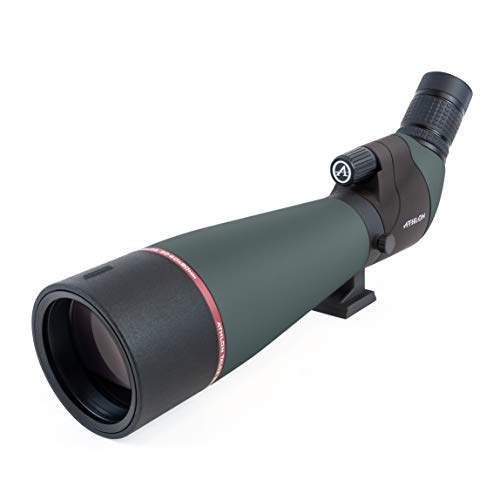
The best angled spotting scopes are easier to compare when the optical system, body design, mounting setup, and carry requirements are considered together. An angled eyepiece can be useful on a tripod because the viewing position is elevated relative to the main tube. That can reduce the need to raise the tripod as high, and it is often comfortable for extended stationary observation. The right choice still depends on whether you prioritize low-light capacity, portability, range work, or accessory compatibility.
Start with the objective lens and magnification
Objective diameter affects how much light the scope is designed to gather, but a larger objective usually means a larger and heavier body. The selected models range from the Celestron TrailSeeker’s 65mm objective to 85mm designs such as the Vortex Razor HD, Vortex Viper HD, Vortex Diamondback HD, and Athlon Argos HD. The 80mm class includes the Vortex Diamondback, Vortex Crossfire HD, Celestron Ultima, and Athlon Talos.
A 20-60x range is common in this group and offers a practical progression from wider scanning to closer inspection. The Celestron Ultima, Vortex Diamondback, Vortex Crossfire HD, and Athlon Talos all use that range. The TrailSeeker’s lower maximum is a trade-off for its compact, travel-oriented format. The Leupold SX-4 Pro Guide HD uses 15-45x, which may be useful when scanning is more important than maximum magnification.
Magnification is not the only specification that matters. Larger zoom settings can make focusing and stable tripod support more important, so check whether the scope includes a helical or large focus control and whether the body has a suitable tripod interface.
Compare optical design and coatings
Listings use different language for optical performance, so compare the specific components rather than assuming every HD label means the same thing. The Vortex Razor HD documents a triplet apochromatic lens, high-density extra-low dispersion glass, and XR Plus coatings. That is the most elaborate optical description in this group. The Vortex Viper HD and Vortex Diamondback HD also specify HD optical systems and anti-reflective coatings.
The Leupold SX-4 Pro Guide HD lists DiamondCoat 2, an ion-assist coating described for light transmission and abrasion resistance. The Celestron TrailSeeker lists XLT coatings and phase-coated BaK-4 prisms, while the Celestron Ultima and Athlon Argos HD specify multi-coated optics. These details help explain why a model may appeal to a particular buyer, but they should not be treated as hands-on proof of image quality.
For dawn, dusk, or shaded woodland use, look for a combination of objective size and light-management features. Several selected models include a built-in sunshade, including the Razor HD, Viper HD, Vortex Diamondback, Vortex Diamondback HD, and Vortex Crossfire HD. A sunshade is also useful for reducing glare and helping shield the front lens from precipitation.
Check weather protection and exterior protection
If a scope will be used outdoors, weather specifications deserve attention. The Razor HD and Viper HD are described as O-ring sealed and argon purged, with waterproof and fogproof performance. The Vortex Diamondback HD, Vortex Diamondback, and Vortex Crossfire HD also document sealed or purged construction and protective rubber armor. Athlon Argos HD lists waterproof, fogproof, and argon-purged construction, while the Leupold SX-4 Pro Guide HD is listed as 100% waterproof and fogproof.
The Celestron TrailSeeker is described as waterproof and nitrogen-purged. The Athlon Talos specifies nitrogen purging and waterproof construction. The Celestron Ultima has a less complete weather-protection specification in the supplied listing, so buyers who expect frequent rain or rapid temperature changes may prefer a model with more explicit sealing language.
Rubber armor can improve grip and help protect the housing, but it does not make a scope indestructible. The Vortex models, Leupold SX-4 Pro Guide HD, and Athlon models document armored or rubberized exteriors. Treat coatings and sealing as maintenance aids, not as permission to neglect lens covers, cleaning, or careful transport.
Match the scope to your tripod and viewing position
Angled scopes work best when the tripod height and collar position are adjusted to the observer. Rotating collars appear on the Vortex Razor HD, Vortex Viper HD, Athlon Argos HD, Athlon Talos, Celestron TrailSeeker, and Celestron Ultima. These features allow the eyepiece position to be changed without moving the tripod legs.
Mounting standards vary. The Vortex Diamondback HD accepts Arca-Swiss heads and 1/4-20 threads. The Vortex Crossfire HD has an Arca-Swiss-compatible foot. The Leupold SX-4 Pro Guide HD lists a built-in 1/4-20 rotatable tripod adapter, while the Celestron Ultima includes an extended tripod mounting plate. Confirm your tripod head or adapter before buying; an angled body does not automatically mean every mounting system will be equally convenient.
An adjustable or multi-position eyecup is useful for viewing with or without glasses. That feature is documented on the Razor HD, Viper HD, Vortex Diamondback HD, Vortex Diamondback, Vortex Crossfire HD, and Celestron TrailSeeker. The Leupold’s rubber armor and the Athlon Argos HD’s rotating ring also support practical field positioning.
Consider weight and included accessories
Portability is where the models separate most clearly. The Celestron TrailSeeker has a listed weight of the current price and a 65mm objective, making it the most specification-aligned choice here for travel, hiking, and all-day birding. The Athlon Talos lists 2.the current price, while the Vortex Diamondback lists 2.the current price and the Vortex Crossfire HD lists the current price. Larger 85mm models such as the Razor HD, Viper HD, and Argos HD are listed above four pounds.
Included accessories can change the practicality of a setup. The Celestron Ultima includes a soft case, extended tripod plate, eyepiece pouch, lens cloth, and integrated T-adapter. The Celestron TrailSeeker includes a padded view-through case, lens covers, and cleaning cloth, and its listing also mentions smartphone and camera adapter compatibility. The Athlon Argos HD includes a soft case. These accessories do not replace a stable tripod, but they may reduce the number of additional items needed for field use.
Choose by activity
For demanding optical specifications and low-light-oriented features, the Vortex Razor HD is the leading choice. The Vortex Viper HD and Vortex Diamondback HD are also strong full-size options. For hunting with explicit ruggedness and tripod support, the Leupold SX-4 Pro Guide HD is compelling. For range work and broad scanning, the Vortex Crossfire HD’s wide-field description and Arca-Swiss-compatible foot are useful advantages.
Birders and travelers should look closely at the Celestron TrailSeeker because its low listed weight and compact 65mm format address carry concerns directly. Wildlife observers who want a more complete accessory kit may prefer the Celestron Ultima. The Athlon Argos HD and Athlon Talos provide 45-degree angled designs with rotating rings, while the Vortex Diamondback offers a familiar 20-60x80 configuration with a moderate listed weight.
Final Recommendation
Vortex Razor HD 27-60x85 Angled ranks first overall in this specification-based comparison under the published weighted criteria.
The final choice among the best angled spotting scopes depends on the documented features that match your intended use.
The Vortex Razor HD 27-60x85 Angled is the highest-scoring returned product and the first overall specification-based choice. Its triplet apochromatic lens, high-density extra-low dispersion glass, XR Plus coatings, helical focus, rotating collar, and weather-sealed construction give it the most complete documented optical and field package in this comparison.
Among the top angled spotting scopes, the Vortex Diamondback HD is a particularly flexible alternative because it combines an 85mm objective with Arca-Swiss and 1/4-20 mounting compatibility. The Leupold SX-4 Pro Guide HD is better suited to buyers who value documented waterproofing, abrasion-resistant coating, and a built-in tripod port over maximum zoom. For travel, the Celestron TrailSeeker is the clearest choice because its listed 1.0-pound weight is substantially below the full-size models.
No listing can establish hands-on image quality from specifications alone. Before purchase, verify tripod compatibility, body dimensions, current included accessories, and the manufacturer’s warranty terms. Also consider whether you will carry the scope frequently or leave it mounted, since the 65mm TrailSeeker and the 80mm and 85mm models serve different portability priorities.
Frequently Asked Questions
Among the best angled spotting scopes, are angled spotting scopes better for tripod viewing?
They can be more comfortable for tripod viewing because the eyepiece sits above the optical tube and may allow a lower viewing position. Models such as the Vortex Razor HD, Athlon Argos HD, and Celestron TrailSeeker also document rotating collars, which can help position the eyepiece for different observers. Comfort still depends on tripod height, seat position, and the user’s viewing angle.
What objective size should I choose?
An 80mm or 85mm objective may suit buyers who want a full-size scope for long-distance or lower-light-oriented observation. The Vortex Viper HD, Vortex Diamondback HD, and Athlon Argos HD use 85mm objectives, while the Vortex Crossfire HD and Celestron Ultima use 80mm objectives. A 65mm model such as the Celestron TrailSeeker is easier to carry and may be preferable for hiking or travel.
Do I need a tripod for an angled spotting scope?
A tripod is generally the practical way to use a spotting scope at its higher magnifications, although the supplied listings differ in how they describe included or compatible mounting equipment. The Leupold SX-4 Pro Guide HD lists a built-in 1/4-20 adapter, the Vortex Diamondback HD supports Arca-Swiss and 1/4-20 mounting, and the Celestron Ultima includes an extended tripod plate. Check the head and thread standard before assembling a kit.
Which selected scope is easiest to carry?
The Celestron TrailSeeker has the lowest documented weight at the current price and uses a 65mm objective. The Athlon Talos lists 2.the current price, and the Vortex Diamondback lists 2.the current price. Larger 80mm and 85mm scopes may offer greater objective capacity but are generally less convenient for long-distance carrying based on their listed weights and dimensions.
Can these scopes be used for digiscoping?
The Celestron Ultima listing specifies an integrated T-adapter, and the Celestron TrailSeeker listing mentions smartphone and camera adapter compatibility. The Celestron Ultima also includes an eyepiece pouch and tripod plate. Adapter fit and phone alignment can vary, so confirm the required adapter and mounting method before treating digiscoping as a primary use.