Buying Guide
Choosing among the best illuminated reticle rifle scopes starts with the rifle’s role, the distances you expect to shoot, and how much weight and mounting height you are willing to add. Illumination can make a reticle easier to see against a dark or cluttered background, but it does not replace suitable magnification, a clear optical system, or correct zeroing. The products here are ranked from supplied specifications and feature descriptions rather than hands-on testing.
Match the magnification to the use
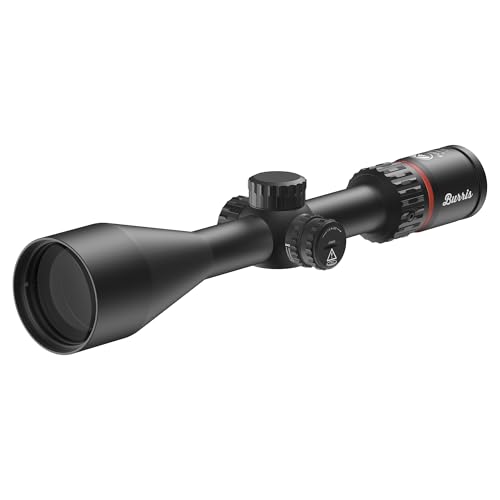
A 1-6x optic such as the SIG SAUER Tango-MSR or Burris RT-6 is designed around speed at short range and identification at moderate range. Their low-end settings are the key distinction. The Burris RT-6 specifically documents true 1x magnification, while the SIG SAUER Tango-MSR provides a 1-6x second focal plane layout and an integrated throw lever. These are logical formats for users who expect frequent transitions between near and farther targets.
Traditional hunting scopes such as the Bushnell Legend 3-9x40, Bushnell Trophy R5 3-9x40, Burris Fullfield 4-16x50, and Arken Optics LH4 4-16x44 offer a more familiar balance. The 3-9x choices keep the range moderate, while the 4-16x models add more top-end detail for longer shots. The Vortex Crossfire HD 4-12x44 sits between those formats and can serve as a general-purpose option.
The Arken Optics SH4J 6-24x50, Vortex Crossfire HD 6-18x50, and DISCOVERYOPT HD 5-30x56 PRS are more oriented toward extended-range work. Higher magnification can be useful for viewing distant targets, but these designs are also larger or heavier. The DISCOVERYOPT listing gives a 2.75-pound weight and calls for 34mm rings, so it is best considered as part of a supported precision setup rather than a lightweight carry rifle.
Understand reticle placement and style
A first focal plane reticle changes apparent size with magnification. The DISCOVERYOPT HD 5-30x56 PRS is explicitly described as FFP, allowing its reticle subtensions to remain proportional across the magnification range. The Arken Optics SH4J uses a Christmas-tree-style reticle with an illuminated center dot, which can provide multiple holdover references according to the listing. These features appeal to shooters who use the reticle itself for holds rather than relying only on turret adjustments.
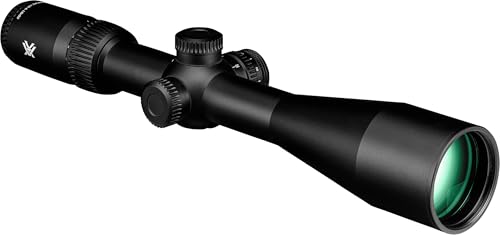
Second focal plane designs keep the reticle at a more consistent apparent size while magnification changes. The SIG SAUER Tango-MSR, Burris RT-6, and Vortex Crossfire HD selections document SFP layouts. The Vortex models pair their illuminated center point with Dead-Hold BDC MOA guidance, while the Burris RT-6 lists hashmarks calibrated for 5.56/.223 ballistics. Buyers should confirm that any ballistic references match the cartridge, load, and zero they intend to use.
Illumination controls also vary. The Bushnell Legend documents six brightness settings with off positions between levels. The Burris RT-6 and SIG SAUER Tango-MSR each list 11 brightness settings. More settings may give finer control in changing light, but the evidence does not establish that any particular model is brighter in practice. Treat the number of settings as a control feature, not as a guarantee of visibility.
Compare objective size and optical features
Objective diameter affects the scope’s format and potential light-gathering area. The 50mm objectives on the DISCOVERYOPT, Arken Optics SH4J, Vortex Crossfire HD 6-18x50, and Burris Fullfield 4-16x50 are suited to buyers prioritizing larger objectives and higher magnification. They may also require attention to ring height and rifle clearance. The 40mm objectives on the Bushnell models are more conventional for hunting configurations, while the 24mm objectives on the LPVOs support compact, low-power designs.
Look for documented optical treatments rather than assuming that illumination alone improves the image. The Vortex Crossfire HD models list select HD glass elements and fully multi-coated lenses. The Arken Optics SH4J lists Japanese ELD glass and fully multi-coated lenses. The Burris Fullfield lists high-performance glass and multi-coated lenses, and the Bushnell Legend lists RainGuard HD coating. These specifications describe intended optical features; they are not independent measurements of brightness or resolution.
Check adjustment and parallax systems
Parallax features are useful when the scope offers them in a form suited to the shooting task. The DISCOVERYOPT HD 5-30x56 PRS and Arken Optics SH4J list side-focus parallax adjustment. The Vortex Crossfire HD models also list adjustable parallax. By contrast, the Burris Fullfield 4-16x50 specifies fixed parallax focus, which is simpler but less adjustable.
Turret design is another practical distinction. The Arken Optics SH4J lists an AZS zero stop, and the DISCOVERYOPT includes a zero stop with 0.1 MRAD clicks. The Arken Optics LH4 uses fully capped tool-less turrets, while the Burris Fullfield uses standard capped knobs. Capped controls can help protect settings from brush and handling; exposed or specialized dialing systems may be more appropriate when frequent ballistic corrections are part of the shooting method.
Evaluate construction and mounting requirements
Weather sealing is well documented across much of this group. The Vortex Crossfire HD models list waterproof, fogproof, and shockproof construction. The Burris RT-6 lists a nitrogen-filled, waterproof, fogproof, and shockproof tube. The Bushnell Legend lists IPX7 waterproof protection and nitrogen purging. The DISCOVERYOPT and Arken Optics SH4J also list sealed, nitrogen-purged construction. These are product specifications, not a prediction of performance under every environment.
Mount compatibility matters before purchase. The DISCOVERYOPT requires 34mm rings, and the 34mm Arken Optics SH4J should likewise be matched with compatible rings. The SIG SAUER Tango-MSR includes a one-piece cantilever mount, while the Burris RT-6 listing describes a 30mm tube but does not indicate that a mount is included. Confirm tube diameter, rail type, eye relief, and clearance before selecting rings.
Final Recommendation
DISCOVERYOPT HD 5-30x56 PRS ranks first overall in this specification-based comparison under the published weighted criteria.
The final choice among the best illuminated reticle rifle scopes depends on the documented features that match your intended use.
The DISCOVERYOPT HD 5-30x56 PRS is the highest-scoring returned product and the first overall specification-based choice. Its FFP illuminated reticle, broad magnification, zero stop, side focus, and 0.1 MRAD adjustments give it the most complete precision-oriented feature set in this comparison. The trade-off is a heavier body and a 34mm mounting requirement.
For a more general hunting scope, the Vortex Crossfire HD 4-12x44 offers a balanced range, illuminated BDC reticle, adjustable parallax, and weather protection. For close-to-medium distances, the SIG SAUER Tango-MSR and Burris RT-6 are the more specialized choices. Among the top illuminated reticle rifle scopes, the right selection depends less on maximum magnification than on matching reticle format, objective size, adjustment style, and mounting hardware to the rifle.
Frequently Asked Questions
What are the best illuminated reticle rifle scopes for long-range shooting?
The DISCOVERYOPT HD 5-30x56 PRS and Arken Optics SH4J 6-24x50 have the most specification-aligned documented long-range feature sets in this comparison. The DISCOVERYOPT adds an FFP reticle, zero stop, side focus, and 0.1 MRAD clicks. The Arken Optics SH4J provides a 6-24x range, a 34mm tube, an illuminated Christmas-tree-style reticle, side parallax, and an AZS zero stop. Both are relatively substantial scopes and require careful ring selection.
Is a first focal plane reticle better than a second focal plane reticle?
Neither layout is universally better. The DISCOVERYOPT HD 5-30x56 PRS uses FFP, so the reticle scales with magnification and its subtensions are intended to remain usable across the range. The SIG SAUER Tango-MSR, Burris RT-6, and Vortex Crossfire HD models use SFP layouts. SFP can keep the reticle visually consistent, while FFP can be useful for holdovers at different powers. Choose based on how you use the reticle and the distances involved.
What objective size should I choose?
A 40mm objective, as found on the Bushnell Legend and Bushnell Trophy R5, is a conventional hunting format. A 50mm objective, used by the Arken Optics SH4J, Vortex Crossfire HD 6-18x50, Burris Fullfield, and DISCOVERYOPT, may suit buyers prioritizing a larger objective and higher magnification. The trade-offs include size, weight, and potentially higher ring clearance. The 24mm objectives on the LPVOs support compact low-power configurations.
Do illuminated reticles work in complete darkness?
The supplied listings describe illumination as helping reticle visibility in low-light conditions, but they do not establish that any selected scope provides a usable aiming image in complete darkness. Illumination highlights the reticle; it does not create a visible target image without available light or a separate night-vision-compatible system. Use the documented brightness controls and reticle design as comparison points, not as a guarantee for every lighting situation.
What should I verify before mounting a scope?
Verify the scope tube diameter, rail or receiver compatibility, ring height, objective clearance, eye relief, and whether a mount is included. The DISCOVERYOPT HD 5-30x56 PRS requires 34mm rings, while the SIG SAUER Tango-MSR listing includes a cantilever mount. Also confirm that any ballistic reticle references match your cartridge and sight-in conditions before relying on them.