Buying Guide
Choosing among the best carbon steel spatulas requires looking beyond the word “carbon” in a product title. The supplied listings cover true carbon steel and blue steel turners, forged iron wok tools, and stainless-steel utensils marketed for use with carbon steel woks. Those are related choices, but they do not have identical care requirements or handling characteristics.
Start with the blade material
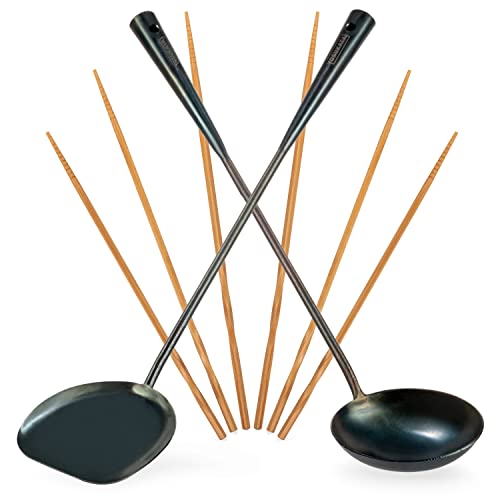
Restaurantware identifies its turner as pre-seasoned carbon steel, while YOSUKATA documents a pre-seasoned carbon steel spatula and ladle. ZhenSanHuan describes a one-piece, hand-hammered iron construction with no coating or paint. These listings are the closest material matches for a carbon steel spatula comparison.
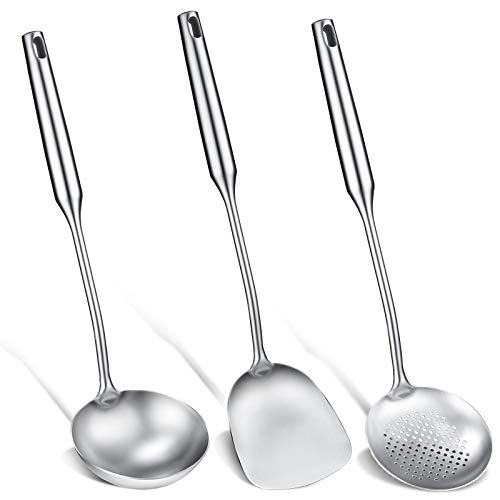
Several other selected products use stainless steel instead. NIITAWH, WANGYUANJI, GXONE, Patelai, and FJNATINH describe stainless-steel wok tools intended for carbon steel or similar cookware. Stainless steel may appeal to shoppers who want a corrosion-resistant, easier-cleaning alternative, but it is a different material from carbon steel. XiaoZu is also stainless steel and is selected for its thin, flexible turner design rather than its carbon-steel construction.
Match the blade to the cookware
A wok spatula should reach the curved cooking surface and move food without requiring an awkward wrist angle. The selected wok designs document smooth or thin edges, rounded corners, or curvature intended to follow the wok. The NIITAWH 17-inch set and the WANGYUANJI set specifically describe edges or shapes suited to wok sides. Restaurantware and ZhenSanHuan provide long formats for stir-frying and turning at a distance.
A broad, flexible blade has a different role. XiaoZu describes a thin flexible blade for fish filets, omelets, steaks, eggs, cookies, and scraping food residue. It may be a better fit for flat pans and general turning than a deep wok spatula. Consider whether you mostly stir-fry in a curved wok or lift individual foods from a skillet or griddle.
Consider handle reach
Long handles are useful when cooking over high heat, but longer is not automatically better for every kitchen. YOSUKATA and NIITAWH both document 17-inch formats. Restaurantware and ZhenSanHuan are approximately 15.7 inches long, while GXONE is also 15.7 inches. The shorter 14-to-15-inch tools from NIITAWH, Patelai, and FJNATINH may be easier to store and control in a smaller cooking area.
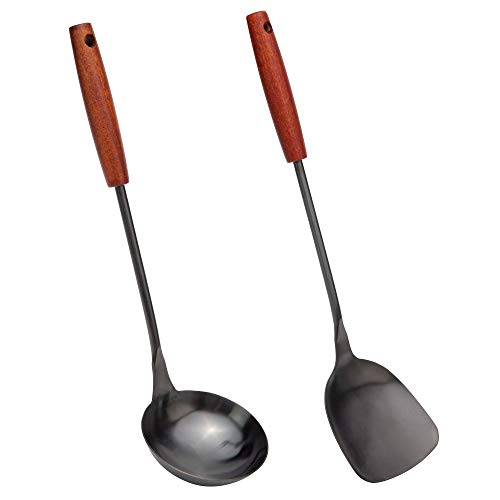
Handle construction also varies. ZhenSanHuan and Restaurantware use hollow or long-handle designs, while NIITAWH, GXONE, WANGYUANJI, and FJNATINH document wooden handles. XiaoZu uses a silicone handle with stainless steel inside. Check the listing’s care instructions rather than assuming every metal utensil can be handled identically.
Decide whether you need a set
A single turner is the most focused purchase. Restaurantware and GXONE are single-spatula choices, while ZhenSanHuan is a single specialized wok tool. Sets add utility when you regularly stir-fry, drain fried food, add liquid, or serve from the wok. YOSUKATA includes a ladle and chopsticks; NIITAWH offers combinations with a skimmer, ladle, or slotted turner; WANGYUANJI includes four distinct tools; and Patelai supplies a spatula, ladle, and skimmer.
A set can also introduce tools you already own. If the spatula itself is your priority, compare the blade and handle specifications first. If you are outfitting a wok station, the extra ladle and skimmer may be more useful than a narrowly focused single tool.
Plan for cleaning and rust prevention
Carbon steel and forged iron require more attention to moisture in the supplied evidence. ZhenSanHuan says to dry the utensil after washing and states that it is not dishwasher safe. YOSUKATA likewise recommends hand washing and wiping the utensil dry after each wash. Restaurantware identifies a pre-seasoned surface, but the supplied listing does not document dishwasher use.
The stainless-steel alternatives provide more convenience in this area. Both NIITAWH listings identify dishwasher-safe designs, as do GXONE, FJNATINH, and XiaoZu. WANGYUANJI specifically recommends hand washing because of its natural wood handles, despite its stainless-steel blades. These distinctions matter if the spatula will be cleaned frequently or stored in a humid area.
Check dimensions and storage
The listings provide useful size references: 17-inch utensils suit shoppers seeking extra reach, 15.7-inch turners offer a middle ground, and the 14-to-15-inch sets are more compact. Width also matters for lifting larger portions, although only some listings provide a clear blade width. Hanging holes appear on Restaurantware, NIITAWH, WANGYUANJI, Patelai, and other selected tools, which can help when drawer space is limited.
Final Recommendation
NIITAWH 17-Inch Wok Utensil Set ranks first overall in this specification-based comparison under the published weighted criteria.
The final choice among the best carbon steel spatulas depends on the documented features that match your intended use.
Restaurantware Pre-Seasoned Carbon Steel Turner is the highest-scoring returned product and the first overall specification-based choice. It directly documents blue carbon steel, pre-seasoning, a 15.7-inch handle, and a hanging hole in a focused single-tool format. ZhenSanHuan is a suitable fit for shoppers seeking hand-forged, one-piece iron construction and direct-fire suitability, provided they are willing to dry it carefully.
Among the top carbon steel spatulas and their stainless alternatives, YOSUKATA offers a complete wok starter set because it combines a 17-inch spatula, ladle, and chopsticks. The NIITAWH 17-inch set is a suitable choice when extra reach and several wok tools matter, while the shorter NIITAWH set and GXONE are practical for shoppers who want easier cleaning. WANGYUANJI and Patelai broaden the set choices, and FJNATINH offers a smaller two-piece format. XiaoZu is the most distinct alternative for a thin, flexible turner rather than a traditional wok spatula.
Frequently Asked Questions
Are the best carbon steel spatulas always made from carbon steel?
No. In this comparison, Restaurantware and YOSUKATA explicitly identify carbon steel, while ZhenSanHuan describes forged iron. Several other selected products are stainless steel tools designed for use with carbon steel woks. Stainless steel can offer easier cleaning, but it is a different material and should be evaluated separately.
Should I choose a 17-inch wok spatula?
A 17-inch design may be useful for larger woks, deep-frying, or shoppers who want more distance from heat. YOSUKATA and NIITAWH document 17-inch options. A 14-to-15-inch tool may be easier to store and maneuver in a smaller kitchen, so match the length to your cookware and workspace.
Do carbon steel spatulas need special care?
The supplied carbon steel and forged-iron listings recommend hand washing and thorough drying to help prevent rust. Stainless-steel alternatives such as the NIITAWH sets and GXONE document dishwasher-safe designs. Always follow the specific listing’s care instructions, especially when a tool has a wooden handle.
Is a wok spatula useful on a flat skillet?
It can be, but the shape may be more specialized than a standard turner. XiaoZu documents a thin, flexible blade for skillet-style foods such as fish, omelets, steaks, and eggs. Wok-focused models are better matched to curved cookware when their listings specifically describe rounded edges or wok-side curvature.
Should I buy a spatula alone or a utensil set?
Buy a single tool if the turner is your only priority. Choose a set when you also need a ladle, skimmer, slotted turner, or chopsticks. YOSUKATA, NIITAWH, WANGYUANJI, Patelai, and FJNATINH document different combinations, so compare the included pieces rather than assuming every set has the same utility.