Buying Guide
The best carbon steel camping fixed-blade knives are defined by more than the steel name. A useful comparison should consider the blade profile, thickness, handle, sheath, and the kind of work described in the listing. Carbon steel can offer useful edge characteristics, but the supplied product evidence also repeatedly warns or implies that the blade should be cleaned and dried after use. That maintenance requirement matters when camping around moisture.
Start with the blade specification
Look for a clearly identified steel type instead of relying only on a title that says “high carbon.” The BPSKNIVES Adventurer and B1 CSH specify 1066 carbon steel, while the Morakniv Companion models and several other selections identify 1095 carbon steel. The Kizer Drop Bear Fix 3 also documents 1095 high-carbon steel. These details make the material easier to compare than vague claims about toughness or sharpness.
Blade length should match the work. Compact models such as the BPSKNIVES Finn Lite, Kizer Drop Bear Fix 3, and Morakniv Companion use blades around four inches or less, which may be easier to control for food preparation, rope cutting, carving, and gear work. The BPSKNIVES Adventurer, WARIVO KNIFE 11-Inch, and SZCO Sawmill provide longer formats for buyers who want more reach in a field knife. Longer does not automatically mean better; it can also add bulk to a hiking setup.
Thickness is another useful specification. The Morakniv Companion Heavy-Duty lists a 3.2 mm blade, while the standard Companion lists 2.0 mm. The BPSKNIVES Adventurer lists 2.8 mm, and the Finn Lite lists a 1.8-2 mm range. These figures help distinguish a compact utility knife from a more substantial bushcraft design, although they do not by themselves establish real-world performance.
Match the grind and profile to camp tasks
A Scandinavian grind appears on the BPSKNIVES B1 CSH, Adventurer, and Finn Lite. Those listings connect the design with bushcraft, carving, or general outdoor utility. A drop point appears on the B1 CSH, Kizer Drop Bear Fix 3, and Metal of Honor knife. The Kizer listing pairs its drop point with a high flat grind, while the Metal of Honor listing emphasizes a curved belly for skinning and controlled field cuts.
The SZCO Sawmill and WARIVO knife use clip-point profiles. The SZCO listing presents its knife as a traditional outdoor and hunting design, while WARIVO describes skinning preparation, wood shaving, and camp tasks.
Evaluate the handle and control features
Handle material and shape affect how a knife fits a camp kit. The Morakniv Companion and Companion Heavy-Duty use high-friction polymer handles, with the Heavy-Duty adding an extra-large ergonomic shape. The Kizer uses Micarta scales and documents a finger choil, finger groove, and spine jimping. The Bloodline uses a textured G10 handle, while the BPSKNIVES models use wooden handles.
A wood handle may appeal to buyers who prefer a traditional bushcraft appearance, but the listings for the BPSKNIVES Adventurer, B1 CSH, and Finn Lite also state care details for the carbon-steel blade. A synthetic handle does not eliminate blade maintenance, but polymer, G10, and Micarta can provide a different design approach for wet or changing outdoor conditions. The evidence supports comparing these materials, not declaring one universally superior.
Check the sheath and carry method
A fixed blade is only practical in camp when it can be stored and carried appropriately. Leather sheaths appear with the BPSKNIVES Adventurer, B1 CSH, Finn Lite, WARIVO, Metal of Honor, and SZCO selections. These listings describe belt or vertical carry for several models. The Morakniv Companion knives use plastic sheaths with belt clips, and the Kizer uses a sheath while emphasizing its compact camp format. The Bloodline uses Kydex and includes a belt clip and mounting hardware.
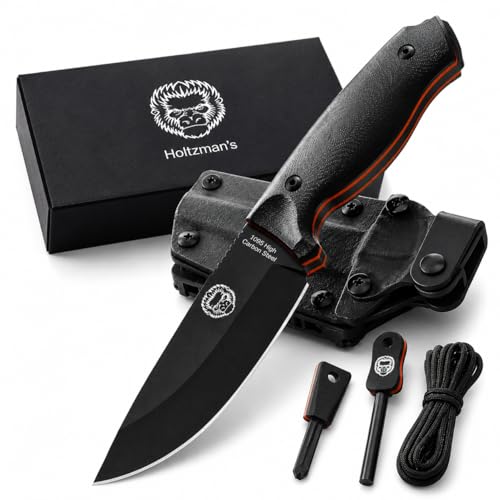
Consider whether the sheath matches your transport method. A belt clip may suit a hiking or work belt, while vertical leather carry may better fit a traditional bushcraft setup. The Bloodline’s accessory package adds a ferro rod, scraper, paracord, and mounting hardware, whereas the BPSKNIVES Adventurer includes a ferro rod with its leather sheath. Those features can reduce the need to assemble separate fire-starting equipment, but they also make the package less minimalist.
Plan for carbon-steel care
Carbon steel is not a maintenance-free choice. The BPSKNIVES Adventurer specifically says to wipe away its protective gun oil before first use and to rinse and dry the blade after use. Its listing warns that the blade can rust in a moist environment. WARIVO similarly advises cleaning and drying the blade, applying a light coat of oil when needed, and avoiding long-term storage in a damp sheath.
That guidance is especially relevant for rainy trips, humid climates, and camps near water. Dry the blade before returning it to its sheath, and follow the manufacturer’s care instructions. Do not confuse a technical steel specification with a promise of corrosion resistance: the selected products include carbon-steel blades, and their listings make maintenance part of ownership.
Final Recommendation
BPSKNIVES B1 CSH ranks first overall in this specification-based comparison under the published weighted criteria.
BPSKNIVES B1 CSH is the highest-scoring returned product and the first overall specification-based choice among these best carbon steel camping fixed-blade knives. Its documented 1066 steel, 57-59 HRC hardness, Scandinavian grind, full-tang construction, walnut handle, and leather sheath give it the most specification-aligned balance of blade information, control, carry, and stated camping utility.
Choose the Morakniv Companion Heavy-Duty if a compact knife with a thicker listed blade and high-friction handle is more useful. The Kizer Drop Bear Fix 3 is a better fit for precise smaller tasks where jimping, a finger choil, and a compact drop point matter. For a broader kit, the Holtzman’s Gorilla Survival Bloodline includes a Kydex sheath and fire-starting accessories. Buyers wanting a longer field format should compare the BPSKNIVES Adventurer or WARIVO KNIFE 11-Inch.
The top carbon steel camping fixed-blade knives are not interchangeable. Compact Morakniv and BPSKNIVES options favor portability, while the SZCO, WARIVO, and Adventurer designs provide more length. Before choosing, confirm the blade dimensions, handle material, sheath style, and care routine that fit your camping setup.
Frequently Asked Questions
What should I look for in the best carbon steel camping fixed-blade knives?
Start with a named steel type, suitable blade length and profile, a handle that supports controlled use, and a sheath that fits your carry method. The listing should also provide enough information to understand care requirements. Models such as the BPSKNIVES B1 CSH, Morakniv Companion Heavy-Duty, and Kizer Drop Bear Fix 3 provide clear combinations of these details.
Do carbon-steel camping knives need special care?
They need regular cleaning and drying, particularly after exposure to moisture. The BPSKNIVES Adventurer and WARIVO listings specifically advise drying the blade and discuss oil or damp-sheath precautions. Follow the product’s supplied care guidance and avoid storing a damp blade in its sheath.
Is a compact fixed blade better for hiking?
A compact knife may be easier to pack and control, but suitability depends on the tasks. The BPSKNIVES Finn Lite, Kizer Drop Bear Fix 3, and Morakniv Companion have shorter blades than the WARIVO and BPSKNIVES Adventurer models. Compare the intended cutting work, sheath arrangement, and total carry setup before deciding.
Which selected knives include fire-starting accessories?
The BPSKNIVES Adventurer includes a ferro rod with its leather sheath. The Holtzman’s Gorilla Survival Bloodline includes a ferro rod and scraper, along with other carry accessories. These additions are documented package features, not evidence of hands-on fire-starting performance.
Are leather sheaths or polymer and Kydex sheaths preferable?
The choice depends on carry preference and maintenance habits. Leather appears on several traditional bushcraft and hunting designs, while the Morakniv Companion uses a plastic sheath and the Bloodline uses Kydex. Compare the documented belt clip, vertical carry, mounting hardware, and storage approach with how you transport the knife.