Buying Guide
The best carpentry squares are easier to choose when the square’s geometry matches the work. A compact triangle square is convenient for marking a board edge and guiding a short crosscut. A combination square adds a ruler and head for transferring measurements. A full-size framing square reaches farther across stock and commonly includes rafter or brace tables. Three-dimensional designs add depth and adjacent-face marking, but their compact bodies serve a different purpose from a 16-by-24-inch framing tool.
Choose the square design first
A speed or rafter square is the most direct choice for common-angle layout, rafter work, and short saw-guide operations. The Swanson S0101 documents try-square, miter-square, saw-guide, line-scriber, and protractor functions. The Klein 9357SSQ similarly combines rafter work, angle finding, square cuts, scribe notches, and a pipe prop. These formats usually sit securely against a board edge and are simple to carry.
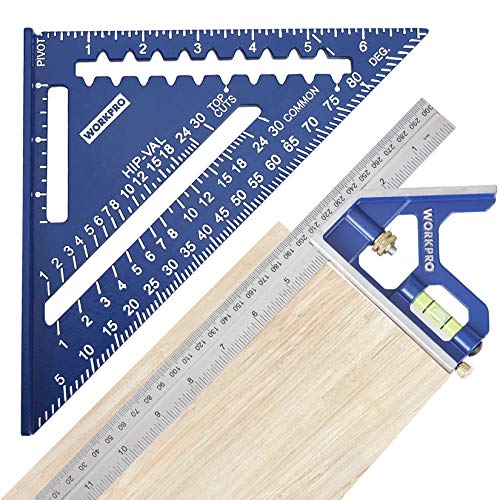
A combination square is better when measurement transfer matters. The IRWIN 1794469 uses a 12-inch stainless steel blade and documents 45- and 90-degree marking plus gauge use for transferring measurements. The WORKPRO set adds a 12-inch combination square to its 7-inch rafter square, while its listing also documents a level vial and metal scriber. A combination square can therefore be the more flexible workshop choice when one tool must handle ruler, square, and angle tasks.
A framing square is the large L-shaped option. The Johnson CS9 and POWERTEC 80008 both use a 16-by-24-inch format. Their longer legs can establish right angles and mark larger stock, while their documented rafter-related tables support framing, stair, and roof-layout work. This size is useful when reach matters, but it is less convenient to carry or use on small pieces.
Match size to the workpiece
Seven-inch tools are portable and practical for trim-sized boards, quick rafter marks, and saw-guide work. The S0101, Klein, and Johnson Johnny Square occupy this compact-to-mid-size range. The Johnny Square’s 7-1/4-inch body adds a one-inch heel and a level vial, which may help when the material is split or irregular.
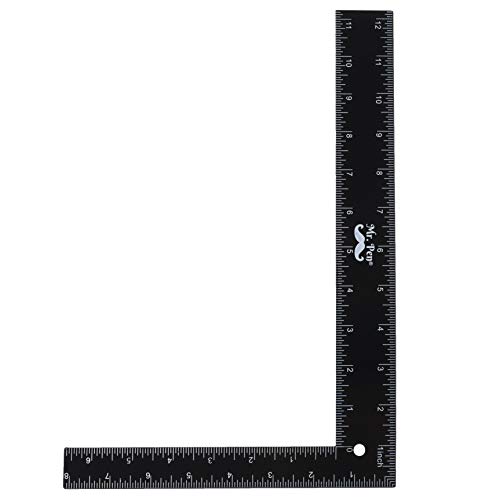
Twelve-inch tools give more reach without the footprint of a full framing square. The IRWIN combination square, the Swanson Big 12 included in the SW1201K set, and the 12-inch designs from the selected set products suit longer marks and broader layout lines. The Mr. Pen’s 8-by-12-inch L shape is a middle-ground framing format with imperial and metric scales.
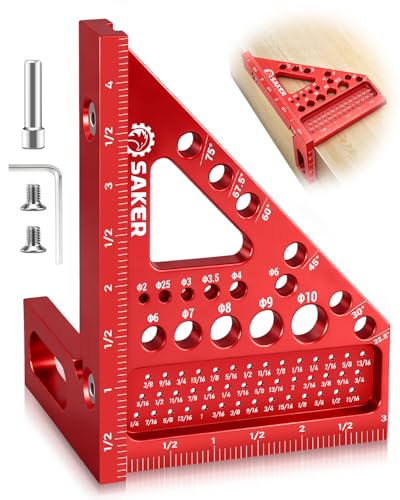
The Saker’s compact 3D layout form is different from a long square. Its supplied specifications describe a compact 4.4-inch design with scales on three edges for width, height, and depth. That can be useful for small woodworking components or adjacent-face marks, but it should not be treated as a replacement for a full-size framing square.
Inspect markings and reference scales
Clear graduations reduce the need to interpret a crowded or low-contrast surface. The Klein listing specifies double laser-etched markings, while the Swanson S0101 specifies black graduations against a non-glare matte finish. Mr. Pen uses bright white markings on black and provides 1/16-inch imperial graduations on one side with metric graduations on the other. The Saker specifies laser-engraved scales on three edges and measurement up to 1/16 inch.
For framing, look for more than a simple inch ruler. Johnson’s CS9 lists 1/8, 1/10, 1/12, and 1/16 graduations as well as rafter, brace, octagon, and board-foot tables. POWERTEC documents the same general scale family on the front and back and includes conversion tables. Swanson’s supplied information includes common, hip, valley, and jack rafter gradations and a Blue Book. These references can make a framing square more useful for layout calculations, although this comparison does not independently verify their accuracy.
Consider material and edge support
The supplied listings identify aluminum, steel, stainless steel, cast zinc, and aluminum-zinc construction across the selection. Aluminum can reduce weight, as shown by the aluminum speed squares and the compact Saker. Steel framing squares provide the large rigid format associated with full-size L-shaped layout tools. The IRWIN combination square uses a stainless steel blade and cast zinc body, while the Johnson CS9 specifies stainless steel construction and a 1/8-inch thickness in its product description.
An edge or heel can matter as much as the scale. The Johnny Square lists a one-inch heel intended to stay seated on split and irregular materials. WORKPRO specifies a lipped fence for bracing its rafter square flush with wood. The Swanson and other speed-square designs also document saw-guide or lipped-edge functions. These features support positioning, but the listings do not provide independent testing of holding force or accuracy.
Extra functions are useful when they correspond to tasks you actually perform. A level vial appears in the Johnny Square and WORKPRO combination square. The Johnny Square also documents 22.5, 30, 45, and 60-degree slots, while the Saker specifies a hidden angle pin for several preset angles. The Klein includes a pipe prop, and the Swanson set includes a rafter-layout reference book.
More functions can also make a tool harder to compare with a simple square. If your main needs are 90-degree and 45-degree marking, a focused combination square or basic speed square may be easier to select. If you regularly frame roofs, mark stairs, or work on irregular stock, the additional tables, notches, vial, or angle features may justify choosing a more specialized format.
Method and specification limits
This ranking uses only the supplied product titles, feature statements, and technical specifications. The criteria emphasize documented layout versatility, marking clarity, material and build information, size fit, and specialized features. It does not represent hands-on testing, laboratory measurement, or customer-opinion analysis. Claims such as rust resistance, readability, or durability are included only when the supplied listing states them. Volatile marketplace information was not used in the published scores.
Final Recommendation
Swanson SW1201K 7-Inch and Big 12 Combo ranks first overall in this specification-based comparison under the published weighted criteria.
The final choice among the best carpentry squares depends on the documented features that match your intended use.
The Swanson SW1201K 7-Inch and Big 12 Combo is the highest-scoring returned product and the first overall specification-based choice. Its two documented aluminum speed squares cover portable and longer layout work, while rafter gradations, scribing notches, saw-guide use, and the Blue Book give it a broad feature set.
For full-size framing, the Johnson CS9 is the clearest fit because its 16-by-24-inch format and multiple reference tables are documented for framing, rafters, stairs, braces, and related layout work. The POWERTEC 80008 offers a similar large format with front-and-back scales and conversion tables.
Among compact tools, the Johnson Johnny Square stands out for its built-in level vial, visible angle slots, layout cutouts, and one-inch heel. Klein’s 9357SSQ is another practical portable option when laser-etched markings, scribe notches, and a pipe prop are priorities. The Swanson S0101 keeps the classic speed-square approach focused and portable.
For workshop versatility, the IRWIN 1794469 is a focused 12-inch combination square, while WORKPRO combines a rafter square and combination square in one set. Mr. Pen is a simpler 8-by-12-inch dual-unit framing option. The Saker is the specialist choice for compact 3D measurement and preset-angle work. Together, these top carpentry squares cover the main documented designs without treating one format as suitable for every project.
Frequently Asked Questions
Among the best carpentry squares, what size carpentry square should a beginner choose?
A 7-inch speed or rafter square is a practical starting point for portable marking, common angles, and short saw-guide work. The Swanson S0101, Klein 9357SSQ, and Johnson Johnny Square all document functions suited to those tasks. Choose a 12-inch combination or framing square instead if longer measurement transfer or broader reach is more important.
Are framing squares and rafter squares the same thing?
No. A rafter or speed square is generally a compact triangular layout tool with angle and rafter markings. A framing square is a larger L-shaped tool. The Johnson CS9 and POWERTEC 80008 document 16-by-24-inch framing formats, while the Swanson S0101 and Klein 9357SSQ document compact rafter-square functions.
When is a combination square useful?
A combination square is useful when you need a ruler, a head for square marking, and measurement transfer in one tool. The IRWIN 1794469 documents 45- and 90-degree marking and gauge use. The WORKPRO set adds a combination square alongside a 7-inch rafter square, giving it broader documented coverage.
Do laser-etched markings matter on a carpentry square?
They may help preserve visibility, but this comparison does not test marking life. The Klein listing specifies double laser-etched markings, and the Saker specifies laser-engraved scales on three edges. When comparing the best carpentry squares, also consider contrast, scale type, and whether the markings match your measurement system.
Should I buy a square with a level vial?
A vial can be useful if you want level or plumb information during layout. The Johnson Johnny Square documents a 320-degree-visibility vial for level, plumb, angle, and roof-pitch work. WORKPRO also documents a level vial in its combination ruler. If you only need right-angle marking, the extra feature may not be necessary.