Buying Guide
Metric carpentry squares vary by geometry and intended layout task. Before choosing among the best metric carpentry squares, identify whether you need a compact try square, a rafter square for roof layout, a long L-square for framing, or a multi-function instrument for workshop work.
A try square or small L-shaped square is mainly for checking and marking right angles. The Woodpeckers 150mm Precision Square is the most workshop-oriented example in this selection. Its shoulder lip, self-standing base, scribe notches, and compact stainless-steel construction are documented around detailed bench layout.
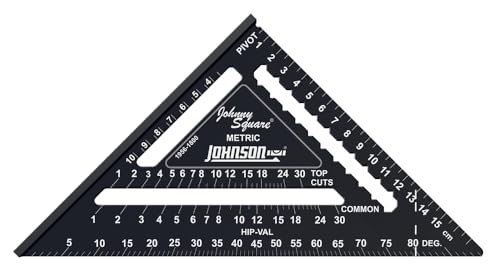
A rafter or speed square is shaped for quick marking and angle work. The Swanson NA202 and Johnson Johnny Square both document rafter-layout features. The Swanson emphasizes metric and degree scales for common and hip-valley rafters, while the Johnson adds continuous scribing notches and a low-glare finish. These designs are more useful when repeated angle or roof-layout marks matter.
A larger L square is better for checking longer edges and marking across broader stock. The WEN ME033L and Auniwaig 300mm Stainless Steel Framing L Square both provide 300mm reach. The WEN adds a grooved overhang that slides along an edge; the Auniwaig uses a stainless-steel L profile and front-and-back reading. These are direct options for framing, stairs, doors, and windows.
Check how metric markings are presented
Metric users should look for millimeter or centimeter scales, not merely a title that says “metric.” The WEN explicitly lists millimeter and centimeter markings and laser-engraved 1mm scales. The Mecurate documents laser-engraved metric markings, while the IUYYPU is described as metric-only with no inch scale.
Metric-only can be useful when mixed units create confusion, but dual-scale tools are more adaptable in shops where plans, materials, or existing tools use inches. The Micymedo includes a 300mm metric ruler alongside SAE scales.
Also consider reading direction. The Auniwaig 300mm Framing L Square documents front-and-back measurement, and the Micymedo uses a double-sided stainless-steel ruler. These details may help when the tool is flipped or used from different sides of a workpiece.
Match the angle features to the job
For basic squaring, a fixed 90-degree tool is usually more direct. The Auniwaig 300mm square and WEN ME033L are right-angle choices. For rafter work, the Swanson NA202 and Johnson 1956-1800 provide more specialized angle-layout information.
Multi-angle tools are useful when one tool must mark several preset angles or locate drill points. The CCIEAO documents preset positions including 22.5, 30, and 45 degrees, along with a detachable 3D configuration, angle pin, screws, and wrench. The ViewReal also documents preset angle-pin holes, side measuring, detachable construction, and a storage feature for the pin. These designs offer more functions, but their detachable parts can require more setup than a fixed square.
Consider marking and secondary functions
Scribe notches are useful when you need repeatable parallel marks. Woodpeckers, Johnson, and the Swanson each document marking features, although they use different approaches. The Mecurate adds drill-gauge holes, an erasable surface, and a mechanical pencil. The Micymedo adds a stored scriber, a bubble level, a locking screw, and a detachable ruler.
Secondary functions are most useful when they match your actual work. A level can help with alignment, but it does not replace a square’s angle reference. A drill gauge can speed bit-size checks, but it is not necessary for ordinary crosscuts. More features should improve the tool’s fit for your tasks rather than simply make the listing longer.
Compare materials and finishes
Aluminum appears across several selected designs, including the WEN, Swanson, Johnson, Mecurate, ViewReal, and CCIEAO. Listings describe aluminum alloy as resistant to rust, corrosion, or warping in various products. Aluminum can also support portable formats, such as the compact rafter squares and multi-angle tools.
Stainless steel is documented for Woodpeckers, the Auniwaig 300mm square, and Micymedo’s ruler. Woodpeckers specifically combines a stainless steel core with aluminum cheeks, while Micymedo uses a stainless ruler with an aluminum head.
Finish matters for reading as well as protection. Swanson lists a matte finish intended to prevent glare, Johnson describes an anti-glare anodized finish, and several products document laser-engraved or permanent markings. These are specification claims, not independent accuracy tests, so treat them as comparison points rather than proof of field performance.
Use dimensions as a practical filter
A 150mm or 18cm square is easier to carry and better suited to smaller stock. The Woodpeckers, Johnson, and Mecurate fit that compact-to-mid-size category. A 300mm tool reaches farther across a board but takes more room in a bag or drawer. The WEN and Auniwaig 300mm options fit larger layouts. The CCIEAO and ViewReal are compact multi-angle tools, but their detachable geometry changes how they are stored and used.
The best metric carpentry squares are not necessarily the largest or most feature-heavy. Choose reach when you regularly work on broad framing members; choose a compact format when portability and close bench work matter more.
Final Recommendation
Woodpeckers 150mm Stainless Steel Precision Square ranks first overall in this specification-based comparison under the published weighted criteria.
Woodpeckers 150mm Stainless Steel Precision Square is the first overall specification-based choice in this comparison.
The final choice among the best metric carpentry squares depends on the documented features that match your intended use. Woodpeckers is the most specification-aligned fit for detailed woodworking layout because of its precision-focused construction, shoulder lip, scribe notches, self-standing base, and compact metric format.
Among the top metric carpentry squares, the Swanson NA202 is the more specialized rafter-layout option, while the WEN ME033L and Auniwaig 300mm square provide greater reach for general construction. Choose the Johnson for compact rafter work, Mecurate for marking extras, CCIEAO or ViewReal for multi-angle layouts, Micymedo for combination-square versatility, and IUYYPU for a straightforward metric-only format.
Frequently Asked Questions
What should I look for in the best metric carpentry squares?
Start with clearly documented millimeter or centimeter graduations, then check the square’s geometry, length, material, and marking features. A fixed 90-degree square is usually more direct for basic checks, while a rafter or multi-angle design may be better for repeated angle layouts.
Is a metric-only square better than a dual-scale square?
It depends on your plans and materials. IUYYPU documents a metric-only format without inch markings, which can reduce scale confusion for millimeter-based work. Micymedo documents both metric and SAE scales, which may be more adaptable when projects use mixed measurements.
Which selected square is best for rafter layout?
The Swanson NA202 is the most specifically focused on rafter layout because its listing documents metric and degree scales for common and hip-valley rafters, a traditional layout method, and speed notches. Johnson’s Johnny Square is another compact rafter-oriented option with continuous scribing notches.
Are multi-angle squares useful for general carpentry?
They can be useful when your work includes preset-angle marking, drill-point layout, or portable setup. CCIEAO and ViewReal document detachable multi-angle designs with angle-pin features. However, a fixed right-angle square may be quicker when you only need ordinary 90-degree checks.
Should I choose a 150mm or 300mm square?
Choose 150mm or 18cm formats for portability, small workpieces, and bench layout. Choose 300mm when you need more reach across boards or for framing tasks. The larger tools occupy more space, while compact squares may not span broad workpieces as easily.