Buying Guide
The best combination carpentry squares are adjustable layout tools built around a ruler blade and a sliding head. Unlike a fixed try square, the head can move to a chosen measurement and lock in place. Depending on the model, the same tool may also mark 45- and 90-degree angles, check level, measure depth, act as a straightedge, or provide a built-in scribe.
This comparison uses listing specifications and feature descriptions only. It does not represent hands-on testing, measured accuracy checks, durability trials, or customer-opinion analysis. When a listing makes a broad claim without a supporting tolerance or test result, the guide treats that claim cautiously.
Choose the blade length
A 6-inch square is compact and convenient for small workpieces, trim, cabinet parts, and bench layout. The Johnson 406EM is the selected short model, and its listing also identifies it as a machinist square, straightedge, adjustable try square, miter square, marking gauge, and depth gauge. Its shorter blade can be easier to control, but it does not span as much material as a 12-inch model.
A 12-inch blade is the most common size represented here. It gives more reach for boards, framing components, and general shop layout. PEC Tools, Johnson, WEN, Arrow, TRACER, and Micymedo all provide 12-inch options in the selected group. Buyers should check the available workspace and the size of typical workpieces rather than assuming a longer blade is always better.
The two-piece sets add a 7-inch rafter or carpenter square alongside a 12-inch combination square. Arrow, GRENPRO, and Micymedo document this arrangement. These sets are relevant when a project includes both standard adjustable-square work and quick angled or roof-layout references.
Compare blade markings
Markings are central to a combination square because they determine how easily a measurement can be transferred. Several selected products document 1/16- and 1/32-inch markings, while Johnson 406EM also lists 1/8-inch and millimeter graduations. PEC Tools goes further with 4R graduations covering eighths, sixteenths, thirty-seconds, and sixty-fourths.
Dual-sided imperial and metric scales are useful when plans, hardware, or shop tools use different systems. Arrow, WEN, TRACER, Micymedo, and GRENPRO document both systems in their listings. Laser-engraved or etched scales are also worth noting because the descriptions identify those marking methods, although the supplied evidence does not independently verify long-term wear.
Readability matters as much as scale range. WEN specifies laser-engraved markings, while GRENPRO describes clear metric and inch scales. PEC Tools lists micro-fine etched graduations. These are documented design details, not measured visibility results.
Evaluate the head and locking mechanism
The sliding head should move for positioning and then hold the blade securely. Johnson specifies an auto-lock blade assembly on both its selected models. Arrow describes a brass screw that moves the handle along the ruler and locks it at the required mark. TRACER lists a secure sliding adjustment, and Micymedo specifies a spring-loaded locking screw.
Head material varies. PEC Tools lists a cast-iron head, Johnson 415EM a high-impact molded reversible head, and several other products aluminum alloy, aluminum zinc alloy, or zinc alloy components. Material names alone do not establish performance under every condition, but they help distinguish the construction approaches documented by each listing.
A reversible or removable head can add flexibility. Johnson 415EM identifies a reversible head, while Arrow describes a ruler that can be used separately. Micymedo lists a detachable ruler. These features may help with specialized layout, but they also create additional moving or separable parts to keep clean and organized.
Check the angle and layout functions
Most selected products document 45- and 90-degree marking. That makes them suitable for common crosscuts, miters, and square layout. Some provide more specialized angle support. The selected two-piece sets include rafter or carpenter squares with degree scales and, in the Micymedo set, common-rafter, hip/valley, and jack-rafter references.
A combination square can also work as a depth or height gauge when the head is positioned against an edge. Arrow, Johnson, Micymedo, and TRACER specifically describe depth, height, or related layout functions. If the primary need is checking a board edge or marking a repeated offset, prioritize a clear scale and a locking head over a long list of secondary features.
Decide whether a level or scribe matters
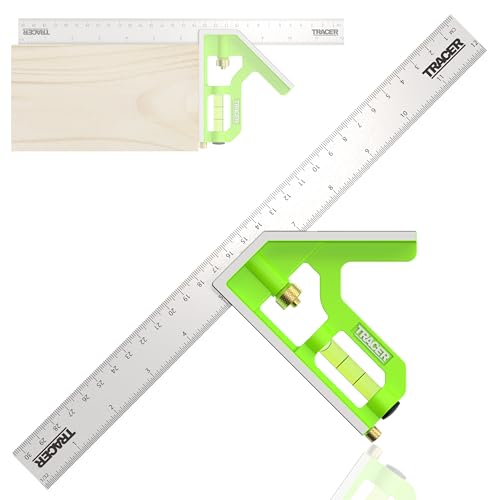
A bubble level is included or documented on many selected products, including PEC Tools, Johnson, WEN, Arrow, TRACER, GRENPRO, and Micymedo. It can provide a quick horizontal or vertical reference, but the supplied data does not establish a laboratory accuracy rating for any of these vials.
Scribes are similarly common. PEC Tools lists a scribe, TRACER has a built-in scribe tool, and Micymedo specifies a stored or removable metal scriber. Arrow’s two-piece set adds scribe notches spaced 1/4 inch apart. These features can reduce the number of separate tools needed, while a dedicated pencil or marking knife may still be preferred for particular materials or line thicknesses.
Match construction to the work
Stainless-steel blades appear throughout the selection and are described as rust-resistant or durable in several listings. Aluminum alloy bodies emphasize a lighter construction in the supplied descriptions, while zinc alloy and cast-iron heads represent other approaches. PEC Tools is the selected product that documents a cast-iron head and a tempered carbon-steel blade.
For a portable kit, an aluminum-bodied 12-inch square or a two-size set may be convenient. For detailed shop layout, PEC Tools or the compact Johnson 406EM offer more explicit precision-oriented specifications. For general construction, a 12-inch model with a level and a secure adjustment may be the more practical fit.
Final recommendation
PEC Tools 12-Inch 2-Piece Combination Square ranks first overall in this specification-based comparison under the published weighted criteria.
PEC Tools 12-Inch 2-Piece Combination Square is the first overall specification-based choice among these best combination carpentry squares. Its documented cast-iron head, tempered carbon-steel blade, micro-fine 4R graduations, level, scribe, and reversible locking bolt give it a detailed documented profile for shop layout.
The top combination carpentry squares are not interchangeable in every workshop. Choose Johnson 406EM when compact size matters, Johnson 415EM for a full-length general-purpose tool, or WEN for a dual-scale aluminum model. Arrow, GRENPRO, and Micymedo’s two-piece sets are relevant when rafter-square references are useful. TRACER and the 12-inch Micymedo model are suitable when an integrated scribe and level are priorities.
Frequently Asked Questions
What should I look for in the best combination carpentry squares?
Start with blade length, graduation detail, and the locking system. Then check whether you need a level, scribe, depth-gauge function, metric scale, or included rafter square. A 6-inch model suits compact work, while a 12-inch blade offers broader reach.
Are 12-inch combination squares better than 6-inch models?
Not universally. A 12-inch square spans larger workpieces and is represented by most products in this comparison. A 6-inch model is easier to handle on smaller parts and can fit better in a compact tool kit. The right size depends on the layout tasks and materials you normally handle.
Do combination squares replace a rafter square?
A combination square can mark and check common 45- and 90-degree angles, but it is not identical to a rafter square. Selected sets from Arrow, GRENPRO, and Micymedo include a separate 7-inch rafter or carpenter square with additional angle or roof-layout references.
Are built-in levels and scribes necessary?
They are convenience features rather than universal requirements. A level can provide a quick horizontal or vertical reference, and a scribe can mark without reaching for another tool. If you already carry dedicated marking and leveling tools, prioritize the blade markings and locking head instead.
Which selected square is aimed at detailed graduations?
PEC Tools documents 4R graduations through 64ths on a 12-inch tempered carbon-steel blade. Johnson 406EM also documents 1/8-, 1/16-, and 1/32-inch graduations plus millimeter markings. These specifications make both relevant for detailed layout, with PEC Tools offering the finer stated graduation range.