Buying Guide
The best engineer’s carpentry squares are not all built for the same job. Some are inspection tools intended to check a fixed 90-degree relationship, while others are layout rulers designed to mark boards, rafters, stair parts, or three-dimensional workpieces. The listings in this comparison show that the most useful distinction is not brand repetition or marketplace activity; it is the evidence supplied for accuracy, construction, scale design, and intended use.
Start with the type of square
A traditional engineer’s square has a blade and stock arranged at a right angle. It is useful for checking an edge, setting out a line, or inspecting a small assembly. The KINEX, Faithfull, Taytools, Suwimut, and Boomgood products fit this format. Their listings emphasize tool steel or stainless steel, ground surfaces, hardened blades, formal DIN classifications, or rigid blade-to-stock construction.
A framing L square is larger and more layout-oriented. The HARFINGTON 10-inch squares and the Auniwaig 300mm square are better aligned with long board edges, doors, windows, stairs, and general construction layouts. Their greater reach can be more useful than a small inspection square when the line must extend across a wider workpiece. They should not automatically be treated as laboratory-grade inspection instruments, because their supplied listings do not state the same formal accuracy classes as KINEX or Taytools.
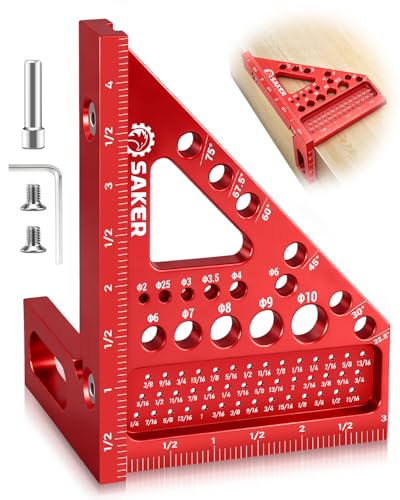
Multi-angle designs add functions beyond a fixed right angle. Saker documents preset angles, three-edge scales, marking, and drill-bit sizing. This can reduce the number of separate layout tools needed, but it also makes the design more specialized. A multipurpose square is appealing when angle marking is part of the workflow; a plain steel engineer’s square is easier to evaluate when the main requirement is checking 90 degrees.
Accuracy claims vary considerably in the supplied evidence. KINEX states DIN 875 Class 1 compliance and a 0.0007-inch right-angle specification across the longest edge. Taytools is listed as DIN 875/0 with a 0.0003-inch within-square tolerance. Boomgood identifies DIN 875/1 for both its four-piece set and its compact single square. These details make the products easier to compare for precision inspection.
Other listings use careful but less formal language, such as “true right angles,” “high precision,” or “accurate 90-degree” design. Those descriptions can support a useful comparison, but they do not establish the same numerical tolerance. Suwimut, HARFINGTON, Auniwaig, and TRUTOPWAY therefore suit buyers who need documented construction and practical layout features but do not require a published DIN class in the listing.
Match the material to the work
Steel provides the dominant construction choice among the precision-oriented products. Hardened, tempered, polished, or ground steel is documented for several selected squares. Stainless steel appears in Taytools, HARFINGTON, and Auniwaig, while KINEX and Faithfull use solid or high-quality tool steel. These materials are appropriate when a rigid reference edge is the central requirement.
Aluminum appears in Saker and TRUTOPWAY. The listings describe anodized aluminum as lightweight, corrosion-resistant, or wear-resistant. That can make these designs easier to carry and more versatile for layout, but the supplied evidence does not justify assuming that aluminum automatically provides the same inspection characteristics as a formally graded steel square. Choose based on the documented function rather than material preference alone.
Consider scale and visibility
Clear graduations matter when the square is used to mark rather than simply check an edge. HARFINGTON uses laser engraving, Auniwaig supports front-and-back reading, and TRUTOPWAY provides metric and imperial laser-etched scales. Saker uses scales on three edges for width, height, and depth. These details can help when the tool must be read from different angles or used on a three-dimensional workpiece.
The KINEX, Faithfull, Taytools, and Boomgood listings focus more on square construction and accuracy than on graduations. That does not make them unsuitable for layout, but the supplied evidence supports selecting them primarily as inspection references. Check the actual marking scheme before purchase if a particular imperial or metric graduation is essential.
Small squares are convenient for tight spaces and small components. The Boomgood single, TRUTOPWAY, and Saker designs emphasize compact handling, while the Suwimut and Boomgood sets provide multiple small sizes. A larger square is preferable when the reference edge must span a longer board. HARFINGTON and Auniwaig document longer formats for this purpose.
Storage also affects precision-tool ownership. Boomgood includes a plastic case, Suwimut lists individual storage cases, and Taytools lists a cardboard box. A case can help protect edges during transport, but the evidence does not establish how protective any package will be in every workshop. Keep reference edges away from impacts and avoid using a measuring square as a pry bar or hammer; the HARFINGTON listing expressly gives that caution.
Choose by primary task
For formal inspection, begin with KINEX or Taytools because their listings provide the clearest accuracy information. For a range of compact sizes, compare Faithfull, Boomgood’s four-piece set, and Suwimut. For a single compact reference, Boomgood’s DIN Grade 1 square is a focused option. For long carpentry layouts, HARFINGTON and Auniwaig offer the most relevant reach. For angle marking and multifunction layout, Saker is the most documented choice. For hands-free work on compatible metal surfaces, TRUTOPWAY is the distinctive option.
Final recommendation
Boomgood Machinist Square Set, 4 Pieces ranks first overall in this specification-based comparison under the published weighted criteria.
KINEX Engineers Square Set, 3 Pieces is the first overall specification-based choice among the best engineer’s carpentry squares because it combines a stated DIN 875 Class 1 standard, a numeric right-angle specification, solid tool-steel construction, and three practical sizes. The Taytools square is the better fit when one stainless-steel reference with a specific tolerance is preferred, while the Boomgood four-piece set and Suwimut set offer broader size coverage.
For carpentry rather than close inspection, HARFINGTON and Auniwaig provide longer formats suited to boards, framing, stairs, doors, and windows. Saker belongs on a different shortlist for its preset-angle and three-dimensional layout functions. Together, these are the top engineer’s carpentry squares for different documented requirements, not a claim that one shape is ideal for every workshop.
Frequently Asked Questions
What is the best engineer’s carpentry squares option for formal accuracy documentation?
KINEX has the clearest combination of stated DIN 875 Class 1 compliance and a numeric right-angle specification. Taytools also supplies a formal DIN 875/0 designation and a specific tolerance. These details make both easier to assess for precision inspection than products whose listings use general accuracy wording without a published class or tolerance.
Should I choose a set or a single square?
Choose a set when workpieces vary in size or when both small and medium reference edges are useful. Faithfull, KINEX, Boomgood’s four-piece set, and Suwimut provide multiple sizes. A single square may be more appropriate when one consistent reference is needed; Taytools and the Boomgood 4-by-2.5-inch model fit that approach.
Are framing L squares suitable for engineering checks?
They can check and mark right-angle relationships, but their longer layout format is oriented toward carpentry and construction. HARFINGTON and Auniwaig document long scales and framing applications, while KINEX, Taytools, Faithfull, and Boomgood provide stronger formal accuracy evidence for precision inspection. Review the published tolerance or grade before using a framing square where a controlled specification is required.
What does a magnetic machinist square add?
TRUTOPWAY’s dual rare-earth magnets are intended to attach the square to compatible metal surfaces for hands-free alignment. Its metric and imperial scales, seat, and notch add practical layout functions. The magnetic feature does not apply to nonmagnetic workpieces, so it should be treated as a specialized handling advantage rather than a replacement for every conventional square.
Is a multi-angle square a replacement for a traditional engineer’s square?
Saker documents preset angles, three-edge scales, 0-to-90-degree layouts, and drill-bit sizing, so it can consolidate several layout tasks. A traditional steel square remains the more direct choice when the priority is a fixed right-angle reference with formal accuracy documentation. Select the design according to whether inspection or multifunction marking is the primary job.