Buying Guide
The best carpenter’s tool belts should be selected by the tools you carry, how much support you need, and how precisely the belt fits. Listing data can identify useful design differences, but it cannot replace checking measurements or confirming how a loaded rig feels.
Start with the storage pattern
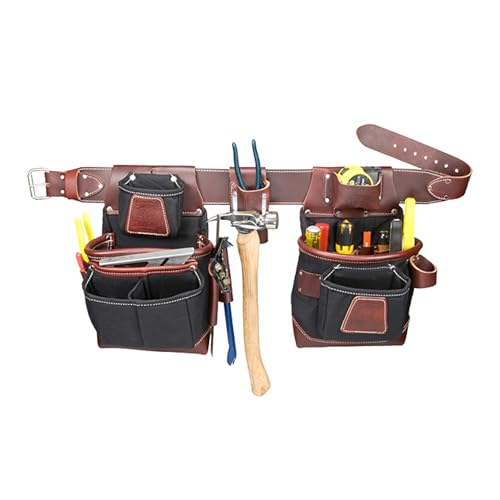
Pocket count is only one part of organization. A large number can help when you carry fasteners, hand tools, a drill, a tape measure, and layout tools, but a smaller arrangement may be easier to manage for repair work. The Occidental Leather Badger Carpenter Set lists 27 pockets and tool holders, while the Aupofit system lists 32 pockets and loops across three pouches. Klein’s 23-pocket rig adds named holders for a phone, tape, and headlamp.
Look for the specific holders that match your routine. DEWALT’s DWST540601 lists two hammer loops and a tape-measure holster. Dead On identifies a drill holder, steel-loop hammer holder, and tape-measure holder. The Marscamd rig lists slots for hammers, pliers, screwdrivers, drill bits, nails, and other essentials, plus a magnetic panel for compatible small metal parts.
Choose between a single belt and suspenders
A single belt is generally the simpler format in this selection. The DEWALT DWST550112 and Carhartt belt focus on waist-mounted storage, while most of the larger systems add suspenders. Suspenders can be useful when a rig carries many tools because the documented designs distribute support between the waist and shoulders. Klein lists padded belt and shoulder supports; Dead On lists gel-padded suspenders; Marscamd specifies adjustable suspenders with a wide padded waist belt.
A suspender rig also adds bulk and more adjustment points. If your daily kit is limited to a hammer, tape, pencils, and a few hand tools, a compact leather or single-belt design may be more practical. If you carry a drill, fasteners, and multiple layout tools, the added structure of a full rig may better match the documented capacity.
Compare materials and reinforcement
Material descriptions help distinguish intended construction. Several fabric rigs use 1680D material, including Klein, DEWALT, Aupofit, Marscamd, and MELOTOUGH. Reinforced stitching and rivets appear repeatedly in the listings and are relevant at stress points. OX specifies 2.0 mm leather with industrial rivets and double stitching, while DEWALT’s leather model uses nubuck top-grain leather, double stitching, and reinforced rivets.
Leather can offer a different structure and break-in profile than fabric, but the supplied listings do not establish long-term comparative durability. Occidental Leather documents heavyweight 1000D nylon with a water-repellent coating, closed-cell foam, and abrasion-resistant webbing. Carhartt lists 1200 denier polyester, Rain Defender treatment, and a Duravax abrasion-resistant base. Treat these as construction indicators, not proof of service life.
Check fit before choosing capacity
Fit information varies considerably. Klein lists a 30- to 52-inch waist range, Dead On lists 29 to 46 inches, and Aupofit lists 36 to 49 inches. Marscamd states 35 to 48 inches, while Carhartt says its contoured waist belt fits up to 52 inches. These figures should be compared with your actual waist measurement and the clothing you expect to wear underneath.
A one-size label is not a substitute for a measured range. The DEWALT DWST540601 and DWST550112 listings use one-size descriptions without providing the same numeric detail as some competing products. The OX Construction listing also contains conflicting size wording, so verify the seller’s current fit information before buying.
Consider modularity and transport
Modular pouches can make a belt more adaptable. MELOTOUGH specifically says its organizers and suspenders can be removed or added. Marscamd includes detachable pouches, and Aupofit lists three pouches with carry handles. Those features may help when moving between a light task and a full construction setup.
Carry handles matter when the rig is off your body. Klein, DEWALT, Aupofit, and the Occidental Leather set document transport or detachable components in different ways. They do not indicate how comfortable a loaded system will be, so use the feature list to narrow the options rather than treating it as a hands-on result.
Match the belt to the workday
For a broad tool load, prioritize storage, support, and reinforced materials. For lighter work, prioritize a manageable pocket layout and straightforward fit. The best carpenter’s tool belts are not identical: the Klein and Occidental Leather systems emphasize complete organization, while the DEWALT leather and Carhartt options are more focused. Confirm the pocket arrangement, waist range, and included components before ordering.
Final Recommendation
Klein Tools 55896 Tool Rig ranks first overall in this specification-based comparison under the published weighted criteria.
Klein Tools 55896 Tool Rig is the highest-scoring returned product and the first overall specification-based choice. Its 23 pockets, padded belt and shoulder supports, 30- to 52-inch adjustment, and 1680D construction give it the most balanced documented profile for a demanding carpenter setup.
The Occidental Leather Badger Carpenter Set is the most specification-aligned alternative for buyers who want 27 pockets and a more premium specified material package. OX Construction is a logical leather-based choice, while DEWALT DWST540601 offers broad fabric storage. For modularity, consider Marscamd, MELOTOUGH, or Aupofit. The top carpenter’s tool belts in this comparison cover both full suspender rigs and simpler belts, so the right choice depends on load and fit rather than pocket count alone.
The best carpenter’s tool belts should also be judged against the tools you actually carry. Carhartt and DEWALT DWST550112 suit more compact setups, while Dead On offers a lighter listed suspender rig with clearly identified holders.
Frequently Asked Questions
Start with a usable pocket layout, an accurate waist range, and enough support for your normal load. Materials, rivets, stitching, padding, suspenders, hammer holders, and tape-measure clips are useful specification details. A high pocket count is helpful only when the pockets fit your tools and do not add unnecessary bulk.
Not always. Suspenders are documented on the Klein, Occidental Leather, OX, Dead On, Marscamd, MELOTOUGH, and Aupofit systems, and they can distribute support across the waist and shoulders. A single belt such as the DEWALT DWST550112 or Carhartt model may be a better match for a smaller tool load. The choice depends on capacity, personal fit, and how much equipment you carry.
Which selected belts have leather construction?
The OX Construction Tool Belt, DEWALT DWST550112, and Occidental Leather Badger Carpenter Set document leather or leather-related construction. OX specifies high-quality oil-tanned leather, DEWALT specifies nubuck top-grain leather, and Occidental Leather specifies heavyweight nylon for the belt components in its set. Compare the complete material descriptions rather than assuming every pouch uses the same material.
How should I verify fit before buying?
Measure your waist where the belt will sit, including typical work clothing, then compare that measurement with the listing’s stated range. Examples include Klein at 30 to 52 inches, Dead On at 29 to 46 inches, and Aupofit at 36 to 49 inches. Pay particular attention when a listing says one size or contains inconsistent size information.