Buying Guide
Universal AC adapters convert household AC input into selectable DC output for compatible electronics. The products in this comparison are not interchangeable with every device: the device label still determines the required voltage, current, connector, and polarity. Use the specifications below to narrow the best universal ac adapters for your particular equipment rather than relying on the word “universal” alone.
Confirm the device requirements first
Read the original adapter label or the device’s power specification. Match the DC voltage exactly. An adapter that can produce a higher voltage is not automatically suitable; the selector must be set to the device’s stated requirement before connection. Also check current demand. A device drawing less current than the adapter’s maximum is generally within the stated output range, but the supplied listings repeatedly warn against exceeding the adapter’s limits.
Connector size matters just as much. A tip can look similar while having a different inner or outer measurement. Compare the plug dimensions supplied with the adapter against the device socket. Some selected models include Micro-USB, USB-C, terminal connectors, alligator-clip leads, or multiple barrel sizes. Those accessories expand documented compatibility, but they do not remove the need to verify fit.
Choose the right voltage range
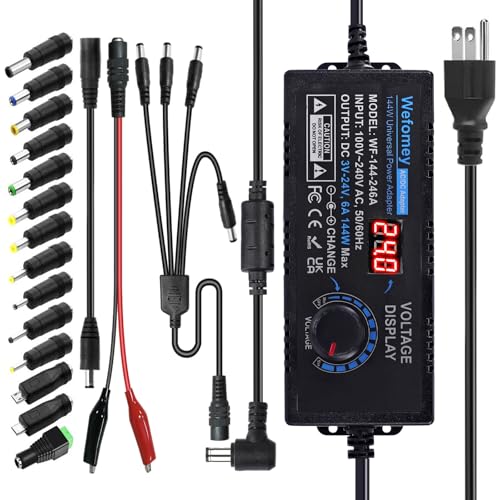
The broadest selected designs cover 3V or 4V through 24V. Wefomey WF-144-246A, AOYADAISU AD-004, Meiyue US-Adjustable, SHNITPWR SNT-0324-72, and minidodoca are listed with 3V-to-24V adjustment. SHNITPWR SNT-0324-144 and Aclorol start at 4V and reach 24V. These models suit a wider range of low-voltage electronics than adapters capped at 12V.
A 3V-to-12V model can be more appropriate when the device belongs to that narrower range. Meiyue AM-005 reaches 12V but offers a stated 144W and 12A maximum. ALITOVE LP-1000 reaches 12V and lists a 30W maximum. The important point is not to select the widest range by default; select a range that includes the device’s exact voltage and supports its current requirement.
Compare capacity carefully
Maximum wattage and current are separate limits. The 144W models provide the highest listed capacity, while AOYADAISU, Aclorol, and Meiyue US-Adjustable list 120W. SHNITPWR SNT-0324-72 and minidodoca list 72W. Basicvolt lists 48W, and ALITOVE lists 30W.
For a device with a known wattage, compare that figure with the adapter’s stated maximum. For a device labeled in amps, verify the output-current limit at the required voltage. Some listings recommend operating below the full rated load, so treating the maximum as a target operating point would not follow the supplied guidance. Battery-powered products should also be checked carefully: SHNITPWR SNT-0324-144 and AOYADAISU explicitly identify their products as AC-to-DC adapters rather than chargers.
Evaluate connector and polarity options
Connector selection is one of the main differences between these models. The Wefomey WF-144-246A, Meiyue AM-005, SHNITPWR SNT-0324-144, AOYADAISU AD-004, Aclorol, and Meiyue US-Adjustable listings specify 14 tips. Minidodoca specifies 16, while ALITOVE LP-1000 also specifies 14 and adds a 5V USB port. Basicvolt includes 10. More tips may improve the chance of finding a physical match, but the device socket must still be measured or identified correctly.
Polarity is equally important. Several products state center-positive output. Wefomey WF-144-246A, AOYADAISU AD-004, Aclorol, Meiyue AM-005, Meiyue US-Adjustable, and ALITOVE LP-1000 include a polarity converter or reversed-polarity cable. Basicvolt lists center-positive polarity without the same built-in flexibility. Connect only when the adapter’s polarity matches the device, unless the supplied converter is specifically appropriate.
Look for monitoring and protection features
An LCD or LED display can show the selected or current output voltage before use. Wefomey WF-144-246A, SHNITPWR SNT-0324-144, AOYADAISU AD-004, Aclorol, Meiyue US-Adjustable, SHNITPWR SNT-0324-72, and minidodoca document voltage displays. This feature helps with setup, but it does not replace checking the device label.
Protection descriptions vary. Wefomey WF-144-246A, SHNITPWR SNT-0324-144, SHNITPWR SNT-0324-72, AOYADAISU, and ALITOVE list combinations of over-voltage, over-current, over-temperature, overload, and short-circuit protection. Basicvolt specifically lists over-voltage and short-circuit protection. Protection circuitry is a useful specification, but it cannot correct an incorrectly selected voltage, connector, or polarity.
Match the design to the use
For a mixed collection of 3V-to-24V electronics, the 120W and 144W adjustable models offer the broadest documented operating envelope. For smaller devices, the 72W models provide similar voltage coverage with lower stated capacity. For common 3V-to-12V equipment, ALITOVE LP-1000 adds a USB port and a broad tip package. Basicvolt covers several stepped settings through 24V, but its listing does not document a polarity-reversal cable. Consider the device list, required voltage, maximum current, connector, polarity, and display preference together.
Final Recommendation
Wefomey WF-144-246A 3V-24V 144W Adapter ranks first overall in this specification-based comparison under the published weighted criteria.
The final choice among the best universal ac adapters depends on the documented features that match your intended use.
Wefomey WF-144-246A is the highest-scoring returned product and the first overall specification-based choice. Its 3V-to-24V range, 144W capacity, 14 tips, polarity converter, LCD, and multiple protection cutoffs give it the most complete documented feature set in this comparison.
The top universal ac adapters for demanding 12V applications include Meiyue AM-005 because its listing states a 12A and 144W maximum. SHNITPWR SNT-0324-144 is another strong fit for 4V-to-24V equipment, while AOYADAISU AD-004 and Meiyue US-Adjustable cover the full 3V-to-24V span at 120W. For lower-capacity equipment, SHNITPWR SNT-0324-72 and minidodoca retain broad voltage coverage. Basicvolt and ALITOVE LP-1000 are better aligned with narrower voltage requirements.
Before use, verify four items: exact voltage, current capacity, connector dimensions, and polarity. Do not connect a battery-powered device unless the product documentation specifically supports that use; selected listings identify these products as power adapters rather than battery chargers.
Frequently Asked Questions
What should I check before using the best universal ac adapters?
Check the device’s required DC voltage, current, connector size, and polarity. Set an adjustable adapter to the exact voltage before plugging it into the device. Confirm that the device’s current demand does not exceed the adapter’s stated limit.
Do all universal AC adapters reach 24V?
No. Wefomey WF-144-246A, AOYADAISU AD-004, Meiyue US-Adjustable, SHNITPWR SNT-0324-72, and minidodoca are listed with 3V-to-24V adjustment. SHNITPWR SNT-0324-144 and Aclorol reach 24V but start at 4V. Meiyue AM-005 and ALITOVE LP-1000 stop at 12V.
Are more connector tips always better?
Not necessarily. More tips increase the number of listed connector options, but the selected tip must match the device socket exactly. Minidodoca lists 16 tips, while several selected models list 14. Always compare the tip dimensions and polarity with the device requirements.
Can these adapters charge batteries?
The supplied evidence does not support using the selected adjustable adapters as battery chargers. SHNITPWR SNT-0324-144 and AOYADAISU explicitly state that they are AC-to-DC adapters and not chargers. Use a charger designed for the specific battery system instead.
What does a polarity converter do?
A polarity converter changes the relationship between the connector’s center and outer contacts when the included design supports it. Wefomey WF-144-246A, AOYADAISU AD-004, Aclorol, ALITOVE LP-1000, and several other selected models list polarity-conversion accessories. The device’s required polarity must still be confirmed before connection.