Buying Guide
This guide compares the best ac adapters using documented voltage flexibility, connector versatility, power capacity, input compatibility, and safety and documentation.
Before comparing models, read the device label or original adapter and record its required DC voltage, maximum current, polarity, and barrel-plug dimensions. The replacement should provide the same voltage, the same polarity, and at least the current the device requires. A higher available current rating is generally different from forcing extra current into a device, but the supplied specifications should still be followed carefully.
Start with voltage
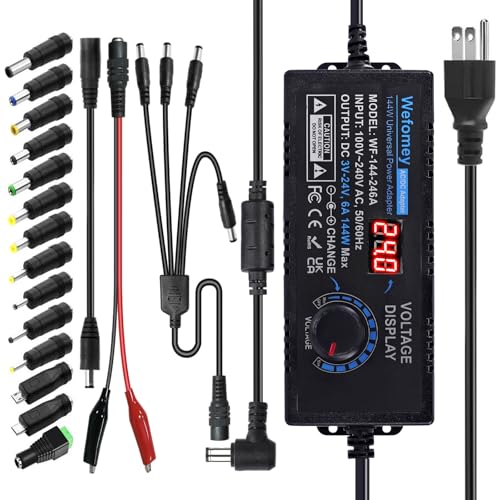
Voltage is the first filter. Adjustable models such as the Wefomey 72W Adjustable Universal Adapter, SHNITPWR SNT-0324-72 72W Adapter, and Minidodoca 72W Adjustable Adapter cover several settings from 3V through 24V. That range can be useful when one household or workshop contains electronics with different power requirements. It also creates a setup responsibility: the selector or knob must be set to the device’s required voltage before connection.
Fixed-output units are simpler when the voltage is known. The ALITOVE 12V 2.5A Adapter, Gilivier 12V 5A 60W Adapter, Facmogu AL-1230 12V 3A Adapter, and LitStar AZ1202018 12V 2A Adapter are all designed around 12V equipment. The ALITOVE ALT-2403 24V 3A Adapter is intended for 24V applications, while the Arkare 5V 2A 10W Adapter is aimed at compatible 5V electronics. A fixed adapter avoids accidental selector changes, but it cannot serve devices that require another voltage.
Match current and wattage
Current and wattage determine whether an adapter has enough capacity. For example, a 12V device drawing 2A needs a supply capable of at least 2A, equivalent to 24W. The LitStar model documents 12V and 2A, while the Facmogu model reaches 3A or 36W. The Gilivier model reaches 5A or 60W, giving it more headroom for compatible 12V equipment. The 24V ALITOVE model reaches 3A or 72W, but that capacity applies only to devices designed for 24V.
The adjustable 72W models provide up to 3A across their documented voltage range. Their listings also advise not running continuously at full load.
Check the connector carefully
Measure the device socket or compare it with the original connector. The Wefomey, SHNITPWR, and Minidodoca models list numerous barrel sizes and additional USB or terminal connectors.
Some fixed-output products document compatibility between closely related barrel sizes. Facmogu lists a 5.5x2.5mm plug as compatible with a 5.5x2.1mm socket, and several 12V listings describe similar compatibility. Even so, connector fit should be confirmed before powering equipment.
Verify polarity
The Wefomey and SHNITPWR adjustable models list polarity-conversion support, which can help with devices requiring a different arrangement. The Belker models identify center-positive output and note that a separate polarity-reversal cable may be needed for center-negative equipment.
Never assume that a universal label means every device is compatible. Compare the polarity symbol on the equipment with the adapter documentation.
Consider reach and placement
Cable length can matter as much as electrical specifications. The ALITOVE 12V 2.5A Adapter lists a 6.2-foot power cord, the Facmogu model lists 6.7 feet of total cable, and the LitStar model lists six feet. These can be useful where the outlet is not immediately beside a router, camera, speaker, or light. The Gilivier listing specifies a shorter 3.28-foot power cord, so placement should be checked before ordering.
Several products are described for indoor use. That matters for LED installations, cameras, and workshop projects: the adapter should be kept in the environment described by its listing rather than treated as weatherproof equipment.
Use documented protections as a comparison point
The listings commonly document overvoltage, overcurrent, overload, short-circuit, or over-temperature protection. The Arkare and LitStar listings also describe built-in protection features.
Final recommendation
Minidodoca 72W Adjustable Adapter ranks first overall in this specification-based comparison under the published weighted criteria.
The final choice among the best ac adapters depends on the documented features that match your intended use.
Wefomey 72W Adjustable Universal Adapter is the highest-scoring returned product and the first overall specification-based choice. Its 3V-to-24V adjustment, LCD readout, broad tip selection, polarity-reversal support, 72W capacity, and universal AC input give it the widest documented utility in this comparison.
For a known 12V requirement, choose among the ALITOVE 12V 2.5A Adapter, Gilivier 12V 5A 60W Adapter, Facmogu AL-1230 12V 3A Adapter, and LitStar AZ1202018 12V 2A Adapter according to current, cable length, and tip needs. The ALITOVE ALT-2403 24V 3A Adapter is the focused 24V choice, while the Arkare 5V 2A 10W Adapter is the focused 5V replacement. These top ac adapters are not interchangeable solely because they share a wall-plug format; the device’s electrical requirements should decide.
Frequently Asked Questions
How do I choose the best ac adapters for a replacement device?
Record the device’s DC voltage, required current, polarity, and connector size. Select an adapter with the same voltage and polarity, enough current capacity, and a plug that fits correctly. Adjustable models add flexibility, while fixed-output models can be simpler for a known requirement.
Are adjustable AC adapters safer than fixed-output models?
Neither design is automatically safer from the supplied specifications alone. Adjustable models such as Wefomey 72W Adjustable Universal Adapter document a broad range and a display, but the setting must be checked before connection. Fixed models reduce that adjustment step but still require exact voltage, polarity, current, and plug matching.
Can a 12V adapter power any 12V device?
No. The device must also match the adapter’s current capacity, polarity, connector, and intended use. Check every parameter rather than relying on voltage alone.
When is a 24V adapter the right choice?
Use a 24V model only when the equipment specifically requires 24V DC. It should not be used for a 12V or 5V device.
Do more connector tips guarantee compatibility?
No.