Buying Guide
Choosing among the best kitchen countertop waste bins starts with identifying what you are collecting, where the container will sit, and how often you want to empty it. The products in this comparison are primarily indoor food-scrap or compost caddies. They are not hands-on tested here; the recommendations use supplied listing descriptions and specifications.
Choose the capacity for your routine
Capacity affects both convenience and countertop size. The BLUE GINKGO is the smallest selected option at 2.6 liters, making it a practical fit for a very small kitchen or a household that empties food scraps frequently. The simplehuman holds 4 liters, while KAZAI documents a 4.5-liter capacity. These middle sizes can balance a modest footprint with enough room for routine preparation scraps.
Larger bins can reduce trips to an outdoor compost area or main waste container. EKO lists a 7-liter capacity, the largest in this selection. Leafory lists 2.1 gallons, while LINSSEN lists 1 gallon and Epica, RED FACTOR, and KIBAGA list approximately 1.1 to 1.3 gallons. A larger bin is not automatically better: it may take more counter space and may be less convenient if you prefer to empty scraps daily.
Compare odor-control approaches
Odor control is documented in several different ways. Models such as RED FACTOR use dual-filter technology, while AIRNEX, Epica, KIBAGA, Leafory, LINSSEN, and KAZAI specify carbon or activated-charcoal filters. These filters are replaceable or supplied as part of the product on some listings, so check the maintenance requirements before buying.
Other designs emphasize a tight or airtight lid. Because the final comparison includes only selected products, the relevant filter-free design represented here is BLUE GINKGO’s lid-based odor containment without costly charcoal filters. In practical terms, a lid can help contain smells, but the evidence does not establish identical performance across models.
Look for a removable liner or bucket
A removable inner bucket separates food scraps from the outer body and can make emptying and rinsing more manageable. simplehuman, KAZAI, LINSSEN, Leafory, and BLUE GINKGO explicitly document removable buckets, baskets, or liners. The EKO also specifies a removable inner liner. These designs are useful when you want to carry the inner container to a larger compost bin rather than lift the entire outer housing.
Not every model lists this feature. RED FACTOR, AIRNEX, KIBAGA, and Epica emphasize their outer construction and lid or filter systems, but the supplied evidence does not document a removable inner bucket for those models. That does not prove cleaning is difficult; it simply means the comparison should not award them the same liner-related advantages without supporting information.
Consider dishwasher-safe parts
Dishwasher-safe components can reduce hand-washing, but the evidence varies. KAZAI states that both the body and inner bucket are dishwasher-safe. BLUE GINKGO describes its plastic bin and removable inner basket as dishwasher-safe.
For products without a dishwasher-safe claim, follow the supplied care directions rather than assuming compatibility. In this top 10, the absence of a dishwasher statement is treated as unknown—not as evidence that a product cannot be washed.
Match the placement style to your kitchen
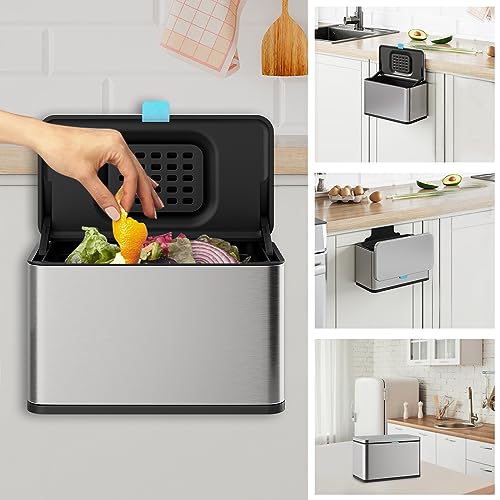
Standard countertop bins are simplest when you have a convenient open corner. EKO, Leafory, KIBAGA, Epica, RED FACTOR, AIRNEX, KAZAI, simplehuman, and BLUE GINKGO all document countertop use. Measure the available width and height, especially for taller designs such as Epica, which lists an 11-inch height.
Mountable designs can preserve counter space. LINSSEN documents standing, hanging, and wall-mounted use. Leafory offers countertop, wall, and cabinet-door placement, while EKO lists countertop, wall-mounted, and over-cabinet-door options. Check the limitations: Leafory specifies cabinet doors up to 0.95 inches, and cabinet or wall mounting also requires an appropriate surface and installation method.
Evaluate material and handling details
Stainless steel is prominent in this category. EKO, RED FACTOR, LINSSEN, Leafory, and Epica specify stainless-steel construction or exteriors. Their listings mention features such as fingerprint resistance, rust resistance, or leak resistance, but these are product claims rather than independent test results. AIRNEX uses wheat straw, KAZAI uses a compact bin with anti-slip pads, KIBAGA specifies powder-coated carbon steel, and BLUE GINKGO uses dishwasher-safe plastic.
Handles matter when the bin must travel to an outdoor compost area or larger container. simplehuman, KAZAI, RED FACTOR, LINSSEN, KIBAGA, and BLUE GINKGO document a handle or carrying feature. A handle does not replace a removable bucket, but it can make a full caddy easier to move. Also consider lid access: Leafory and LINSSEN document flip or slide opening modes, while EKO uses a swing lid.
Final recommendation
EKO Kitchen Compost Bin 7L ranks first overall in this specification-based comparison under the published weighted criteria.
The final choice among the best kitchen countertop waste bins depends on the documented features that match your intended use.
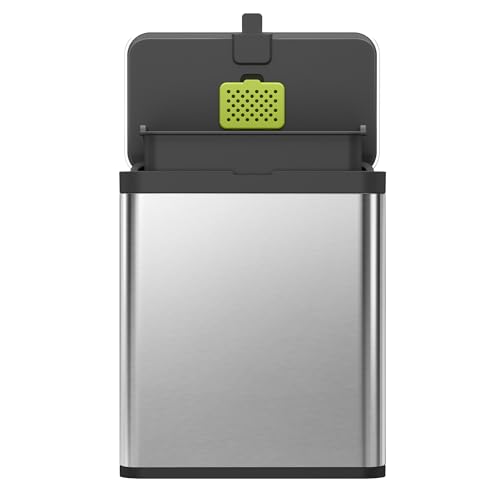
simplehuman Compost Caddy 4L is the highest-scoring first overall specification-based choice because it combines a detachable prep-side format, soft-seal lid, removable bucket, and included compostable liners. It is especially compelling for users already using a compatible simplehuman can. For larger capacity and flexible placement, EKO Kitchen Compost Bin 7L and Leafory Kitchen Compost Bin 2.1 Gallon are stronger fits. KAZAI Elin is the cleaning-focused pick, while LINSSEN is the most adaptable for cabinet or wall placement. Among the top kitchen countertop waste bins, BLUE GINKGO stands out for very small counters and dishwasher-safe parts. Choose by capacity, available mounting surface, filter needs, and cleaning routine rather than by appearance alone.
Frequently Asked Questions
What should I look for in the best kitchen countertop waste bins?
Start with capacity, lid design, cleaning access, and placement. A removable inner bucket or basket can simplify emptying, while a carbon filter or tight-sealing lid may help contain food-scrap odors. Also check the listed dimensions against your counter and confirm whether the bin can hang or mount if you need to save workspace.
Are countertop compost bins better with carbon filters?
A carbon filter is one documented odor-management approach, but it adds a component that may need replacement. The selected models from AIRNEX, Epica, KIBAGA, KAZAI, Leafory, LINSSEN, and RED FACTOR list carbon or activated-charcoal filtration. BLUE GINKGO instead documents a tight-sealing lid and odor containment without costly charcoal filters. The supplied evidence does not establish that one approach performs better in every kitchen.
Which selected bin is easiest to clean?
KAZAI and BLUE GINKGO have the clearest dishwasher-related specifications. KAZAI says its body and inner bucket are dishwasher-safe, while BLUE GINKGO describes its plastic construction and inner basket as dishwasher-safe. simplehuman, EKO, LINSSEN, and Leafory also document removable buckets or liners, which can support rinsing and emptying even when dishwasher compatibility is not stated.
Can these bins be mounted instead of placed on the counter?
Yes, but only some selected products document that feature. LINSSEN lists standing, hanging, and wall-mounted use. Leafory lists countertop, wall, and cabinet-door placement, and EKO lists countertop, wall-mounted, and over-cabinet-door options. Check the specific mounting instructions and cabinet-door limits before installation; a bin should not be assumed to fit every cabinet or wall.
How large should a kitchen food-waste bin be?
Choose a smaller 2.6-liter or 1-gallon model if counter space is limited or you empty scraps often. A 4- to 4.5-liter caddy is a middle-ground option. EKO’s documented 7-liter capacity and Leafory’s 2.1-gallon capacity suit users who want fewer emptying trips, but larger bins need more room and may become heavier when full.